
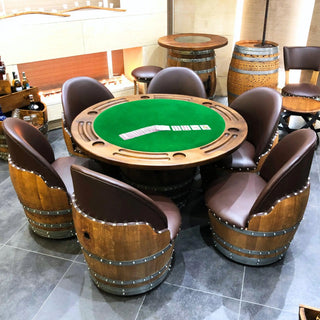
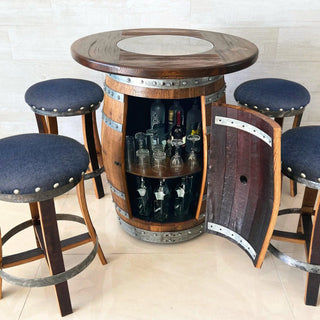
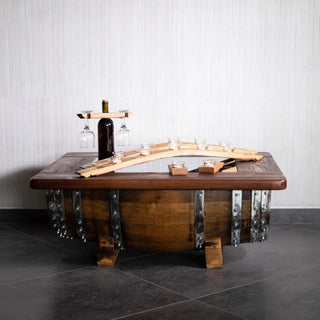
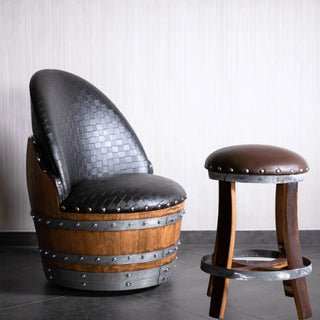
Wine barrel furniture care, done well, keeps a handcrafted reclaimed oak piece looking like the day it arrived for decades. Done poorly, it accelerates the few problems oak furniture is actually susceptible to — humidity-related movement, hoop loosening, finish dulling, and visible dust accumulation in the wire-brushed grain. Most owners are somewhere in the middle: they handle obvious cleaning but skip the smaller seasonal checks that prevent small issues from becoming larger ones.
This is the pillar hub for our care content. It lays out a complete month-by-month care calendar for indoor wine, whiskey, and bourbon barrel furniture — what to do each month, why, and how long each task actually takes. The full calendar takes roughly 4 to 6 hours of total attention per piece per year, spread across twelve months. Most months require only 10 to 20 minutes. Four sister posts in this pillar go deeper on specific topics: spar varnish vs tung oil vs wax for indoor barrel pieces, why wire-brushed staves look this way, how to fix a loose hoop, squeaky stave, or scratched top, and will wine barrel furniture outlast me.
If you only have time for three tasks per year, skip to the "If you only do 3 things per year" sidebar at the end. That covers the irreducible minimum.
According to the USDA Forest Products Laboratory and ongoing research from the Wood Database, white oak in stable indoor conditions (40 to 60 percent relative humidity, 60 to 75 degrees F) can remain structurally sound for 75 to 100 years. Spar varnish properly maintained extends that durability further. The 12-month calendar below is built around keeping conditions inside that ideal range.
January — Post-holiday humidity check
January is the month indoor humidity drops to its lowest point in most U.S. climates, thanks to heating systems running continuously. The capsule: check the relative humidity in the room with a $15 hygrometer, and if it reads below 35 percent, place a small humidifier in the room to bring it into the 40 to 50 percent range.
Oak furniture in sub-35 percent humidity for extended periods can show minor stave separation and hoop slight loosening. Catching this in January prevents it from becoming visible by February.
Time required: 5 minutes for the check, plus ongoing humidifier maintenance if needed.
February — Light dust and finish inspection
February is a slower household month for most owners and a good time for an unhurried visual inspection. The capsule: wipe down the piece with a slightly damp microfiber cloth, then walk around it and look for any dull spots in the spar varnish finish, any new scratches, or any darkened areas that might indicate moisture contact.
Spar varnish typically holds its satin sheen evenly. A noticeably duller patch usually indicates either a spill that was wiped without proper cleanup or a contact mark from another piece of furniture rubbing the surface. Both are addressable.
Time required: 15 minutes.
March — Spring conditioning pass
March is the month to apply a fresh conditioning pass to the finished surfaces. The capsule: use a small amount of furniture wax or a manufacturer-recommended wood conditioner (we recommend a clear paste wax compatible with spar varnish), apply with a soft cloth in small circular motions across all visible exterior surfaces, and buff to a soft sheen 15 minutes after application.
This is not a refinishing — it is a thin protective layer applied over the existing spar varnish. It refreshes the surface luster, fills micro-scratches accumulated over the past several months, and provides a small additional moisture barrier going into spring's humidity rise. For owners weighing whether spar varnish, tung oil, or wax is the right finish system for their piece long-term, our spar varnish vs tung oil vs wax comparison walks through each.
Time required: 30 to 45 minutes per piece.
April — Hoop inspection
April is a good month for the annual hoop check, after the seasonal humidity has shifted and before the summer heat sets in. The capsule: visually inspect each steel hoop on the piece, checking for any visible looseness, gaps between hoop and stave, or any darkened areas where the steel might be transferring rust onto the wood. Tap each hoop gently with a finger — a tight hoop produces a clean ring; a loose hoop produces a dull thud.
If a hoop is loose, do not attempt to retighten it without proper tools. Our companion guide on fixing a loose hoop, squeaky stave, or scratched top walks through what is and is not a safe field repair, or reach out to our contact page at obarrel.com for guidance. Most cases are minor and can be addressed with a single rubber-mallet adjustment that takes a few minutes.
Time required: 10 minutes.
May — Deep dust extraction
May is the month for the deep dust pass, especially for wire-brushed pieces where dust accumulates in the raised grain. The capsule: use a soft natural-bristle brush (a clean paintbrush works well) to brush dust out of the wire-brushed stave surfaces, then follow with a damp microfiber cloth wipe to lift any remaining fine particles. Pay attention to engraved areas, where dust collects in the cut lines.
Skipping this for multiple years allows dust to build up in the grain to the point where it darkens the wood's appearance permanently. An annual deep dust prevents that.
Time required: 30 minutes per piece.
June — Humidity recheck
June is the second humidity check of the year, this time on the high side. The capsule: check the room's relative humidity again. If it reads above 65 percent, run a dehumidifier or ensure adequate room ventilation to bring it back into the 40 to 60 percent ideal range.
High-humidity environments above 65 percent can cause minor stave swelling and finish softening. In severe cases (above 70 percent for extended periods), spar varnish can develop a slight tacky surface. Catching this in June prevents it.
Time required: 5 minutes for the check.
July — Hardware check
July is hardware-attention month. The capsule: open every door, drawer, and hinged compartment on the piece. Operate each mechanism several times, looking and listening for any sticking, squeaking, or rough motion. Tighten any hardware that has loosened with use (typically requires a small Phillips or flathead screwdriver). Apply a single drop of clear furniture-grade lubricant to any hinge or slide showing friction.
Hardware on barrel furniture is more substantial than on factory case goods, but it still benefits from a once-yearly check. A hinge that has loosened slightly in normal use can be retightened in seconds before it becomes a structural issue.
Time required: 15 minutes.
August — Light surface clean
August is a light maintenance month — just a damp wipe-down to keep summer dust and ambient grime from settling into the wood grain. The capsule: damp microfiber wipe across all exterior surfaces, with extra attention to horizontal surfaces (the top of a cabinet, the surface of a barrel-head table) where dust accumulates fastest.
Time required: 10 minutes.
September — Fall conditioning pass
September mirrors the March conditioning pass — a fresh paste wax application going into fall and winter. The capsule: same procedure as March, with attention to any areas that have shown wear since the last conditioning. Apply slightly more product to high-touch areas (handles, drawer fronts, chair arms) and less to low-touch decorative surfaces.
The twice-yearly conditioning is the single most impactful maintenance habit for keeping the piece looking new across decades. Once a year is acceptable; twice a year is meaningfully better.
Time required: 30 to 45 minutes per piece.
October — Visual inspection and photo record
October is a good month for a careful visual inspection paired with a quick photo record of the piece. The capsule: walk around the piece in good daylight, looking carefully at staves, hoops, finish, hardware, and engraving. Take three to five photos from consistent angles (same angles each year) so year-over-year comparison is possible.
This photo record is useful for two reasons. First, it makes year-over-year change visible — what looks normal in real time often shows up as obvious shift in side-by-side photos. Second, in the unlikely event of damage or insurance claim, the photo record establishes the piece's condition.
Time required: 15 minutes.
November — Pre-holiday prep
November is the month to prepare the piece for heavier-use holiday months. The capsule: clean thoroughly with damp microfiber, apply a fresh thin coat of wax if it has been more than six weeks since the last conditioning, and confirm the room's humidity and temperature are in the ideal range before heating systems start running continuously.
For pieces in entertaining-focused rooms (bar cabinets, bistro sets, lounge chairs), this is also the month to add felt pads or small cork coasters anywhere glassware will contact the wood. Wine and spirit rings can mark even sealed surfaces if left for hours.
Time required: 30 minutes.
December — Quick check between gatherings
December is the lightest maintenance month, with one quick check between holiday gatherings. The capsule: wipe down the piece with damp microfiber after any large gathering, address any spills immediately rather than letting them sit, and note any new marks or scratches in the photo record for spring attention.
Time required: 10 minutes after each major gathering.
Summary table: 12-month care at a glance
| Month | Task | Time |
|---|---|---|
| January | Post-holiday humidity check | 5 min |
| February | Light dust, finish inspection | 15 min |
| March | Spring conditioning pass (wax) | 30 to 45 min |
| April | Hoop inspection | 10 min |
| May | Deep dust extraction | 30 min |
| June | Humidity recheck | 5 min |
| July | Hardware check | 15 min |
| August | Light surface clean | 10 min |
| September | Fall conditioning pass (wax) | 30 to 45 min |
| October | Visual inspection, photo record | 15 min |
| November | Pre-holiday prep | 30 min |
| December | Quick check between gatherings | 10 min |
| Annual total | ~4 to 5 hrs |
If you only do 3 things per year
Most owners do not follow a 12-month calendar. The capsule for minimal-care owners: prioritize these three tasks, and the piece will hold up well across decades even without the rest of the calendar.
1. Spring wax conditioning (March or April). A single annual paste wax application is the single most impactful protective step. It refreshes the surface, fills micro-scratches, and adds a moisture barrier. Skip everything else if needed, but do not skip this.
2. Humidity check twice per year (January and June). A $15 hygrometer in the room tells you whether the conditions are inside the ideal 40 to 60 percent range. Add a humidifier in winter and a dehumidifier in summer if needed. This single environmental control prevents most stave and hoop issues.
3. Annual hoop and hardware inspection (April or July). A 10-minute check for hoop tightness and hardware function catches small issues while they are still small. Loose hoops and worn hinges only get worse if ignored.
These three tasks together take roughly 1 to 1.5 hours per year. They cover the irreducible minimum for keeping reclaimed oak barrel furniture sound across decades.
What we use in our own workshop
For owners asking what specific products we recommend, our family workshop uses a small set of consistent supplies for our own and customer pieces:
- Microfiber cloths in white (no dyes that could transfer)
- A clear paste wax compatible with spar varnish for the twice-yearly conditioning
- A digital hygrometer ($15 to $25 at hardware stores) in any room where barrel furniture lives
- A soft natural-bristle paintbrush for deep dust extraction from wire-brushed grain
- A single small bottle of clear furniture-grade lubricant for hardware
We do not recommend lemon oil, "wood feeding" sprays, or silicone-based polishes for spar-varnish finished pieces. These can react unpredictably with the varnish or leave residue that interferes with future re-finishing.
When to reach out
If a piece develops any of the following, the right move is to reach out to our contact page at obarrel.com for direct guidance rather than attempting field repair:
- Visible hoop looseness or any stave gap wider than a credit card edge
- Persistent finish dulling that does not respond to a fresh wax pass
- Any cracking in a stave, barrel head, or visible structural element
- Hardware that has detached from the wood (not just loosened)
Most of these issues are addressable — sometimes with a small at-home fix, sometimes with the piece returning to our workshop for a repair pass. We do not charge for repair guidance, and minor field repairs are usually possible without shipping the piece back.
For the broader collection of pieces this care calendar applies to, the full catalog at obarrel.com shows every current piece. Every item ships finished in spar varnish from our family workshop, with the same care expectations laid out above.