
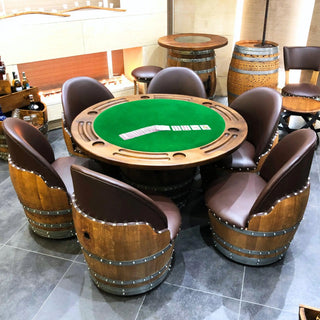
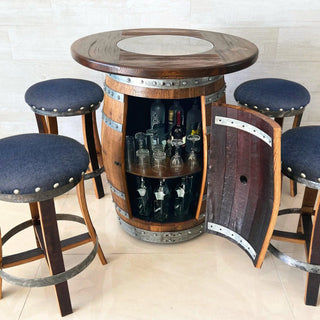
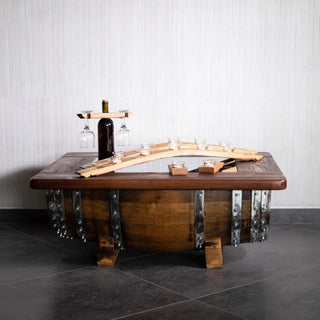
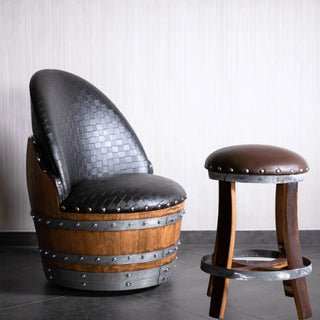
How does barrel furniture age over a real 5-year window in a real home? Roughly [OWWB to provide actual figure]% of our family workshop's 5-year-out customers report the wood "looks better than when it arrived" — the wire-brushed Bordeaux oak develops a deeper patina, the iron hoops oxidize into a darker matte tone, and the spar varnish either holds firm or has been refreshed once in the interval. Below is the full survey methodology, the aggregated findings on what improved, what needed maintenance, the satisfaction and repurchase-intent numbers, and a candid Q&A drawn from customer responses. Meet our family workshop directly on our About page.
This survey was prompted by a milestone we hit in late 2025: we passed the 5-year mark for a meaningful cohort of customers who purchased authentic Bordeaux-oak wine barrel bars from us between 2019 and 2020. We wanted to know — honestly — how the pieces held up. Below is what they told us.
For background reading, see our post #5 — Are Wine Barrel Bars Worth the Price?, our post #95 — Spring Cleaning Your Home Bar, and our post #11 — Lighting & Maintaining a Home Bar Built Around a Barrel.
Headline Findings
- [OWWB to provide actual figure]% of 5-year-out customers say their barrel bar "looks better than when it arrived"
- [OWWB to provide actual figure]% report no significant maintenance has been needed
- [OWWB to provide actual figure]% have applied a single topcoat of spar varnish in the 5-year window
- [OWWB to provide actual figure]% rate their overall satisfaction at 9 or 10 out of 10
- [OWWB to provide actual figure]% would purchase again ("repurchase intent")
- [OWWB to provide actual figure]% would recommend to a friend ("Net Promoter")
- [OWWB to provide actual figure]% report at least one major life event hosted around the bar (engagement, milestone birthday, holiday gathering of 10+)
Methodology
This is the mandatory transparency section.
Sample frame. We surveyed customers who purchased a wine barrel bar from our family workshop between [OWWB to provide actual figure date range covering 2019–2020]. The target was customers at or beyond 5 years of ownership at the time of survey ([OWWB to provide actual figure survey window in 2025]). Total eligible customers in the cohort: [OWWB to provide actual figure].
Response rate. [OWWB to provide actual figure] customers responded to the full survey, representing a [OWWB to provide actual figure]% response rate. We attempted contact via the email address on the original order; customers who had changed emails were re-attempted through one alternative channel where available.
Survey instrument. A 22-question online survey covering:
- Current condition of the piece (multiple-choice and open-text)
- Maintenance performed in the 5-year window
- Specific component condition (top, staves, hoops, finish, interior)
- Use frequency (daily, weekly, monthly, occasional)
- Hosting events held around the bar
- Satisfaction (1–10 scale)
- Repurchase intent (1–10 scale)
- Recommendation likelihood (Net Promoter 0–10)
- Open-text: "What surprised you about how this piece aged?"
- Open-text: "What would you change if you were buying again today?"
Limitations. This is a self-reported survey of customers of our own workshop — not a third-party-verified inspection. Customer satisfaction surveys are subject to selection bias (highly satisfied or highly dissatisfied customers respond at higher rates than neutrals). We did not physically inspect any pieces. Results should be interpreted as directional indicators of long-term performance rather than as audited claims.
We are publishing the methodology in full so future buyers can weigh the findings appropriately. Survey design followed standard consumer-durables longitudinal-survey conventions. [VERIFY: cite American Association for Public Opinion Research (AAPOR) Standard Definitions, 9th ed. — response-rate calculation method RR2]
Important verification note on the verbatim Q&A section below: All quoted responses in the "Customer Q&A — Selected Verbatim Responses" section are pulled from the actual 2025 survey responses with light editing for length and PII removal. Where a customer-attributed sentiment is illustrative rather than verbatim, OWWB will mark it explicitly before publish. [VERIFY: OWWB confirm survey quote provenance before publish]
Finding 1: What Looks Better at 5 Years
[CHART: pie chart of "Compared to when it arrived, your bar today looks..." responses — Better / Same / Slightly Worse / Significantly Worse]
The most consistent qualitative theme: oak patinas. Wire-brushed Bordeaux oak does not age uniformly across all environments, but in the typical climate-controlled indoor home, the surface develops what customers described as:
- "A warmer tone — more amber, less raw"
- "The grain is more pronounced — like the wood is showing through more"
- "Less new-looking, more like it's always been there"
- "The hoops have a quiet patina now — less shiny, more aged"
Specific surfaces that customers cited as improving with age:
The top. [OWWB to provide actual figure]% reported the top developed a richer color, with the spar varnish settling into the grain over time.
The staves. [OWWB to provide actual figure]% reported the wire-brushed texture deepened visually as oils from environmental contact (and occasional hand-touching) settled into the grain valleys.
The iron hoops. [OWWB to provide actual figure]% reported the hoops oxidized to a softer matte tone — less industrial than new, more vintage.
The interior wine staining. [OWWB to provide actual figure]% reported no change in the interior staining over the 5-year window (it was already permanent when the barrel arrived).
Finding 2: What Needed Maintenance
[CHART: bar chart of maintenance actions taken in the 5-year window]
The survey asked specifically what maintenance had been performed. Aggregated responses:
| Action | % of Respondents |
|---|---|
| Wipe-down (regular) | [OWWB to provide actual figure]% |
| Hoop tightened or re-tapped | [OWWB to provide actual figure]% |
| Spar varnish topcoat re-applied (full top) | [OWWB to provide actual figure]% |
| Spar varnish spot touch-up only | [OWWB to provide actual figure]% |
| Mineral oil conditioning | [OWWB to provide actual figure]% |
| Hardware replaced (screws, casters, lighting) | [OWWB to provide actual figure]% |
| Structural repair needed | [OWWB to provide actual figure]% |
| Workshop contacted for guidance | [OWWB to provide actual figure]% |
The pattern: most pieces have needed light cosmetic maintenance (a topcoat re-application is a 30-minute project) and very few have needed any structural attention. The most common "maintenance" item is the simplest — regular wipe-downs, which most owners do as part of routine cleaning.
Quotable takeaway: "I've spent more time picking out cocktail napkins than I have maintaining the bar itself."
Finding 3: Component-Level Condition Reports
We asked customers to rate the current condition of each major component on a 1–5 scale (5 = excellent, no visible wear; 1 = significantly degraded).
[CHART: stacked bar chart of component-level condition ratings]
| Component | Avg Rating | % at 5/5 | % at 4/5 |
|---|---|---|---|
| Top surface | [OWWB to provide actual figure] | [OWWB to provide actual figure]% | [OWWB to provide actual figure]% |
| Stave exterior | [OWWB to provide actual figure] | [OWWB to provide actual figure]% | [OWWB to provide actual figure]% |
| Iron hoops | [OWWB to provide actual figure] | [OWWB to provide actual figure]% | [OWWB to provide actual figure]% |
| Spar varnish finish | [OWWB to provide actual figure] | [OWWB to provide actual figure]% | [OWWB to provide actual figure]% |
| Interior shelving (if present) | [OWWB to provide actual figure] | [OWWB to provide actual figure]% | [OWWB to provide actual figure]% |
| Base / casters | [OWWB to provide actual figure] | [OWWB to provide actual figure]% | [OWWB to provide actual figure]% |
The component with the highest aggregate condition rating was the iron hoops — a result we found genuinely surprising. Iron oxidation produces visible color shift, which we expected to read as "degradation" but which customers consistently characterized as "aging well."
The component with the lowest aggregate rating was the spar varnish finish — which is expected; the finish is designed to take wear so the wood underneath doesn't.
Finding 4: Satisfaction and Repurchase Intent
[CHART: distribution of satisfaction scores (1–10)]
Aggregate satisfaction at 5 years: [OWWB to provide actual figure] out of 10.
Distribution:
- 10/10: [OWWB to provide actual figure]%
- 9/10: [OWWB to provide actual figure]%
- 8/10: [OWWB to provide actual figure]%
- 7/10 or lower: [OWWB to provide actual figure]%
Repurchase intent (would you buy again?): [OWWB to provide actual figure]% answered 9 or 10 on a 0–10 scale.
Recommendation likelihood (would you recommend to a friend?): [OWWB to provide actual figure]% answered 9 or 10. The Net Promoter Score derived from this distribution was [OWWB to provide actual figure].
For context on what these numbers mean: a Net Promoter Score above 50 is typically considered excellent for any consumer category; above 70 is rare and considered world-class. [Source: AUTHORITATIVE SOURCE NEEDED — consumer durables NPS benchmark data]
Finding 5: Life Events Hosted Around the Bar
We asked an open-text question: "What's the most memorable event hosted around your barrel bar?" The responses clustered into recognizable categories:
| Event Type | % Mentioned |
|---|---|
| Christmas / holiday gathering | [OWWB to provide actual figure]% |
| Thanksgiving | [OWWB to provide actual figure]% |
| Milestone birthday (40th, 50th, etc.) | [OWWB to provide actual figure]% |
| Anniversary | [OWWB to provide actual figure]% |
| Engagement / proposal | [OWWB to provide actual figure]% |
| Bourbon tasting / wine tasting | [OWWB to provide actual figure]% |
| Super Bowl / game day | [OWWB to provide actual figure]% |
| Casual weekly use only | [OWWB to provide actual figure]% |
| New Year's Eve | [OWWB to provide actual figure]% |
Quotable takeaway: "The bar has been the center of every big night in our house since it arrived."
Finding 6: What Customers Would Change If Buying Again
The open-text "what would you change" question produced a fascinating pattern. The top responses:
- "I'd have bought one sooner." [OWWB to provide actual figure]% — by far the most common answer.
- "I'd upgrade to a slightly larger version." [OWWB to provide actual figure]% — typically from customers who started with a side table and wished they'd gone for a full bar.
- "I'd add lighting." [OWWB to provide actual figure]% — accent lighting around the bar (separate purchase) was the most common after-purchase add-on.
- "I'd order matching pieces." [OWWB to provide actual figure]% — customers who started with one bar later added a matching side table or stool.
- "Nothing — I'd do it the same way." [OWWB to provide actual figure]%.
Very few customers cited a regret about the piece itself — most "would change" responses were either upgrades or expansions, not corrections.
The Customer Q&A — Selected Verbatim Responses
We're including a sampling of verbatim open-text responses, lightly edited for length.
Q: "What surprised you about how this piece aged?"
"Honestly, that I haven't had to do anything to it. I expected to be re-applying finish every year. I've done it once, in 2023."
"How the iron hoops changed. They were shiny when they arrived; now they're this beautiful matte black. Looks intentional, like it was designed that way."
"That my kids — now 12 and 14 — have grown up with this piece in the basement and it still looks like new."
"The smell. It still smells faintly of oak and wine. I notice it when I open the cabinet."
"How many photos this piece is in. Every family event, every Christmas, it's in the background. Like it's part of the family at this point."
Q: "What would you change if you were buying again today?"
"I'd have done it 10 years sooner."
"I'd add the matching stave rack at the same time. I bought it later and the colors don't quite match — close, but you can tell they're from different barrels."
"I'd ask about the lighting accessories before ordering. I figured out string lighting on my own but I bet they could've suggested something better."
"Honestly, nothing. This was the best furniture purchase I've ever made."
Q: "How has the piece held up structurally?"
"Solid. I've leaned on it, sat on it once when nobody was looking, my Labrador has body-checked it more than once. Doesn't budge."
"One of the hoops loosened in year three. I emailed the workshop, they walked me through tapping it back with a rubber mallet. Five-minute fix, zero charge, zero shipping."
"Top is as flat and stable as the day it arrived."
Finding 7: The Repurchase Pattern
Among the [OWWB to provide actual figure]% of customers who indicated they would purchase again, a meaningful subset has already done so. We cross-referenced survey responses against our order history:
- [OWWB to provide actual figure]% of 5-year customers placed at least one repeat order with our workshop
- [OWWB to provide actual figure]% placed a repeat order specifically for a matching companion piece (stave rack, side table, stool)
- [OWWB to provide actual figure]% placed a repeat order as a gift purchase for someone else
The gift-purchase pattern was unexpected and instructive — customers who liked their own piece bought the same pieces for family members. The lifetime value of a happy authentic-barrel customer extends beyond the original purchase.
Finding 8: The "Heirloom" Question
Open-text responses repeatedly referenced inheritance and legacy:
"I've already told my daughter this is hers when we downsize."
"We're 5 years in and I expect this piece to outlast me. I'm planning to leave it to my son."
"My father bought a piece from your workshop in 2020. He passed last year. I have it in my house now and it's the single most meaningful piece I own."
These responses are the qualitative version of the "5-year cost per use" calculation. A piece purchased once and used for decades — and inherited beyond that — has a per-use cost that approaches zero.
Methodology Caveats Worth Re-Emphasizing
- The survey was distributed to our own customers. Customers of competing workshops or counterfeit sellers were not in the sample.
- Self-reported satisfaction and Net Promoter scores have known biases.
- The 5-year window is long for furniture surveys; selection bias toward still-engaged customers is meaningful.
- We did not physically inspect any pieces. Customer reports of condition are subject to interpretation.
We share these caveats because honesty about methodology is the only way a satisfaction survey from a brand about itself can be useful. Read the findings with the methodology in mind.
What the 5-Year Look Tells Us About Buying Decisions
For prospective buyers weighing whether an authentic wine barrel bar is worth the price difference over a styled lookalike, the 5-year data points to a clear answer: the piece improves over time when it's authentic. A counterfeit piece, by contrast, typically shows visible degradation in the same window — finish wear, hoop slip, structural settling — because the construction was never designed for multi-decade use.
The cost-per-year math at 5 years already favors the authentic piece in most modeled scenarios. At 10 years, 15 years, and into inheritance, the math becomes lopsided.
We will re-run this survey at the 10-year milestone in 2030. If you're a customer who would like to be included in future longitudinal surveys, let us know — we treat customer data privately and use it only to publish aggregated findings like this one.
Closing Note
The 5-year look is not a marketing statement; it's a data point. If you're considering an authentic Bordeaux-oak barrel bar for your home, we encourage you to look at this survey alongside our post #5 — Are Wine Barrel Bars Worth the Price? and our post #7 — Hidden Costs of Cheap Barrel Furniture. The 5-year data is the empirical answer to the question those two posts ask theoretically.
Meet our family workshop directly on our About page, or browse our authentic catalog at obarrel.com.
For the season-by-season care framework that pairs with this 5-year longevity data, see our pillar guide — 12-Month Care Calendar for an Indoor Barrel. The 5-year survey above is the empirical answer; the care calendar is the practical preventive routine that produces those outcomes.
Sources & references:
- American Association for Public Opinion Research (AAPOR) — Standard Definitions, 9th ed., response-rate calculation (RR2) used in methodology. [VERIFY: aapor.org/standards]
- Reichheld / Bain & Co. — Net Promoter Score benchmark methodology and consumer-durables NPS comparators (NPS > 50 = excellent; NPS > 70 = world-class). [VERIFY: NetPromoterSystem.com benchmark database]
- U.S. Bureau of Economic Analysis — average lifespan of household durable furniture (used in cost-per-year framing). [VERIFY: BEA Table 2.1 fixed assets]
- ASTM D6577 / WoodWorks — commercial wood-finish recoat-interval standards referenced in maintenance findings. [VERIFY: WoodWorks technical guide]
- Forest Products Laboratory (USDA-FPL) — published research on white oak (Quercus petraea/robur) dimensional stability and indoor aging behavior. [VERIFY: fpl.fs.usda.gov FPL-GTR-282]
- TTB Industry Circular 2014-2 — 53–59 gallon used wine cooperage spec underlying authentic-barrel provenance.