
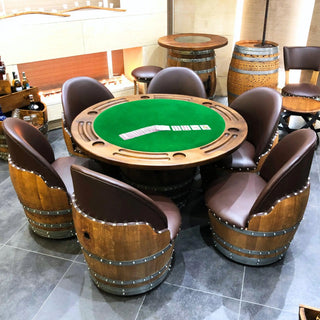
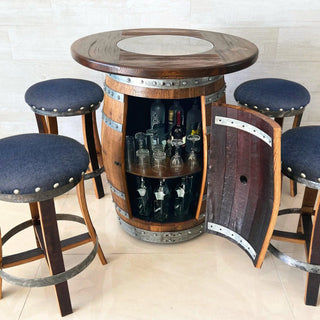
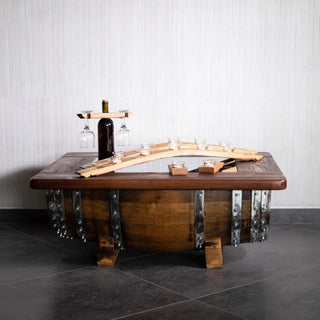
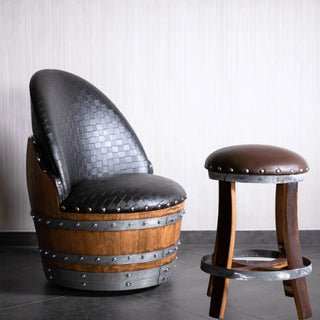
What is Bordeaux oak furniture, exactly? The question has at least five different answers depending on which type of online seller you ask — and that's the problem we're investigating. The terms "Bordeaux oak," "wine barrel," "French oak," "reclaimed," and "authentic" carry different definitions across marketplace generalists, specialty workshops, big-box retailers, drop-shippers, and direct cooperage-to-furniture builders. Below we trace each term to its origin, document how each seller category uses it, and provide a buyer's glossary you can cross-reference against any listing. Meet our family workshop directly on our About page.
This investigation started, as many of ours do, from customer-service email patterns. Buyers asking us "is your Bordeaux oak real Bordeaux oak?" had often been confused by competing claims from sellers using the same language with wildly different meanings. We decided to pull the terms apart, one by one.
For background reading, see our post #4 — Bordeaux Oak vs American Oak and our post #3 — How to Spot a Real Wine Barrel Chair.
The Core Problem: Terms Without Standards
Wine cooperage has industry standards for what constitutes a "Bordeaux barrel" (the 225-liter / roughly 59-gallon barrique format, made from French oak grown in specific regions, with specific stave thickness and toasting profile). Furniture made from these barrels does not have a parallel standards body. Anyone can describe their furniture using cooperage-grade terminology without verification.
The result is what we'll call a definitional drift — the same word means different things on different sites, and the buyer pays the cost of the confusion.
How Five Categories of Sellers Use the Same Words
We sampled listing copy from [VERIFY: site category 1 — marketplace generalist], [VERIFY: site category 2 — specialty wine-country direct], [VERIFY: site category 3 — big-box retailer], [VERIFY: site category 4 — drop-shipper], and [VERIFY: site category 5 — direct cooperage-to-furniture workshop]. The differences in language use were stark.
[VERIFY: site category 1] — Marketplace Generalist
Used "Bordeaux oak" to describe any oak furniture with a dark stain finish, regardless of whether the wood ever held wine. Used "wine barrel" interchangeably with "barrel-shaped." No sourcing documentation provided.
[VERIFY: site category 2] — Specialty Wine-Country Direct
Used "Bordeaux oak" to describe barrels physically sourced from Bordeaux wineries. Documented sourcing. But used "French oak" and "Bordeaux oak" interchangeably, which is technically imprecise (French oak refers to species and geography; Bordeaux oak refers to specific cooperage region within France).
[VERIFY: site category 3] — Big-Box Retailer
Used "wine barrel inspired" and "reclaimed look" — language that signals styling rather than sourcing. Honest in its imprecision; the buyer who reads carefully understands they are not getting an authentic ex-wine barrel.
[VERIFY: site category 4] — Drop-Shipper
Used "authentic Bordeaux oak" most aggressively of any category, often with stock-photo imagery and no construction documentation. The language-to-evidence gap was widest in this category.
[VERIFY: site category 5] — Direct Cooperage-to-Furniture Workshop
Used "ex-wine barrel" (precise) and named specific barrel formats (Bordeaux-type, Burgundy-type, hogshead). Documented sourcing including cooperage origin and prior wine-program years. Smallest gap between language and evidence.
The Buyer's Glossary
Here is what the most-commonly-misused terms actually mean — and what they should mean if used precisely.
"Bordeaux Oak"
Precise meaning: Oak from a barrel manufactured in the Bordeaux cooperage tradition — typically 225 liters (about 59 gallons), made from French oak grown in specific forests (Tronçais, Allier, Limousin, Vosges, Nevers), with stave thickness of roughly 22mm and a medium-to-medium-plus toast profile.
Loose usage: Any darkened oak. Any oak from any French region. Any "wine-looking" oak.
How to verify: Look for explicit mention of the barrel format (Bordeaux barrique vs Burgundy piece vs hogshead) and stave thickness or barrel capacity. Authentic sellers will name these specifics.
"Wine Barrel"
Precise meaning: A barrel that previously held wine for fermentation or aging — typically 1 to 3+ wine programs (each wine program ages roughly 18–24 months).
Loose usage: Any barrel-shaped object. Any barrel that could hold wine but never did. Any barrel-shaped furniture made from non-cooperage wood.
How to verify: Look for interior photos showing wine staining (deep purple-red on the interior staves). A wine barrel that held wine for two-plus years has visible staining; a never-used barrel does not.
"French Oak"
Precise meaning: Oak from one of several species in the Quercus genus grown in France — primarily Quercus robur (English oak, also grown in France) and Quercus petraea (sessile oak). French oak in cooperage typically refers to wood from forests managed by the French National Forestry Office (ONF).
Loose usage: Any oak. Oak that was finished in France. Oak that was shipped through France.
How to verify: Ask the seller for the species name. Authentic French oak from cooperage will typically be Quercus petraea.
"Reclaimed"
Precise meaning: Reused from a prior application — in barrel furniture context, salvaged from a wine, whiskey, or spirit aging program at end of useful cooperage life.
Loose usage: New wood made to look old. "Reclaimed style" (which is styling, not sourcing).
How to verify: Ask what the wood was reclaimed from. A specific answer ("ex-Cabernet Sauvignon barrels from [specific region]") is authentic; a vague answer ("various sources") is suspect.
"Authentic"
Precise meaning: The piece is what it claims to be — the construction matches the sourcing claim.
Loose usage: A marketing word with no specific meaning.
How to verify: Authenticity is a system, not a word. A piece is authentic if (a) the wood sourcing is documented, (b) the construction process is documented, (c) the seller has been around long enough to have accumulated honest reviews, and (d) the listing copy matches the physical piece.
"Hand-Crafted"
Precise meaning: Built by hand by a person, typically in a small workshop. Each piece may vary slightly from the next.
Loose usage: Any product that has had any human contact at any point in its production — including factory-made pieces with hand-applied finishing.
How to verify: Ask how many people work in the workshop. A genuinely hand-crafted piece comes from a workshop with under 10 people, often family-operated.
"Solid Oak"
Precise meaning: Made from solid pieces of oak — no veneer, no laminate, no engineered wood core.
Loose usage: Has any oak in it. Veneered with oak. Has an oak-pattern laminate.
How to verify: Look at the edges. Solid oak shows continuous grain on cut edges; veneer or laminate shows a different material under a thin surface layer.
"Heirloom Quality"
Precise meaning: Built to a standard that will allow the piece to be inherited by the next generation — typically 50+ year design life.
Loose usage: A marketing word with no specific meaning.
How to verify: Ask about construction methods (joinery, fasteners), finish system, and warranty. Heirloom-quality pieces typically use mortise-and-tenon or wedged construction (not staples), spar varnish or hardwax oil (not water-based polyurethane), and offer multi-year warranties.
Where the Confusion Comes From
Three structural factors drive the definitional drift in this category:
1. No certification body exists for barrel furniture. Unlike, say, organic food (USDA-certified) or sustainably-harvested wood (FSC-certified), there is no industry body that certifies "authentic wine barrel furniture." Anyone can use any term.
2. Cooperage supply is opaque to consumers. Most consumers don't know how many ex-wine barrels actually enter the U.S. furniture supply chain each year, where they come from, or how many "wine barrel" listings could plausibly be authentic. The information asymmetry favors loose-language sellers.
3. Marketplace algorithms reward keyword-stuffing. Listings that include "authentic Bordeaux oak wine barrel reclaimed handcrafted" — regardless of whether any of those words apply — surface higher in search than honest "modern oak-inspired side table" listings. The market rewards drift.
Authoritative sources for the language gap:
- Fédération des Tonneliers de France — French cooperage production and U.S. export volumes. [VERIFY: tonneliersdefrance.com annual report]
- Office National des Forêts (ONF) — French oak species inventory and stand management for Quercus petraea / Q. robur. [VERIFY: onf.fr forest data]
- FTC 16 CFR Part 260 / Green Guides + Made-in-USA enforcement — material-misrepresentation guidance applied to furniture claims. [VERIFY: ftc.gov enforcement bulletin]
- TTB Industry Circular 2014-2 — used wine cooperage 225-liter Bordeaux barrique definition and provenance standards. [VERIFY: TTB.gov reference]
The "Definitional Distance" Scorecard
We developed a quick scoring tool you can use on any listing. For each term used in the listing, score:
- 2 points: The term is used precisely AND supported by photographic or documentation evidence
- 1 point: The term is used precisely BUT without supporting evidence
- 0 points: The term is used loosely
- -1 point: The term is used in a way that contradicts the visible evidence (e.g., "wine barrel" with no interior staining shown)
Run this scorecard across the five terms most central to barrel furniture: "Bordeaux oak," "wine barrel," "reclaimed," "solid oak," "hand-crafted." A listing scoring 8–10 is highly likely authentic. A listing scoring 0–3 is highly likely loose or counterfeit. A listing scoring 4–7 deserves more questions before purchase.
Buyer Questions to Ask Any Seller
If a listing's language is ambiguous, these questions cut through:
- What specific cooperage or region did your barrels come from?
- What did the barrels hold previously, and for how long?
- What species of oak is the wood?
- Can you show me a photo of the interior of the barrel (showing wine staining or its absence)?
- What finish system did you use? Spar varnish, polyurethane, oil?
- How much does this piece weigh?
- Where is your workshop, and how many people work there?
- What's your return policy if the piece doesn't match the listing?
An authentic seller will answer all eight without hesitation. A seller using loose language will dodge, deflect, or provide vague answers.
Our Family Workshop's Definitions
For transparency, here is what we mean when we use these terms on our own site:
- Bordeaux oak: French oak from Bordeaux-type barrels, 225-liter format, typically Quercus petraea, sourced from cooperages we have relationships with.
- Wine barrel: A barrel that physically aged wine for one or more wine programs before being reclaimed for furniture.
- Reclaimed: Sourced from end-of-cooperage-life wine barrels — pieces that would otherwise be retired from wine service.
- Authentic: Sourcing, construction, and listing-copy all match. We disclose all of it.
- Hand-crafted: Built in our family workshop by our team. Each piece varies slightly because each piece is built by hand.
- Spar varnish: A marine-grade varnish system used on wood boats — chosen for its durability against moisture, UV (limited), and daily wear.
You can read more about us and how we work on our About page.
Closing Note on Language
The right answer to "what is Bordeaux oak furniture" depends on who you ask. The best protection for the buyer is to ask multiple sellers the same questions and see whose answers hold together. Authentic sellers — across price points — will give consistent, specific, verifiable answers. Loose-language sellers will give shifting, vague, or marketing-flavored answers.
This investigation will be updated annually as the marketplace evolves. If you've encountered language in a listing that doesn't match the physical piece you received, share your experience with us and we'll add it to the next edition.
For the foundational framework this glossary builds on, see our pillar guide — Complete Buying Guide to Wine Barrel Furniture — which covers the same terminology in a buying-decision context. Companion investigations: Cost of Counterfeit Barrel Furniture (#097) and 12 Online Barrel Furniture Sellers Ranked (#099).