
Every September, National Bourbon Heritage Month invites us to raise a glass to America's native spirit — but the truest hero of that story is not the corn or the copper still. It is the oak barrel. Bourbon owes its color, its depth, and much of its flavor to the wooden vessel it rests in, and that vessel carries a story that continues long after the last drop is poured. This is a look at what lives inside every stave, and why that story is worth honoring.
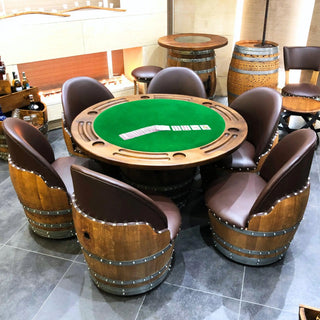
If you already sense that a retired barrel is too full of history to end its life as scrap, you are not alone. That conviction is exactly why we exist. Across our full collection of handcrafted barrel furniture, the wood that once aged wine goes on to anchor homes for decades more. But first, let's understand why the barrel matters so much in the first place.
Why Congress named a month for bourbon
In 2007, the U.S. Senate passed a resolution designating September as National Bourbon Heritage Month, formally recognizing bourbon as a distinctive product of the United States. That recognition was not just about a drink. It acknowledged a craft tradition — generations of distillers, coopers, and farmers — that helped shape American culture. Bourbon is one of the few consumer goods with a legal identity tied to a place and a method, and the barrel is central to both.
The barrel does the heavy lifting
Here is the fact that surprises most people: a large share of bourbon's character comes from the barrel, not the grain. Clear spirit goes into the wood. What comes out years later is amber, aromatic, and complex — and the wood is responsible for the transformation. The oak filters harsh notes, contributes vanilla and caramel tones as the spirit works into the charred layer, and breathes with the seasons as temperature swings push the liquid in and out of the wood's grain.
Oak is not chosen by accident. It is dense enough to hold liquid for years without leaking, yet porous enough to let the spirit interact with the wood and the air. Its grain is rich in the compounds that give aged spirits their signature warmth. Few materials on earth do this job, which is why the barrel has never been replaced by anything cheaper or more convenient. The craft depends on it.
A barrel's working life is only the beginning
A barrel spends years in a warehouse doing patient, invisible work. It expands and contracts through countless seasons. It absorbs the spirit and gives back flavor. By the time it is retired, the wood is seasoned in a way no kiln can replicate — dimensionally stable, deeply grained, and quietly beautiful.
Then, in most industries, that remarkable object gets discarded, broken down, or burned. To us, that is a waste of something irreplaceable. A retired barrel is a finished education in wood: it has already survived the extremes that would warp lesser lumber, and it carries the visible record of everything it held. The staining, the grain, the faint marks of its working years — these are not flaws to sand away. They are the story.
From stave to heirloom
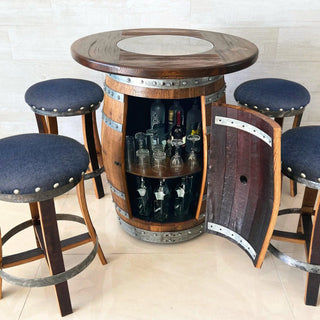
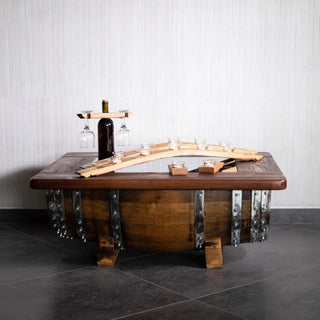
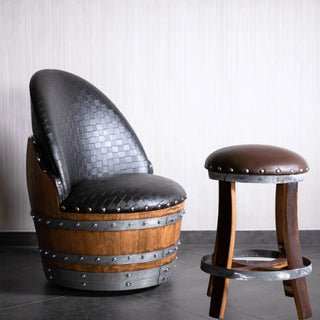
This is where the barrel's second life begins. Our family workshop, founded in 2018 by four engineers, takes genuine retired oak Wine Barrels and rebuilds them into furniture meant to outlast us. The staves are 1-inch solid oak of the Bordeaux type — real wine wood with authentic staining earned over years. We hand-wirebrush the tops to raise and reveal the grain, then finish them with a durable spar varnish that protects the wood while letting its history show through.
The result is furniture with provenance. A barrel bar, a table, a chair, a wine rack — each one still carries the fingerprint of the barrel it came from. No two pieces are identical, because no two barrels lived the same life. When you rest a glass on one of our tops during Bourbon Heritage Month, you are touching a vessel that spent years doing exactly the work you are celebrating.
What the story is worth
There is a quiet symmetry to it. A barrel devotes its first life to aging a spirit that people gather around. In its second life, it becomes the very surface people gather around. The purpose never really changes — it just takes a new form. That continuity is what makes barrel furniture feel different from ordinary woodwork. It was never inert lumber. It was always part of the ritual.
| Stage of the barrel's life | What happens | What it leaves behind |
|---|---|---|
| Cooperage | Oak is shaped, fired, and assembled into a barrel | Dense, watertight, charred or toasted wood |
| Aging | Years of holding spirit through seasonal swings | Deep staining, seasoned grain, character |
| Retirement | The barrel is emptied and set aside | An irreplaceable, fully seasoned oak vessel |
| Second life | Rebuilt into heirloom furniture | A piece that carries the whole story forward |
Honoring the heritage in your own home
You do not need to be a distiller to keep this heritage alive. A single piece of genuine barrel furniture brings the story into your home permanently. Many collectors start with a bar cabinet, because it unites the spirit and the vessel in one place — the bottles you love, displayed on the very wood that gives spirits their soul. Our double barrel bar cabinet does exactly that, giving your collection a home with real provenance rather than a mass-produced shelf.
For those who lean into the ritual, the appeal runs deeper. Pouring a bourbon and setting the glass on oak that once did the same work the bourbon depends on closes a satisfying loop. It is a small daily act of respect for a craft that took generations to perfect.
A story you can pass down
What makes barrel furniture especially fitting for a heritage month is that it, too, is built to endure. Heritage is not just about looking back — it is about carrying something forward. A genuine oak barrel piece, handcrafted from solid staves and finished to last, is meant to move through a family rather than wear out in a few years. The barrel spent its first life aging a spirit meant to be shared across occasions; in its second life, it becomes a piece shared across generations.
There is a quiet appropriateness to that. Bourbon itself is a tradition handed down — recipes, methods, and knowledge passed from one set of hands to the next. Furniture made from the very barrels that tradition depends on continues the chain in physical form. Years from now, someone in your family may set a glass on that same oak top without knowing its full history, and the story will still be there in the grain, waiting to be told. That is what heritage looks like when you can touch it.
A month worth marking
National Bourbon Heritage Month is a fine excuse to slow down and appreciate what usually goes unnoticed — that the humble wooden barrel is the quiet author of a great American tradition. The corn gets the credit and the distiller gets the name on the bottle, but the oak does the transformation, and it deserves a story of its own.
This September, when you raise your glass, spare a thought for the vessel. And if the idea of keeping that vessel in your home for the next several decades appeals to you, know that the story does not have to end when the barrel is emptied. In the right hands, it is only getting started.
About Oak Wood Wine Barrels — A family workshop handcrafting authentic Bordeaux-oak Wine Barrel furniture. 4.9-star rated, 4,000+ orders shipped. Shop our collection at obarrel.com.