
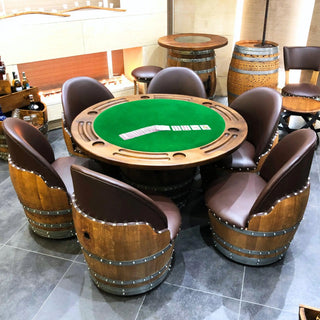
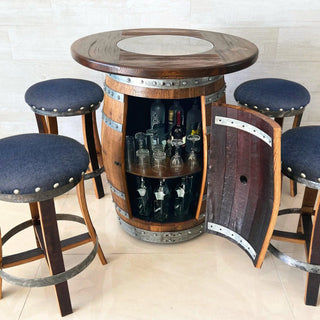
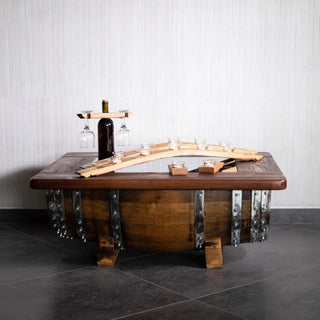
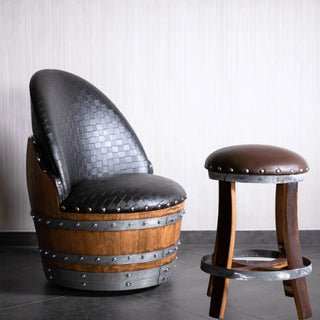
Modern barrel furniture has been trapped in a single category in most retail conversations: rustic. Reclaimed oak gets paired with leather, sisal, and exposed beams, and the result is a look that has been done to exhaustion since the early 2010s. The wood itself does not require that framing. An authentic retired wine, whiskey, or bourbon barrel can sit comfortably inside at least five distinct aesthetic registers — most of which are not rustic at all.
This guide walks through five aesthetic directions for barrel furniture beyond the standard rustic playbook. Each direction includes the palette that supports it, the lighting choices that make it work, the key pieces from our family workshop catalog that fit the look, and a short room example. These are designer-oriented recommendations grounded in what we see succeeding in real client spaces.
According to the American Society of Interior Designers' 2024 Outlook & State of Interior Design Report, "warm minimalism," "modern speakeasy," and "industrial refined" all appeared in the top ten residential design directions cited by surveyed practitioners. Coverage in Dezeen on contemporary speakeasy and bar interiors, and ongoing reporting from House Beautiful on warm minimalism in residential schemes, both point to the same shift away from heavy rustic theming. Barrel furniture, specified correctly, works inside every one of them.
1. Industrial — Steel and oak as equals
The industrial direction pairs the warm density of reclaimed oak with the cool linearity of blackened steel, brushed aluminum, and exposed concrete. The capsule: barrel furniture in this register reads as if the wood and the structural metal of the room were sourced from the same hand. Original steel hoops on the barrel become a visual bridge to surrounding metalwork.
Palette. Charcoal, blackened steel, concrete gray, warm white walls, deep saturated oak tones. No more than one accent color — typically a deep olive, oxblood, or burnt sienna used sparingly.
Lighting. Linear LED architectural fixtures, exposed Edison bulbs in matte black sockets, or a single black metal track light system. Avoid warm soft-glow vintage lighting in this register — it pulls the room toward rustic.
Key pieces. A standing barrel cabinet with steel hoops kept blackened (not polished). A barrel-head dining or conference table with welded steel base. Wall-mounted barrel-head pieces in a horizontal run, mounted on visible black steel hardware.
Room example. A loft basement bar with polished concrete floors, blackened steel beam exposure, and one barrel cabinet centered against a smooth charcoal wall. Linear LED cove lighting above. A single steel-and-leather bar stool. The barrel reads as industrial sculpture rather than country accent.
2. Coastal — Whitewashed staves and pale linen
The coastal direction lightens the barrel's natural register through whitewashing or limewash finishes, pairing it with pale linen, woven natural fibers, and soft blue-green color notes. The capsule: a whitewashed barrel piece anchors a coastal room without the cliché of nautical hardware or rope detailing.
Palette. Warm white, off-white, soft greige, pale sand, hints of muted blue-green or seafoam used as accent. Avoid bright navy or saturated turquoise — they push the look toward kitsch.
Lighting. Soft diffused window light during the day; warm-temperature ceramic or rattan-shaded lamps in the evening. Avoid harsh overhead lighting.
Key pieces. A custom whitewashed barrel cabinet (a finish we apply on request rather than as standard). A bistro set with lighter spar varnish finish. Wall-mounted barrel-head display pieces in soft tones, ideally engraved with subtle line work rather than dark heavy graphics.
Room example. A sunroom or three-season porch with soft linen drapes, a pale jute rug, two woven cane chairs, and a whitewashed barrel-head bistro table at the center. A single ceramic vessel in pale terra cotta as a small color note. The room feels like a clean coastal home without a single nautical motif.
3. Modern minimalist — One statement piece, nothing else
The modern minimalist direction uses a single barrel piece as the room's only material gesture, surrounded by restraint. The capsule: in a strict minimalist room, the barrel piece carries 100 percent of the warmth and visual interest. Everything else recedes.
Palette. Warm white walls, pale natural wood floor or smooth concrete, one piece of upholstered seating in oatmeal or cream linen. No secondary colors. No patterns.
Lighting. A single architectural pendant or a slim wall-mounted reading light. The lighting fixture itself should be minimal in form — no decorative elements.
Key pieces. A single standing barrel cabinet, planed-smooth staves (not wire-brushed), satin or matte spar varnish finish, minimal hardware. Or a single Captain's Chair as a sculptural object rather than functional seating.
Room example. A reading nook or small home library with smooth white walls, a single low-profile lounge chair in cream linen, a slim modern reading lamp, and a single barrel cabinet against the wall holding three books and one ceramic vessel. The barrel is the entire room's material story. The room reads as quietly luxurious.
4. Old-world wine library — Deep stains and leather
The old-world wine library direction leans into the barrel's wine heritage with deep-stain finishes, oxblood and forest green color notes, vintage leather, and traditional cabinetry detailing. The capsule: a barrel piece in this register reads as if it has been in a family wine cellar for three generations.
Palette. Deep forest green, oxblood, walnut brown, brass accents, warm cream wall surfaces. Saturated and traditional.
Lighting. Warm-temperature library lamps with brass or oil-rubbed bronze bases, picture lights above framed art, a small chandelier in brass or aged bronze if the room scale supports it.
Key pieces. A standing barrel cabinet finished in a darker satin spar varnish, paired with brass hardware. A barrel-head reading table with a single library lamp. Wall-mounted barrel heads engraved with vintner names, vintage years, or wine appellations.
Room example. A private study or wine room with deep green walls, a Chesterfield sofa in oxblood leather, a wall of framed wine labels and vintage maps, a brass library lamp, and a substantial barrel cabinet against the main wall holding a small collection of bottles and stemware. A single Persian rug underfoot. The room reads as a wine collector's private retreat — not a theme bar.
5. Speakeasy and art deco — Brass and dark oak
The speakeasy and art deco direction pairs dark-stained barrel oak with brass, black lacquer, deep jewel-tone velvet, and geometric pattern. The capsule: a barrel piece in this register reads as part of a 1920s private members' club, with deliberate glamour and considered moodiness.
Palette. Black, deep emerald, midnight blue, oxblood, brass and aged gold. Wall surfaces in deep saturated tones or in art deco wallpaper with geometric pattern.
Lighting. Brass sconces, fluted glass pendants, brass cabinet picture lights. Lighting itself is part of the design statement — not just functional.
Key pieces. A darker-stained standing barrel cabinet with brass hardware, used as a bar cabinet. A barrel-head bar plaque mounted as a focal piece behind the bar surface. A Captain's Chair with deep emerald or oxblood upholstery on the seat.
Room example. A private home bar in a finished basement or sunroom converted to a hosting space. Walls in deep emerald lacquered finish, art deco fluted brass sconces, a black-and-brass cocktail trolley, and a darker-stained barrel cabinet serving as the bar back. Two velvet bar stools in deep midnight blue. A small brass shaker collection on the cabinet's top surface. The room reads as a private speakeasy lounge — moody, considered, glamorous.
Summary table: five directions at a glance
| Direction | Palette | Lighting | Key pieces | Best room |
|---|---|---|---|---|
| Industrial | Charcoal, concrete, steel, deep oak | Linear LED, exposed Edison, matte black | Cabinet with blackened hoops; barrel-head table on steel base | Loft basement bar |
| Coastal | Warm white, sand, soft greige, muted seafoam | Diffused window light, ceramic/rattan lamps | Whitewashed barrel cabinet; lighter bistro set | Sunroom, three-season porch |
| Modern minimalist | Warm white, cream linen, pale natural floor | Single architectural pendant or slim wall light | One planed-smooth barrel cabinet; Captain's Chair as sculpture | Reading nook, small home library |
| Old-world wine library | Deep green, oxblood, walnut, brass, cream | Brass library lamps, picture lights, small chandelier | Dark-stain cabinet with brass; engraved barrel heads | Private study, wine room |
| Speakeasy art deco | Black, emerald, midnight blue, brass | Brass sconces, fluted glass pendants | Dark-stain bar cabinet; barrel-head bar plaque | Private home bar, lounge |
How to choose between directions
Five directions sound like a lot of options, but in practice the right direction for a given room usually narrows itself down quickly. Three filtering questions help.
What is the rest of the home doing? A modern minimalist living room next door to a planned barrel installation should usually receive a modern minimalist or industrial barrel piece, not an old-world wine library piece. Continuity across rooms matters more than maximizing visual interest in any single room.
What does the room get used for? A room used primarily for entertaining benefits from a stronger directional choice (speakeasy, old-world wine library) because the room itself is performing. A room used primarily for everyday living benefits from a quieter choice (modern minimalist, coastal) that ages well across years of daily exposure.
What lighting does the room actually have? A room with abundant natural daylight supports the coastal and modern minimalist directions strongly. A room with limited daylight and primarily evening use supports the speakeasy and old-world directions better. Industrial works in either, given the right artificial lighting plan.
Two notes on custom finishing
Two of the directions above — coastal whitewash and speakeasy dark stain — require custom finishing beyond our standard satin spar varnish. We handle both on request, with a modest finishing surcharge that we quote in advance.
Whitewashing requires careful application to preserve the visible oak grain rather than obscuring it. We apply a thinned white pigment in spar varnish base, hand-rubbed and sealed. The result lightens the wood meaningfully while keeping the original grain visible.
Dark staining requires the opposite — a depth-of-color treatment that intensifies the oak's natural tone without losing the wire-brushed texture or the char marks. We use compatible oil-based stains under spar varnish topcoat.
Both finishes are documented on the spec sheet we provide for any trade or custom commission. Designers ordering for client projects can request finish samples (small stave cuts) before committing to the full piece.
Where to start
For designers exploring aesthetic directions beyond rustic, the our favorites collection at obarrel.com is the right starting point — these are pieces our family workshop considers most adaptable across multiple design directions. The full catalog at obarrel.com shows every current piece available for standard or custom finishing.
Every piece in the catalog can be ordered in standard satin finish, custom whitewash, or custom dark stain, with the finishing adjustments noted above. The wood is the same authentic Bordeaux-type oak across every direction — what changes is how we finish it and what the surrounding room asks it to do.