
From Vineyard to Living Room: How We Source and Select Every Barrel
There’s always that moment.
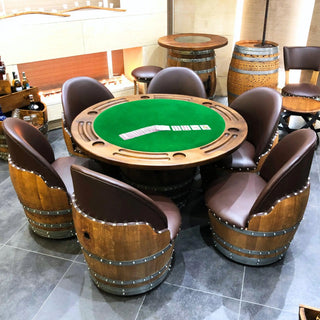
Someone walks into a room, sees a piece of wine barrel furniture, and kind of pauses for a second.
You can almost see the thought process happening:
“Wait… is that actually a barrel?”
And then it turns into a conversation.
Where did it come from? Is it real? How does something like that even end up in a living room?
That curiosity is part of what makes this whole thing different.
Because unlike most furniture—which basically starts as raw wood and gets shaped into something new—wine barrel furniture already had a life before it ever got to you.
And honestly, that’s the part most people don’t think about right away.
They see the finished piece.
But the real story starts way before that.
It Doesn’t Start in a Workshop (It Starts Somewhere Else Entirely)
Before a barrel ever becomes a table or a cabinet or anything like that… it’s doing a completely different job.
It’s sitting in a winery.
Sometimes for years.
And during that time, it’s not just holding liquid—it’s part of the process. The wood interacts with the wine, the environment, the aging process. It picks things up over time.
That’s where the character actually comes from
Not from distressing or finishing techniques later.
From time.
From use.
From just being there and doing what it was originally built to do.
So by the time a barrel is “done” in a vineyard, it’s not really done at all.
It’s just ready for something else.
Not Every Barrel Is Worth Turning Into Furniture (And That’s a Good Thing)
This is something people don’t always realize.
Just because a barrel exists doesn’t mean it should become furniture.
Some are too worn down.
Some don’t hold their structure anymore.
Some just… don’t have that look or feel that translates well once you bring them into a home.
There’s a lot of filtering that happens here
At Oak Wood Wine Barrels, it’s not about using every barrel available.
It’s about choosing the ones that still have something left in them—strength, structure, character.
Because once you turn that barrel into a piece of furniture, it has to do a completely different job.
It’s not sitting quietly in a cellar anymore.
It’s in someone’s home. Getting used. Getting noticed.
So the starting material matters more than people think.
Why Oak Keeps Showing Up in All of This
There’s a reason barrels are made from oak in the first place.
It’s not random.
Oak is strong. Dense. It holds up under pressure.
But it also has a certain look to it—grain, tone, texture—that works really well when you bring it into a home setting.
It ages in a way that actually adds to it
Some materials wear out.
Oak kind of… settles in.
Even after years of use in a winery, it still has structure. Still has life to it.
And when it gets repurposed into furniture, that carries through.
You’re not starting from scratch—you’re continuing something that was already working.
The Shift From “Used Barrel” to “Something You’d Actually Put in Your House”
This is where things could easily go wrong… if it’s not done right.
Because there’s a big difference between:
“Hey, this used to be a barrel”
and
“This actually works as furniture”
The goal isn’t to erase the barrel—it’s to work with it
The curves stay.
The staves stay.
The marks, the variations, even some of the imperfections—that’s the whole point.
But at the same time, it has to function.
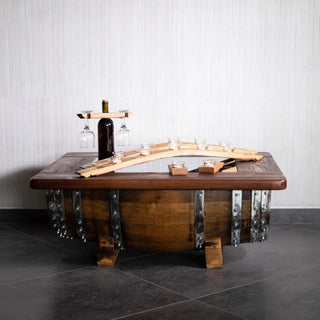
A table can’t wobble.
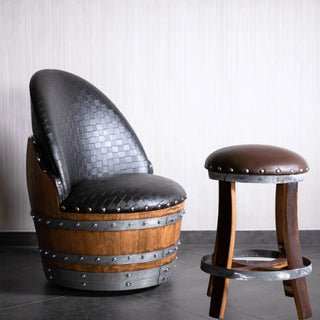
A chair can’t just look good—it has to feel good to sit in.
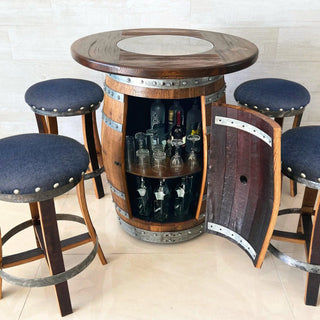
A cabinet has to open smoothly, not just exist as a cool-looking piece.
So there’s this balance between keeping the character… and making it usable in real life.
And honestly, that’s where a lot of the craftsmanship shows up.
Why No Two Pieces Ever Feel Exactly the Same
This is one of my favorite parts, personally.
Even if two pieces are the same “style”… they won’t feel identical.
And that’s not something being done on purpose after the fact.
It comes from the barrel itself.
Each one carries its own history
Different grain patterns.
Different tones.
Different marks from how it was used and aged.
So when it becomes furniture, that variation comes with it.
You end up with something that feels a little more personal—even if you didn’t customize it.
It’s just naturally that way.
There’s a Point Where You Stop Thinking of It as “Furniture”
This might sound a little weird, but stick with me.
At some point, you stop looking at it like just another piece in the room.
It feels a little more grounded than that.
Like it belongs there in a different way
Not because it matches everything perfectly.
But because it has a presence.
It doesn’t feel like something that was mass-produced and dropped into your space.
It feels like something that came from somewhere—and ended up there.
And even if you can’t explain that out loud, you notice it.
Why This Whole Process Actually Matters (Even If You Never Ask About It)
Most people don’t ask where their furniture comes from.
They see it, they like it, they buy it.
And that’s completely normal.
But with wine barrel furniture, the source shows up in the final piece more than you’d expect.
You can feel it without thinking about it
The weight.
The texture.
The way it sits in a room.
It doesn’t feel like something temporary.
It feels like something that’s already proven it can last.
And that’s a big part of why people are drawn to it—even if they don’t realize that’s what they’re responding to.
Where Oak Wood Wine Barrels Fits Into All of This
Oak Wood Wine Barrels isn’t just focused on the finished product.
The sourcing part matters just as much.
The selection. The materials. The way each piece is built from the starting point of the barrel—not just shaped into something generic.
The goal isn’t to standardize it
It’s to carry that original character through… and turn it into something functional without losing what made it interesting in the first place.
That’s why the pieces don’t feel identical.
And that’s why they don’t feel replaceable.
At the End of the Day, It’s Not Just About Furniture
It’s about what you’re actually bringing into your space.
A table, a chair, a cabinet—sure.
But also something that already had a purpose.
Something that’s been used, aged, and then turned into something new.
That’s what gives it weight—beyond just the material
And whether you ever tell that story to anyone or not…
It’s still there.
Our Links
- Explore handcrafted wine barrel furniture collections — https://www.obarrel.com
- Shop barrel tables, chairs, and custom pieces — https://www.obarrel.com
- Browse rustic oak furniture made from real barrels — https://www.obarrel.com
Other Resources to Check Out!
- Wine Spectator (How Wine Barrels Are Used in Winemaking) — https://www.winespectator.com
- VinePair (Understanding Oak & Barrel Aging) — https://vinepair.com
- American Oak Cooperage (Barrel Crafting Process) — https://www.americanoakcooperage.com
This blog post is for informational purposes only. While we aim to provide transparent and helpful insight into sourcing, materials, and craftsmanship, individual products, finishes, and barrel characteristics may vary due to the natural and reclaimed nature of the materials used. Availability, appearance, and structural details may differ slightly from piece to piece. Always review product specifications directly and consider your space and needs before making a final purchase decision.