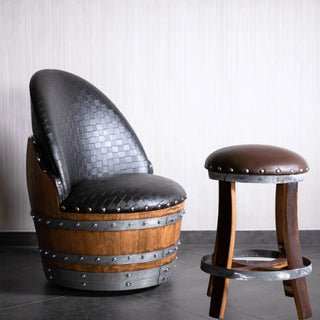
Wine barrel terminology is a working vocabulary borrowed from centuries-old cooperage, blended with woodworking and modern furniture-trade language. Knowing the words makes you a better buyer — you can describe what you want, ask the right questions, and read product listings the way the workshop wrote them. This A-to-Z glossary covers the 40 most useful terms for anyone shopping for, owning, or specifying authentic wine barrel furniture — and you can browse the full collection at obarrel.com to see them applied to actual finished pieces. Each entry includes a one-sentence definition, a one-sentence example, and a "see also" pointer to related terms.
A
Air-seasoning — The process of drying cooperage staves outdoors for 24 to 36 months before they are built into a barrel, which equilibrates moisture content and leaches harsh wood compounds. Example: "These staves were air-seasoned for three years in the Allier region before becoming a barrel." See also: stave, cooper.
B
Barrel head — One of the two flat circular ends of a barrel, built from several jointed pieces of oak doweled together. Example: "We laser-engraved the venue logo on the barrel head as a tasting-room sign." See also: croze, head hoop.
Bilge — The widest point of a barrel, located in the middle of its length where the staves bow outward. Example: "The bunghole is always drilled through the bilge of one stave." See also: stave, bunghole, bilge hoop.
Bilge hoop — The hoop located at the widest point of the barrel, doing the most load-bearing work of any single hoop on the barrel. Example: "The bilge hoop is the band you see most prominently in any photograph of a finished barrel." See also: hoop, bilge, quarter hoop.
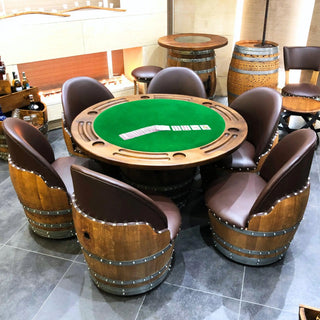
Bistro set — A small two-or-three-piece dining configuration, typically one round table and two chairs, used in tight indoor lounges, sunrooms, and basement bars. Example: "The barrel bistro set anchors the corner of our basement bar." See also: pub table.
Bordeaux barrel — The 225-liter (approximately 59-gallon) wine barrel format historically associated with Bordeaux wine production, built from French oak. Example: "All our furniture is made from authentic Bordeaux-type oak barrels." See also: Quercus petraea, hogshead.
Bung — The tapered wooden plug that seals the bunghole during wine aging. Example: "Original bungs are sometimes left in place as a decorative detail on furniture pieces." See also: bunghole.
Bunghole — The 50mm hole drilled through the bilge of one stave, used to fill, sample, and drain the barrel. Example: "The bunghole is filled with a custom inlay on the finished bar top." See also: bung, bilge.
C
Captain's chair — A traditional armchair style with a curved back, adapted in barrel furniture to use stave-built backrests and seats. Example: "Six captain's chairs ring the barrel pub table in our tasting room." See also: stave-back chair.
Char level — The degree to which the interior of a whiskey or bourbon barrel has been charred during cooperage, ranging from Char 1 (light) to Char 4 (alligator skin) [Source: TTB regulations on bourbon barrel charring, 27 CFR §5.143 — VERIFY current section]. Example: "The visible interior char on this bar table tells you it was a former bourbon barrel." See also: toast level, head.
Chime — The angled edge of the staves at each end of the barrel, where the wood extends just past the head. Example: "Foam corner protectors go on the chime of every barrel during transport." See also: stave, head hoop.
COI (Certificate of Insurance) — A document issued by a vendor's insurer naming a venue as additional insured for a specific event, often required by commercial properties before vendor furniture can be delivered [Source: Insurance Information Institute, commercial general liability guidance — VERIFY]. Example: "Most wedding venues require a COI before delivery day." See also: scheduled-property rider.
Cooper — The craftsperson who builds barrels; the trade is called cooperage. Example: "A working cooper today apprentices for 4 to 7 years before building barrels independently." See also: cooperage, stave.
Cooperage — Both the trade of building barrels and the workshop where barrels are built. Example: "Our staves come from a regional cooperage that has built Bordeaux barrels for over a century." See also: cooper, Bordeaux barrel.
Croze — The groove cut around the inside of the staves near each end of the barrel, into which the head fits. Pronounced "kroze." Example: "The croze is the geometry that holds the barrel together without glue." See also: head, stave.
E
Earlywood / latewood — The two density bands within each oak growth ring; earlywood is the softer, less dense spring growth, latewood is the harder, denser summer growth. According to the USDA Forest Products Laboratory, white oak latewood is roughly 30-40 percent denser than its earlywood [Source: USDA Forest Products Laboratory, Wood Handbook — VERIFY]. Example: "Wire brushing removes the earlywood and leaves the latewood ridges standing in relief." See also: wire brushing, stave.
F
French cleat — A wall-mounting system using two interlocking beveled boards, commonly used to hang barrel-head signs and stave wall racks. Example: "All our wall pieces ship with French cleats pre-attached." See also: stave rack.
H
Head hoop — The hoop closest to each end of the barrel, also called a chime hoop. Example: "If a hoop loosens, it is almost always the head hoop." See also: hoop, chime.
Hogshead — A larger barrel format (approximately 250-300 liters / 66-79 gallons) sometimes used for whiskey aging. Example: "Hogshead barrels make slightly larger bar bases than standard Bordeaux barrels." See also: Bordeaux barrel.
Hoop — The metal band that compresses the staves of a barrel together. Bordeaux barrels typically have four to six hoops. Example: "We preserve the original cooperage hoops when we rebuild barrels into furniture." See also: head hoop, quarter hoop, bilge hoop.
J
Jointing — The shaping of stave edges so adjacent staves meet at precisely the right angle to form a watertight circle. Example: "Stave jointing is the most experienced-hands operation in cooperage." See also: stave, cooper.
L
Laser engraving — A custom branding technique that burns a design into oak with controlled depth, used on barrel heads, stave fronts, and chair backs. Example: "Vector files are required for laser engraving production." See also: pyrography, stave inlay.
Lead time — The time between order placement and delivery. For custom-branded wine barrel furniture, lead times typically run 4 to 12 weeks. Example: "Custom inlay work has the longest lead time of any branding option." See also: MOQ.
M
MOQ (Minimum Order Quantity) — The smallest order a workshop will accept for a given custom-branded item; typically 6 pieces for custom-engraved staves. Example: "MOQ for custom-branded barrel heads is 1." See also: lead time.
P
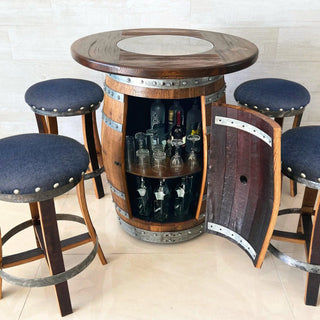
Pub table — A standing-height table, typically 40-42 inches tall, often built on a half-barrel or full-barrel base. Example: "Plan one pub table per 4 to 6 standing guests in a tasting room." See also: bistro set.
Pyrography — The craft of decorating wood by burning designs into the surface with a heated tool; one of three main custom branding techniques for barrel furniture. Example: "Hand-pyrography staves carry slight variation that reads as authentic craft." See also: laser engraving, stave inlay.
Q
Quarter hoop — The hoop positioned between the head hoop and the bilge hoop on each side of the barrel. Example: "Quarter hoops do a meaningful share of the load-bearing work in barrel furniture." See also: hoop, bilge hoop.
Quarter-stave — A stave that has been cut or split lengthwise into a narrower piece, used in stave wall racks and decorative cladding. Example: "Quarter-staves give you twice the coverage per barrel for wall installations." See also: stave, stave rack.
Quercus alba — American white oak, the primary species used for whiskey and bourbon barrels [Source: USDA Forest Products Laboratory species profile for Quercus alba — VERIFY]. Example: "Quercus alba develops a richer caramel tone than European oak when refinished." See also: Quercus petraea, Quercus robur.
Quercus petraea — Sessile oak, one of two French oak species used for Bordeaux wine barrels. Example: "Tronçais forest is famous for the tight grain of its Quercus petraea." See also: Quercus robur, Bordeaux barrel.
Quercus robur — English oak, the second French oak species used for Bordeaux barrels, often blended with Quercus petraea in cooperage. Example: "Most Bordeaux cooperages use both Quercus robur and Quercus petraea." See also: Quercus petraea.
S
Scheduled-property rider — An insurance addendum listing specific high-value items individually, used to cover custom barrel furniture above standard contents limits. Example: "Add a scheduled-property rider for any branded statement piece over $2,500." See also: COI.
Spar varnish — A flexible, UV- and moisture-resistant varnish originally developed for marine brightwork, used as the protective topcoat on quality wine barrel furniture [Source: ASTM D5572 marine varnish performance standard — VERIFY scope]. Example: "The spar varnish topcoat allows in-place scratch repair." See also: tung oil.
Star Seller — An Etsy designation awarded to sellers who consistently meet high standards for shipping, customer service, and review ratings [Source: Etsy Seller Handbook, Star Seller program page — VERIFY URL]. Example: "Our family workshop holds a 4.9-star Star Seller rating across 1,500+ sales." See also: Etsy.
Stave — One of the curved wooden boards that forms the side wall of a barrel; a Bordeaux barrel uses 28 to 32 staves. Example: "Wire-brushed staves are the signature surface of our wall racks." See also: cooper, wire brushing, earlywood / latewood.
Stave-back chair — A chair whose backrest is built from individual barrel staves, often spanning the chair's full back height. Example: "Stave-back chairs read more rustic than captain's chairs." See also: captain's chair.
Stave inlay — A custom branding technique in which letters or designs are routed into a stave and filled with contrasting wood for a premium permanent mark. Example: "Member-name stave inlay is a hallmark feature of our whiskey-lounge installations." See also: laser engraving, pyrography.
Stave rack — A wall-mounted display made from arranged staves, typically used for bottle storage or glassware display. Example: "Our 6-stave wall rack holds nine wine bottles and a row of Glencairns." See also: quarter-stave, French cleat.
T
Tannin — A class of astringent polyphenolic plant compounds in oak that transfer to wine during barrel aging and contribute structure and aging potential to the finished wine. Example: "The tannin transfer is part of why air-seasoned oak makes better barrels." See also: air-seasoning.
Toast level — The degree to which the inside of a wine barrel has been heated during the bending process, ranging from light to heavy. Example: "Bordeaux barrels are typically built to medium or medium-plus toast." See also: char level.
Tonnellerie — French for cooperage; the trade and the workshops that build wine barrels. Example: "Many French tonnelleries have been operating continuously for over 200 years." See also: cooperage, cooper.
Tung oil — A natural oil finish sometimes used on barrel furniture as an alternative to spar varnish, with a flatter sheen and slightly more matte appearance. Example: "Tung oil deepens the wood color but requires more maintenance than spar varnish." See also: spar varnish.
W
Wire brushing — A finishing technique in which stiff steel-bristle brushes rake out the softer earlywood fibers of an oak stave, leaving the harder latewood ridges in relief and exposing the grain. Example: "Hand-wire-brushed staves give wine barrel furniture its tactile, dimensional surface." See also: stave, spar varnish, earlywood / latewood.
Why this vocabulary matters
A buyer who can name the parts of a barrel writes more useful emails, asks more productive questions, and ends up with furniture better matched to the space it will live in. A commercial buyer who knows what MOQ, lead time, and COI mean gets quoted faster and avoids the back-and-forth that slows production. A new owner who recognizes that a "loose hoop" or a "squeaky stave" is a 30-minute repair, not a defect, treats their piece appropriately for the decades it will last.
Browse our full collection at obarrel.com to see these terms applied to actual finished pieces, or reach out with any vocabulary question we have not answered here.
Sources referenced
- USDA Forest Products Laboratory — Wood Handbook, white oak earlywood/latewood density and Quercus alba species profile
- TTB (Alcohol and Tobacco Tax and Trade Bureau) — bourbon barrel charring regulations [VERIFY current CFR section]
- ASTM International — D5572 marine varnish performance standard [VERIFY scope]
- Insurance Information Institute — commercial general liability guidance [VERIFY]
- Etsy Seller Handbook — Star Seller program criteria [VERIFY URL]