
Classy man cave ideas start with a hard edit. The stereotype — neon brewery signs, team-color foam fingers, a giant TV mounted dead-center on a wall of black paint — has been so thoroughly worked over by reality-TV remodels and big-box-store catalogs that the room reads as costume rather than design. The alternative is not minimalism or showroom polish. It is a room that takes the same source materials a serious whiskey lounge or a vintner's cellar would use — reclaimed oak, leather, blackened brass, wool, candlelight — and lets the craftsmanship carry the story. The twelve ideas below replace the clichés with material-driven decisions, each of them buildable in a basement, sunroom, three-season porch, or finished lounge — and many can start with a single piece from a curated barrel-furniture collection.
1. Lead with a Material Story, Not a Theme
Themes are clichés in slow motion. "Sports bar," "Irish pub," "speakeasy" — all of them collapse into costume because every object in the room has to play to the script. A material story is the opposite. Pick two or three real materials — reclaimed Bordeaux-oak wine barrel staves, full-grain leather, blackened brass, wool felt — and let every object in the room come from that short list. The result is a room that has unity without theme, the same way a well-designed restaurant feels coherent without telling you what it is supposed to be.
The working rule: if a single object in the room could only exist inside a theme (a Guinness mirror, a neon Coors sign, a Patriots flag), it goes. If the object exists because of its material (a reclaimed-stave bottle rack, a leather club chair, a blackened-iron pendant), it stays.
2. One Statement Piece, Not a Wall of Memorabilia
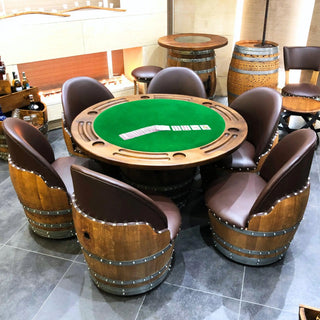
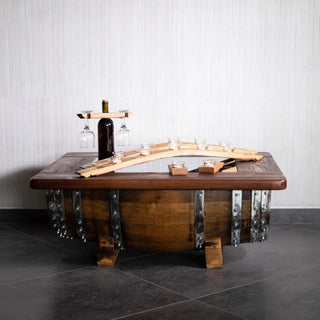
The cluttered-trophy-wall look is the single biggest tell of a clichéd man cave. The fix is not less stuff arranged the same way — it is a single statement piece that does the work of fifteen smaller objects. An authentic 53-to-59-gallon Bordeaux-type wine barrel, fitted as a bar, a cabinet, or a half-barrel wall mount, anchors a 200-square-foot room on its own. So does a six-foot reclaimed-stave bottle rack, a full barrel-head coffee table, or a tall library-style bourbon shelf.
The visual physics: one large object with strong proportions reads as architecture. Fifteen small objects read as collection. A man cave with architecture inside it feels finished. A man cave with collection inside it feels like storage.
3. The Reclaimed-Oak Color Palette
The default man cave palette — black walls, red accents, chrome — fights with every warm material in the room. The reclaimed-oak palette is the opposite. Walls in warm taupe, mushroom, or deep olive. Trim in matte black or rubbed bronze. Textiles in cognac leather, oat-colored wool, and walnut velvet. The wine barrel oak itself — toasted amber where the spar varnish catches the light, deeper mahogany in the hand-wire-brushed valleys — sits in the center of that range and pulls every other surface toward it.
A palette in service of one anchor material reads as designed. A palette built around contrast and accent colors reads as decorated.
4. The Library-Style Bourbon Shelf
The back-bar bottle wall is a cliché because of how it is usually built — mirrored, lit from below, lined with three rows of identical 750-milliliter bottles in marching order. The library-style alternative treats bourbons and whiskies the way a serious reader treats a book wall: open shelving in reclaimed oak or stained pine, varied bottle heights staggered intentionally, picture lights above each shelf, two or three rocks glasses and a Glencairn stacked next to a stack of tasting journals.
What this does: it reframes the bottle collection from "stock" to "library." Guests read the room as a curated reference shelf rather than a retail display.
5. Designer-Grade Lighting on Dimmers
The lighting layer is where the cliché lives. A single ceiling fan-light combo on a wall toggle is the lighting equivalent of a foam finger. The classy alternative is four layers, each on its own dimmer:
- Ambient. Pendant pair at 2,700K over the bar zone, or wall sconces if the ceiling is low.
- Task. Under-counter LED strip on the pour surface.
- Accent. Picture lights on the stave wall, floor uplight behind the barrel.
- Signature. A single decorative fixture — vintage Edison cage pendant, blackened-brass chandelier, or a single oversized lantern.
The Illuminating Engineering Society's RP-29 residential lighting practice recommends layered ambient-task-accent design over a single overhead source for relaxed rooms. Wire each layer to its own rotary or smart dimmer. The room reads as casual at 60 percent ambient and as after-dinner pour at 20 percent ambient plus accent. The cost of the dimmers is the cheapest upgrade in this list and the one that does the most work.
6. Leather Seating That Has Already Been Lived In
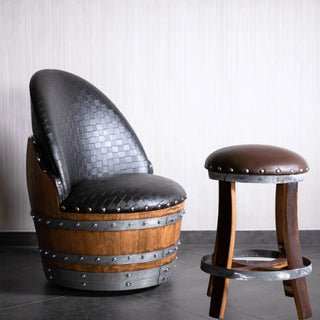
New black bonded-leather recliners are a cliché not because they are leather, but because they look brand-new and shiny. The fix is to either buy real full-grain leather that develops patina (cognac, saddle, oxblood, mushroom) or buy used vintage Chesterfield, club, and wingback chairs and have them re-stuffed. A pair of cognac leather club chairs angled toward a barrel-head coffee table is the single most upgrade-able move in this entire list.
If the budget is tight, one well-chosen vintage leather chair and a wool-upholstered loveseat beats two new bonded-leather recliners every time.
7. A Gallery Wall of Vintage Cooperage and Distillery Prints
Sports posters and brewery banners get replaced by framed vintage cooperage diagrams, 19th-century distillery lithographs, botanical prints of oak species, and antique wine-region maps. eBay and Etsy both have deep inventories of public-domain reprints in the $25-to-$80 range. Frame them in matte black or walnut with two-inch white mats.
The wall stays themed to the room's material story — oak, cooperage, distillation — without telling guests what to think. A vintage Bordeaux wine-region map next to a 19th-century cooperage tool diagram next to a botanical print of Quercus alba reads as a curated reference wall.
8. The Single-Stave Coat and Hat Rail
A single reclaimed wine barrel stave, mounted horizontally on the wall by the door with four blackened-brass coat hooks, replaces both the freestanding coat tree and the wall of wire hooks. It also introduces the reclaimed-oak material to the entryway, which pre-loads guests for the larger statement pieces deeper in the room.
A second stave above it works as a hat shelf. The total install is one stave, four hooks, and four wall anchors — under $120 in materials and under an hour of work.
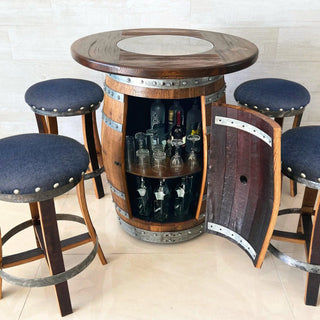
9. The Barrel as Focal Point — Treated as Furniture
A wine barrel parked in a corner as decoration is a cliché. A wine barrel built into the room as functional furniture is not. The three configurations that earn their square footage:
- Full barrel bar. 53-to-59-gallon barrel with a flat top, used as the pour zone. Two matching stools, a picture light overhead, an uplight behind.
- Half barrel wall mount. Mounted to the wall, shelves inside, used as a back-bar bottle display in a smaller room.
- Barrel cabinet with flip-up top. Closed storage below, working tasting surface above, used in a corner of a lounge.
In all three, the barrel is the focal point because the seating, the lighting, and the sightlines orient toward it. This is the difference between decoration and design.
10. Textiles That Quiet the Room
The cliché man cave is acoustically a racquetball court — hard floor, hard walls, glass coffee table, big TV. The classy version puts wool, leather, and lined drapery on at least three of the six surfaces of the room. A wool area rug 8x10 or larger. Lined drapery on every window. A wool felt panel or a tall bookcase loaded with books on the wall behind the seating.
The Acoustical Society of America associates reverberation times (RT60) of 0.4-0.6 seconds with comfortable speech intelligibility in residential rooms; untreated hard-surface 200-square-foot rooms routinely measure 0.8-1.2 seconds. This does two things at once: it controls the reverberation that makes conversation tiring after 20 minutes, and it visually anchors the harder objects (barrel, leather, metal) against soft mass. A room without soft mass feels like a showroom. A room with it feels like a lounge.
11. The Decanting and Service Vignette
A small, intentional service vignette on the bar zone replaces the cluttered "stuff parked on the counter" look. A working vignette includes a single Bordeaux or whiskey decanter, a foil cutter, a wine key, a jigger, a Glencairn or two on a small reclaimed-wood tray, a citrus board, and a folded linen napkin. Total footprint, roughly 18 by 24 inches.
The vignette signals that the bar is in use, not just for show. It also gives the eye a small, organized object to land on between the larger statement pieces.
12. The Edited TV
The TV is not the enemy of a classy man cave. The treatment is. The fixes that move a TV from cliché to architecture:
- Mount it lower than instinct says — center of screen 60 to 65 inches from the floor, not 80.
- Frame it in reclaimed-stave trim so it reads as a built-in rather than a hung appliance.
- Choose matte over glossy — the new matte-finish OLEDs and the Frame-style TVs both photograph and look better in lamplight.
- Hide the soundbar — wall-mount it underneath, recess it into the trim, or replace it with discreet in-wall speakers.
- Use the screensaver intentionally — a slow rotation of cooperage photography, vintage distillery prints, or static art beats the default starfield.
A TV that looks built into the architecture of the room is a TV that has stopped being a cliché.
Summary Table
| # | Idea | What it replaces | Effort |
|---|---|---|---|
| 1 | Material story, not theme | "Sports bar" / "speakeasy" framing | Mindset |
| 2 | One statement piece | Wall of memorabilia | Major furniture |
| 3 | Reclaimed-oak palette | Black + red + chrome | Paint + textiles |
| 4 | Library-style bourbon shelf | Mirrored back-bar | Shelving + lighting |
| 5 | Four-layer dimmable lighting | Single ceiling fan-light | Wiring upgrade |
| 6 | Patinated leather seating | New bonded-leather recliners | Furniture |
| 7 | Vintage cooperage gallery wall | Sports posters and neon | Framing + curation |
| 8 | Single-stave coat rail | Freestanding coat tree | 1 hour, <$120 |
| 9 | Barrel as functional furniture | Barrel as corner decoration | Major furniture |
| 10 | Wool, leather, lined drapery | Hard-surface acoustics | Textiles |
| 11 | Service vignette | Cluttered counter | Curation |
| 12 | Edited TV | Centerpiece TV | Mounting + trim |
What Holds the Whole Room Together
The thread running through all twelve ideas is the same: classy man cave ideas work when the room is built around real materials rather than themes. Reclaimed Bordeaux-oak wine barrel staves carry that weight better than almost any other source — they have visible history (the staves often still show the wine-stain ring inside), they have proportion (a full barrel is the right scale for a 200-to-300-square-foot room), and they have craft (every barrel is coopered, toasted, and assembled by hand before it ever holds a drop of wine).
Our family workshop builds full barrel bars, half-barrel wall mounts, barrel cabinets, stave bottle racks, single-stave coat rails, and barrel-head coffee tables from authentic 53-to-59-gallon Bordeaux-type wine barrels. Hand-wire-brushed staves, finished with spar varnish. Free shipping in the continental U.S.; in-stock orders ship within 5 business days, then arrive 3 to 7 business days later.
A classy man cave is not a more expensive man cave. It is one with fewer, better objects, made from materials that have a story worth showing.