
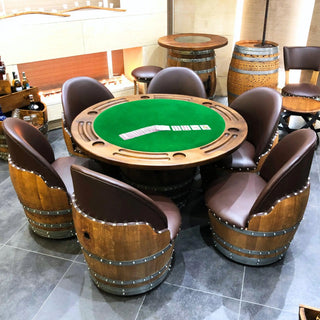
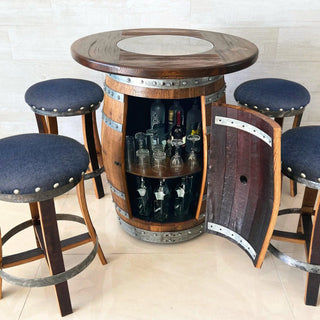
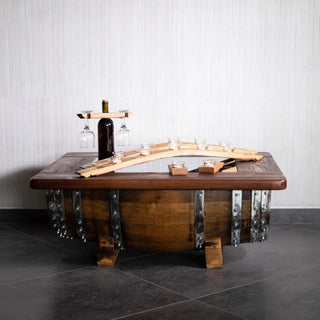
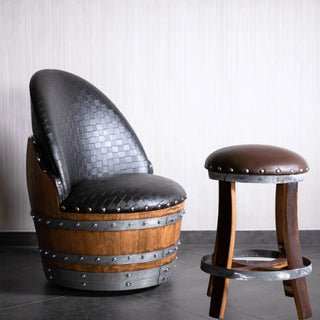
A rustic industrial bar mood board is a single-page visual brief that locks down the palette, the dominant materials, the lighting temperature, and the anchor furniture pieces before a single product is purchased. For a basement bar or a finished-lower-level lounge built around a wine barrel anchor piece, the mood board is the document that prevents the most common failure mode: a mismatched room that reads as either "too rustic" (lodge-y, undisciplined) or "too industrial" (cold, restaurant-y). The process below is the same one our family workshop walks designers and DIY clients through when they bring us a brief — and after 1,527+ Etsy sales, roughly 1 in 5 of our trade-buyer projects start with a mood board exactly like this one. The product anchors come from our curated favorites at obarrel.com. For broader designer-and-trade specification context, see our designers specify authentic barrel furniture pillar guide, the P6 pillar hub.
The rustic-industrial style sits at a specific intersection: reclaimed wood + raw steel + warm-temperature lighting + leather and brick textures. It is not farmhouse (too clean) and not pure industrial (too sterile). The mood board's job is to define that intersection in concrete swatches and references, then carry that brief through to product specification.
Time required: 2-3 hours for a single-room mood board
Skill level: Intermediate (basic design vocabulary helpful)
Tools and materials: see table below
Tools and Materials
| Tool / Material | Purpose | Notes |
|---|---|---|
| Mood board software (Milanote, Pinterest, Figma) | Digital assembly | Pinterest works for solo, Figma for client review |
| 12-18 reference images | Visual anchors | 50% rooms, 30% materials, 20% details |
| Paint chip cards (4-6 colors) | Palette lock-in | Pull from Benjamin Moore or Farrow & Ball |
| Material swatches (oak, steel, leather, brick) | Tactile reference | Even digital boards benefit from physical chips |
| Lighting temperature chart | Bulb spec | 2200K-2700K for rustic-industrial |
| Product spec sheet (PDFs / links) | Anchor pieces | Wine barrel anchor + 2-3 supporting |
Step 1: Define the Palette in Four to Six Colors
The rustic-industrial palette is restrained. Six colors is the ceiling. Four is more disciplined.
Anchor neutrals (2 colors): A warm off-white for any plaster or drywall walls (Benjamin Moore "Swiss Coffee" OC-45 is a workshop favorite); a deep charcoal or warm-black for steel and accent walls (Farrow & Ball "Off-Black" No. 57).
Wood tone (1 color): The reclaimed Bordeaux oak from a wine barrel is in the medium-dark wood family - think a warm walnut, not a pale ash. Match the rest of the wood in the room (floors, shelving) to this tone within a 2-shade range.
Metal accent (1 color): Pick one. Antique brass, blackened steel, or aged copper. Mixing two industrial metals reads as undecided. Black steel + brass is the only combo that survives mixing, and only at a 4:1 ratio.
Optional accent color (1 color): A bottle-green, an oxblood, or a deep navy used in a single textile (a leather sofa, a wool throw, a bar stool). This is the color that prevents the room from reading as monochrome brown-and-black.
Document each color as a hex code and a paint reference. The hex code is for digital communication; the paint reference is for the actual painter.
Step 2: Lock the Material Palette to Five Surfaces
Rustic-industrial rooms use five surfaces and no more. Adding a sixth (marble, terrazzo, polished concrete) breaks the style.
- Reclaimed oak - the wine barrel anchor, stave wall art, shelving
- Raw or blackened steel - hoops on the barrel, pendant lights, hardware
- Leather - bar stool tops, a sofa, a chair (cognac or oxblood)
- Brick or stone - one accent wall, ideally exposed structural brick
- Glass - decanters, bottles, pendant globes, picture frame glazing
Each surface should appear in at least two places in the room. A single leather chair with no other leather feels stranded; the same chair with leather drink coasters and a leather magazine holder reads as a deliberate material choice.
Step 3: Set the Lighting Temperature and Layer Count
Rustic-industrial lighting runs warm. The bulb spec is 2200K-2700K (Edison-bulb territory), never above 3000K. Cool-white LEDs kill the style.
The three layers:
- Ambient: An overhead pendant or two, on a dimmer. Industrial cage pendants or globe pendants with Edison-style bulbs.
- Task: Sconces or a single pendant over the bar surface. Brighter than ambient, same color temperature.
- Accent: Picture lights on stave wall art, under-shelf strip on the back bar, or a single table lamp on a side table.
Specify wattage and lumens, not just bulb shape. A 60W-equivalent Edison bulb at 2200K and 400 lumens is the standard rustic-industrial bar bulb. Document the bulb spec on the mood board.
Step 4: Choose the Furniture Anchor
Rustic-industrial bars need one large furniture anchor and 2-3 supporting pieces. The anchor is almost always a wine barrel bar (with or without a top) because it pulls reclaimed oak + steel hoops + craft narrative into a single object.
The wine barrel bar anchor sizing:
- Standard 53-59 gallon Bordeaux-type barrel: ~36 inches diameter, 35 inches tall
- Wine-stave bar top (optional): adds 12-24 inches of usable surface
- Footprint with two bar stools: 6 x 4 feet of floor space
Supporting pieces:
- Two leather-and-steel bar stools (counter height, 24-26 inches; or bar height, 28-30 inches - confirm against your top height)
- A wine barrel side table for a seating area
- Stave wall art or shelving (1-2 pieces)
Pull the product specs into the mood board as small thumbnail images with dimensions. The mood board should answer the question "how does this object fit in this room?" before any purchasing decision.
Step 5: Photograph or Source Three Reference Rooms
Pinterest, design magazines, and architecture blogs have thousands of rustic-industrial bar references. Pull three that match the palette and material decisions made in steps 1-2. They are not for copying; they are for orienting the rest of the design team (or the client) to the target.
Caption each reference with what you are stealing from it: "Pulling the brass-and-black pendant from this one." "Pulling the leather-stool-on-stained-concrete from this one." "Pulling the stave shelving arrangement from this one."
A note on attribution: when pulling reference images from Pinterest, design magazines, or photographer portfolios for a client deck, credit the source (photographer, designer, publication) on the mood board. This is standard ASID and AIGA practice and protects the designer from copyright disputes if the deck circulates beyond the immediate client relationship.
Step 6: Add the Detail Layer
Detail-layer images are the small references that prevent the room from feeling generic. Pull 4-6:
- A close-up of a wire-brushed stave (the texture that gives reclaimed oak its character)
- A close-up of a steel hoop with patina
- A close-up of a leather seam with antique brass tacks
- A close-up of a brick wall with mortar showing
- A close-up of a warm Edison bulb at night
- A close-up of a single decanter on an oak surface
These detail shots are the most underused part of a mood board. They lock in the texture the room will have, which is what separates a designed rustic-industrial bar from a thrown-together one.
Step 7: Assemble and Review
The mood board layout should be:
- Palette swatches across the top
- Three reference rooms in the upper middle
- Five material swatches in the lower middle
- Anchor product specs across the bottom
- Detail shots in the margins
Print at 11x17 if reviewing in person. Share as a PDF if reviewing remotely. The board is the source of truth - if a product gets proposed that does not fit the palette or the materials, the mood board is the document that says "no."
Common Mistakes to Avoid
- Too many colors. Six is the ceiling. Four is better.
- Mixing two industrial metals beyond a 4:1 ratio. Black steel + brass at 80/20 works. 50/50 reads as undecided.
- Cool-white lighting. Anything above 3000K kills the style.
- No detail shots. The room will feel generic.
- No anchor product spec. The mood board becomes a Pinterest board, not a brief.
- Skipping the brick or stone surface. Rustic-industrial without masonry feels incomplete; it can be a single accent wall or even just a brick-veneer panel behind the bar.
How the Mood Board Translates to Purchasing
Once the mood board is locked, the purchasing sequence is:
- Wine barrel bar anchor (longest lead time - in-stock orders ship within 5 business days)
- Bar stools (in-stock or short lead)
- Lighting (specify and order with electrician's input)
- Stave wall art / shelving (in-stock or short lead)
- Textiles and detail accessories (last; let the room tell you what it needs)
The wine barrel bar gets ordered first because it is the longest-lead, most-anchoring purchase. Everything else flexes around it.
For the curated rustic-industrial-leaning pieces from our workshop, browse our favorites at obarrel.com. For broader designer resources including specification guides and the trade-buyer FAQ, see our designers specify authentic barrel furniture pillar guide. The rustic-industrial style has been documented as a stable design vocabulary in Architectural Digest and Dezeen's industrial-design archives, both of which trace its emergence to the post-2008 conversion of urban warehouse spaces into residential and hospitality lofts.
Final Note on the Style
Rustic-industrial as a category has been around long enough that it is no longer a trend - it is a stable design vocabulary. The mood board exists to keep the room disciplined within that vocabulary. A room that is almost rustic-industrial but drifts toward farmhouse, lodge, or modern-industrial will feel mixed-up to anyone who knows the style. The mood board prevents drift. (For published style-category definitions and the broader vocabulary, the Interior Design Society and ASID's style reference glossaries are the standard trade citations.)