
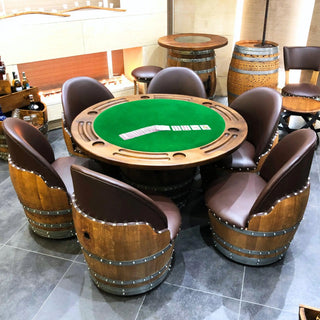
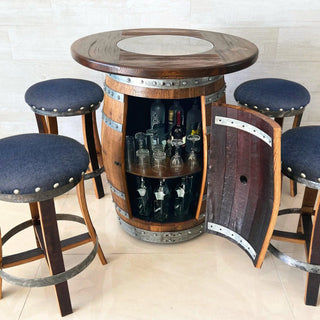
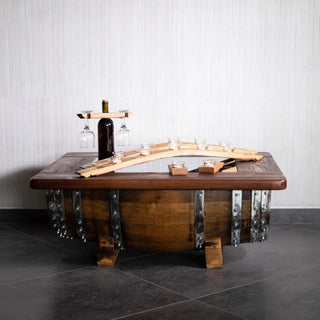
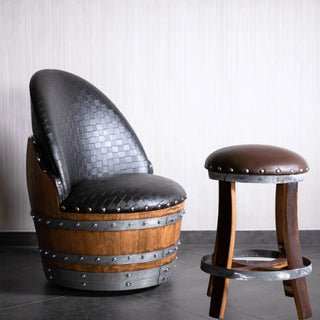
An empty wine barrel that's already in your house is one of the most flexible pieces of raw material a homeowner can have on hand. A retired 53 to 59 gallon Bordeaux-type oak barrel can become 14 different pieces of indoor furniture or decor — most of them in a weekend, most of them without buying additional wood. This guide answers the question "what to do with empty wine barrel" with 14 indoor-first projects, each rated by difficulty and tool list, so you can match the project to the skill level you actually have.
A note on scope: every idea below assumes the barrel lives indoors after the project is done. Wine barrel furniture finished with spar varnish is built for interior living — sunroom, basement bar, three-season porch, dining room, hallway. We don't recommend any of these projects for true outdoor exposure unless you're prepared to refinish annually.
If you'd rather start with finished components and skip the heavy work, our tops, rails, and accessories collection at obarrel.com carries pre-finished staves, heads, and rings cut from authentic Bordeaux barrels.
1. Coffee table on a fixed base (intermediate)
Slice the barrel horizontally at 18 inches from the bottom, flip the bottom section, add a glass top inset into the head, and you have a 28-inch-diameter coffee table with built-in storage inside the hoop. Most-used configuration in our customer photos.
- Difficulty: Intermediate
- Tools: Circular saw or reciprocating saw, sander, drill, glass cutter or pre-cut glass round
- Time: 6–8 hours
2. Side table for a sunroom or reading corner (beginner)
Stand the full barrel upright, finish the top, add four felt pads under the lower hoop. The simplest project on this list — the only one where you don't actually cut the barrel.
- Difficulty: Beginner
- Tools: Sander, spar varnish, brush, felt pads
- Time: 3 hours plus drying
3. Indoor planter for a large statement plant (beginner)
Cut the top head off, drill drainage holes, line with a heavy-duty plastic pot saucer for moisture control, and use it as a planter for a fiddle-leaf fig or large monstera in a sunroom or atrium corner.
- Difficulty: Beginner
- Tools: Reciprocating saw, drill with hole-saw bit, plastic liner
- Time: 2–3 hours
4. Wine rack from the staves (intermediate)
Disassemble the barrel into individual staves, lay six staves side by side, drill 4-inch holes through each at bottle-neck height, and stand the staves vertically in a frame. Holds 18–24 bottles.
- Difficulty: Intermediate
- Tools: Mallet, hole saw, drill, wood glue, two 2x4 vertical supports
- Time: 8–10 hours
5. Stave wall shelves (intermediate)
Curved staves mounted horizontally on a wall make distinctive 30-inch shelves. Mount with hidden brackets so the curved profile floats. Best in a basement bar, sunroom, or hallway.
- Difficulty: Intermediate
- Tools: Drill, hidden-shelf brackets, level, stud finder
- Time: 4 hours per shelf
6. Candle centerpiece on the barrel head (beginner)
The flat barrel head, removed cleanly and sanded, becomes a 22-inch round centerpiece tray for pillar candles, a tea-light cluster, or seasonal greenery. The wood already has the cooper's marks and wine staining as natural decor.
- Difficulty: Beginner
- Tools: Hand saw or jigsaw, sander, spar varnish
- Time: 2 hours plus drying
7. Headboard from joined staves (advanced)
Eight to ten staves joined edge-to-edge with biscuit joinery create a 60-inch curved headboard for a queen-size bed. The curve of the staves matches the curve of the original barrel, giving a subtle concave shape that frames the bed.
- Difficulty: Advanced
- Tools: Biscuit joiner, clamps (six minimum), wood glue, French cleat hardware
- Time: 14–18 hours over a weekend
8. Powder-room sink vanity (advanced)
A horizontally cut half-barrel, mounted on a wall-bracket or short legs, becomes a 22-inch-wide vanity for a powder room. Cut a hole in the top head for the vessel sink and run plumbing through the bottom. Best paired with a vessel sink and a wall-mounted faucet.
- Difficulty: Advanced (recommend a plumber for the rough-in)
- Tools: Reciprocating saw, jigsaw, hole saw, plumbing fittings, sealant
- Time: Full weekend plus plumbing time
9. Hallway console table (intermediate)
Cut the barrel vertically down the middle. Flatten one cut side against the wall. Add a hardwood top across the open side. You get a 30-inch-wide, 12-inch-deep console for a hallway or entry — perfect for keys, mail, and a small lamp.
- Difficulty: Intermediate
- Tools: Circular saw, jigsaw, hardwood plank for top, wall anchors
- Time: 6 hours
10. Bar caddy or whiskey tray (beginner)
The flat barrel head with two rope handles attached to opposite sides becomes a 22-inch round whiskey tray for the bar cart. Holds a bottle, two Glencairns, and a water carafe.
- Difficulty: Beginner
- Tools: Drill, marine rope, screw eyes, spar varnish
- Time: 90 minutes
11. Standing umbrella stand or stick holder (beginner)
A short upright section of the barrel — the bottom 20 inches — left open at the top with a heavy stone in the base, holds umbrellas, walking sticks, or a single tall vase of dried branches in an interior entryway or beside an interior coat closet.
- Difficulty: Beginner
- Tools: Reciprocating saw, sander
- Time: 2 hours
12. Whiskey-tasting flight tray (beginner)
A 4-inch-wide stave segment with four 3-inch holes drilled through it holds four Glencairn glasses in a row — the classic four-pour tasting flight format. Useful for a basement bar or sunroom hosting setup.
- Difficulty: Beginner
- Tools: Drill, 3-inch hole saw, sander
- Time: 90 minutes
13. Dog feeding station (beginner)
Two 6-inch-diameter holes cut in the top head, sized to drop in stainless dog bowls, turn an upright barrel into a raised feeding station. The 30-inch height suits medium and large breeds.
- Difficulty: Beginner
- Tools: Drill, hole saw sized to bowl rim, two stainless dog bowls
- Time: 2 hours
14. Bar back display with curved staves (intermediate)
Mount three to five curved staves vertically on a wall behind your home bar to create a sculptural "barrel-back" feature. Each stave is roughly 36 inches long. Light them from above with a picture light or a track-mounted spotlight.
- Difficulty: Intermediate
- Tools: Drill, French cleat hardware, level
- Time: 4–5 hours
Difficulty and tool summary
| Project | Difficulty | Time | Specialized tool needed |
|---|---|---|---|
| Coffee table | Intermediate | 6–8 hrs | Circular saw |
| Side table | Beginner | 3 hrs | None |
| Indoor planter | Beginner | 2–3 hrs | Hole saw |
| Wine rack | Intermediate | 8–10 hrs | Hole saw |
| Stave wall shelves | Intermediate | 4 hrs | Hidden brackets |
| Candle centerpiece | Beginner | 2 hrs | None |
| Headboard | Advanced | 14–18 hrs | Biscuit joiner |
| Powder-room vanity | Advanced | Weekend+ | Plumbing |
| Hallway console | Intermediate | 6 hrs | Circular saw |
| Bar caddy tray | Beginner | 90 min | None |
| Umbrella stand | Beginner | 2 hrs | Reciprocating saw |
| Tasting flight tray | Beginner | 90 min | Hole saw |
| Dog feeding station | Beginner | 2 hrs | Hole saw |
| Bar back display | Intermediate | 4–5 hrs | French cleats |
How to choose your first project
If this is your first time working with a barrel, start with a beginner project that requires no cutting of the barrel body itself: the side table, the candle centerpiece, the bar caddy, or the dog feeding station. These let you learn how the oak responds to sanding and finishing without committing to an irreversible cut.
If you've worked with wood before but haven't disassembled a barrel, the wine rack and stave wall shelves are the right next step. Disassembly itself is the hardest skill — knocking the hoops off without cracking staves takes patience and a soft mallet.
If you're an experienced woodworker, the headboard and powder-room vanity show what authentic Bordeaux oak can do as a structural design element. Both will sit in the home for decades.
Why authentic wine barrels make better repurpose material than reproduction barrels
Authentic wine barrels — the kind you might already have in your basement from a winery purchase, a wedding, or a hand-me-down — have several advantages over decorative reproduction barrels sold at home centers:
- The oak is true French Bordeaux or American white oak, conditioned by two to four years of wine
- The cooperage is tight, with no glue or staples — only metal hoops compressing the staves
- The staves carry natural wine staining inside that reads as patina in cross-section pieces
- The wood is dimensionally stable because it's already been wet-then-dried in service
A barrel from a working winery will outlast most furniture in the room you put it in. Furniture-grade white oak is widely cited by hardwood industry sources as a multi-generational material — quality oak furniture routinely lasts 75 to 100 years with reasonable care [Source: AUTHORITATIVE SOURCE NEEDED — Hardwood Manufacturers Association or American Hardwood Information Center]. A wine barrel piece sits comfortably in that range. Standard wine barrel volume conventions (the 53 to 59 gallon range used throughout this guide) are documented across cooperage and winery industry references [Source: AUTHORITATIVE SOURCE NEEDED — Wine Institute or American Cooperage Association cooperage standards].
When to call in a professional finisher
A few of the projects above — the headboard, the powder-room vanity, the wine rack at scale — are worth handing off to a workshop if you don't have the tools or the time. Our family workshop does custom barrel furniture from authentic Bordeaux barrels, and we ship finished pieces in one to two weeks with free U.S. shipping. If you'd rather start with a finished piece than a DIY project, browse our full barrel furniture collection at obarrel.com.
For most of the beginner projects on this list, though, a Saturday afternoon, basic tools, and a barrel that's already in the house is all you need.
Sourcing tips if you don't yet have a barrel
If you're reading this without an empty barrel actually in your house — or if you'd rather start from finished components, browse our tops, rails, and accessories collection at obarrel.com — the sourcing options vary by region and timing:
- Local wineries: Many production wineries cycle out 5–10% of their barrel inventory each year and sell retired barrels direct to consumers for $150–$400 each. Call ahead — most don't list this on their websites.
- Wine wholesale distributors: Some regional distributors will sell barrels at lower prices ($120–$250) if you can pick up in person.
- Estate sales and auctions: A barrel that has lived in someone's basement for 10 years is functionally identical to a freshly retired one, often at $75–$200 if you're patient.
- Specialty resellers: A handful of online retailers source from wineries and resell with delivery, typically $250–$500 plus shipping for the freight-class delivery.
The best months to source are January–March, when wineries have completed their annual barrel rotation and are clearing space. Summer prices typically run higher because of patio-furniture demand from retailers and event venues.
A note on safety when working with old barrels
A few safety reminders for first-time barrel projects:
- Wear eye protection during disassembly. Hoops under compression can release suddenly when struck. A driving punch and a soft mallet, used patiently, prevent the worst-case scenarios.
- Ventilate when sanding. Even a wine barrel that has been empty for years can release residual sulfur compounds when sanded. Open a garage door or work in a well-ventilated workshop with the door cracked.
- Check for residual moisture before finishing. Apply finish only to a barrel that has been dry indoors for at least 30 days. Sealing in moisture leads to bubbling and finish failure within months.
- Use a respirator with stain and varnish. Standard dust masks don't filter the solvent vapors in oil-based finishes. OSHA's general industry guidance on respiratory protection (29 CFR 1910.134) is a useful reference for hobbyists choosing between a dust mask and a half-face respirator with organic-vapor cartridges [Source: AUTHORITATIVE SOURCE NEEDED — OSHA 29 CFR 1910.134].
These basic precautions take the project from weekend hobby to safe weekend hobby. Most beginner-difficulty projects on the list above require none of the more advanced safety considerations — they're sanding, finishing, and assembly only.