
By law, straight bourbon must be aged in new, charred oak containers — and that single rule explains almost everything about how bourbon tastes, why it costs what it does, and why the country produces a constant supply of retired barrels every year. It also raises a question most drinkers never think to ask: if a bourbon barrel can only be used once, where do all those barrels go? The answer is more interesting than you would guess.
The short version is that a barrel's first career is brief and its afterlife can be long. That afterlife is the whole reason a piece of genuine barrel furniture can exist at all. But to appreciate the second act, you have to understand the first.
The rule: new, charred, oak
American regulations are unusually specific about bourbon. To be labeled straight bourbon, the spirit must be aged in a new, charred oak container. Three words in that phrase do the heavy lifting: *new*, *charred*, and *oak*. Each one shapes the final spirit, and together they create the rule that keeps barrels moving through the industry.
Oak is the only wood used because it is uniquely suited to the job — dense enough to hold liquid for years, porous enough to let the spirit interact with the wood and air, and rich in the compounds that give aged spirits their warmth and color.
Charred means the inside of the barrel is deliberately set alight before use, creating a layer of blackened wood. That char is not cosmetic. It acts as a filter, smoothing harsh notes out of the raw spirit, and it caramelizes the wood's natural sugars so the bourbon can draw out vanilla, caramel, and toffee tones as it ages.
New is the word that matters most for our story. The barrel must be new for that batch of straight bourbon. It cannot have held bourbon before.
Why "new" changes everything
The requirement that each barrel be new for straight bourbon is what makes bourbon bourbon. A fresh barrel gives the spirit the full, unspent intensity of the wood — all the color, all the flavor compounds, all the char's smoothing power, at maximum strength. A barrel that had already given up much of its character to a previous batch simply could not do the same work.
The consequence is straightforward and enormous: the industry cannot keep reusing barrels for straight bourbon the way other spirits reuse theirs. Every batch demands fresh wood. That is why distilleries generate a steady, reliable stream of once-used barrels — barrels that are still structurally superb but have finished their one permitted job. This is not waste from failure. It is a byproduct of the very rule that guarantees quality.
What a "retired" barrel actually is
It is easy to hear "used barrel" and picture something worn out. The opposite is true. A retired barrel has spent years being seasoned by the best possible process. It has held liquid through countless temperature swings, expanding and contracting until the wood is dimensionally stable in a way no kiln-drying can match. It has absorbed and released spirit until the grain is deep and the staining is rich.
In other words, a retired barrel is not depleted lumber — it is fully seasoned, character-laden oak that has already survived the extremes that warp ordinary wood. For a spirit, its useful life is over. For a craftsman, its best life is just beginning.
Where the barrels go
Once retired, barrels scatter into a surprising number of second uses. Many go on to age other products — the barrel that gave everything to bourbon still has plenty to offer a spirit or beverage that welcomes a gentler wood influence. Some are broken down for smoking chips, or repurposed into planters and novelties.
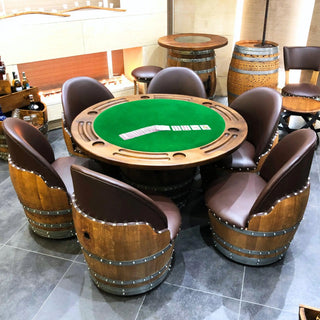
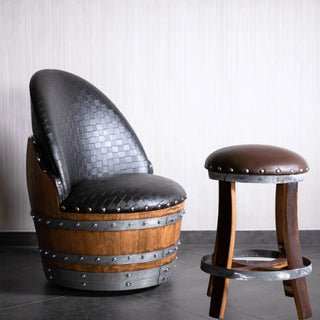
But the highest and best use, in our view, is furniture. A barrel that has been seasoned for years by real work is an extraordinary raw material for pieces meant to last generations. That is where our family workshop comes in.
| The rule | What it does to the bourbon | What it means for the barrel |
|---|---|---|
| Must be oak | Provides strength and flavor compounds | Yields dense, workable wood |
| Must be charred | Filters and sweetens the spirit | Leaves character-rich inner staining |
| Must be new | Delivers full wood intensity | Forces retirement after one job |
The second life: from barrel to furniture
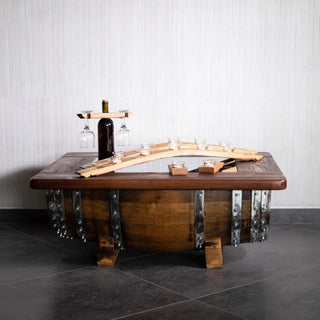
When a barrel reaches us, we treat it as the finished, seasoned oak it is. Our staves are 1-inch solid oak of the Bordeaux type — genuine wine wood carrying authentic staining. We hand-wirebrush the tops to raise and reveal the grain, then protect them with a durable spar varnish that preserves the wood's history while making it ready for daily life. Every piece is handcrafted in our American workshop, and because no two barrels lived identical lives, no two pieces are exactly alike.
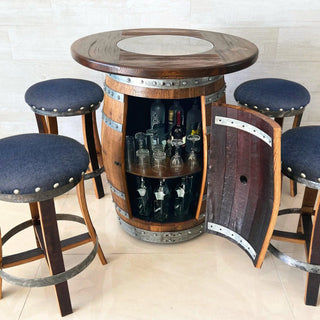
A home bar is the natural destination for this wood, because it brings the barrel's story full circle — the vessel that once aged spirits becomes the place you serve them. Browse our barrel bars and cabinets and you are looking at oak with a documented working past, not lumber milled from a tree last season. That provenance is the difference between furniture that is merely rustic and furniture that is genuinely historic.
The seasoning the barrel received during aging is precisely what makes it superb furniture material. Years of expanding and contracting through temperature swings left the wood dimensionally stable in a way freshly milled lumber never is. The staining runs deep because it was earned over time, not brushed on. When we hand-wirebrush a top to raise the grain and seal it with durable spar varnish, we are not manufacturing character — we are revealing character the barrel already earned. That is why no two pieces are identical: each one carries the fingerprint of a barrel that lived its own life.
Why the story is worth knowing
Understanding the "new charred oak" rule changes how you see a barrel. It is not an arbitrary regulation — it is the reason bourbon tastes the way it does, and the reason America produces a river of superb retired oak every year. Once you know that, a piece of barrel furniture stops looking like decoration and starts looking like conservation: a beautiful object that keeps an irreplaceable material in service instead of the scrap heap.
The next time you enjoy a pour, remember the two-part life of the vessel behind it. First, a single, intense, legally mandated career giving a spirit its soul. Then, in the right hands, decades more as a piece someone gathers around. The rule that ends the barrel's first life is exactly what makes its second one possible.
The bottom line
Bourbon must age in new, charred oak because that combination is what creates the color, flavor, and smoothness the spirit is known for — and because the barrel can only be used once for the job, retirement is inevitable. Far from the end, that retirement frees the wood for a longer, quieter purpose. In our workshop, a barrel's most enduring chapter is the one that begins after the bourbon is gone.
About Oak Wood Wine Barrels — A family workshop handcrafting authentic Bordeaux-oak Wine Barrel furniture. 4.9-star rated, 4,000+ orders shipped. Shop our collection at obarrel.com.