
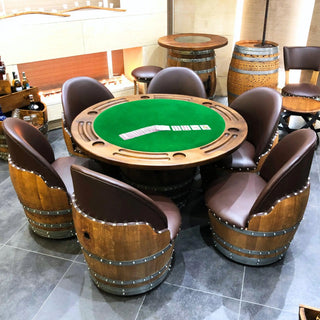
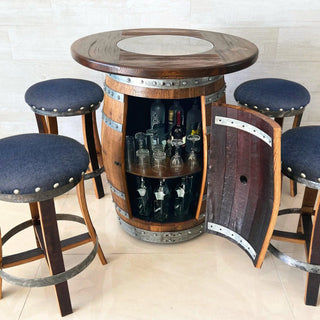
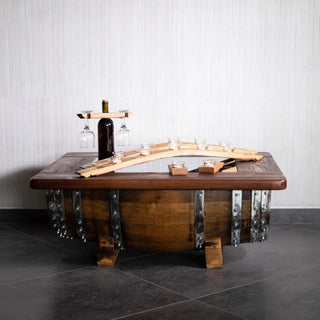
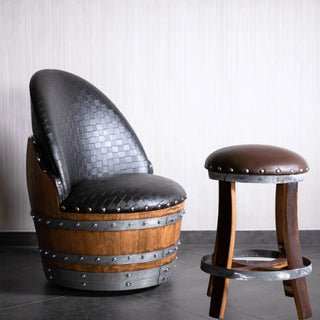
Wire brushed oak is oak whose softer spring-growth fibers have been raked out with a stiff metal brush, leaving the harder summer-growth ridges standing in relief. On authentic wine barrel furniture — the kind we build by hand in our family workshop — this technique exposes the natural grain of the same Bordeaux-type oak that aged wine for years, producing a tactile, dimensional surface that flat-sanded oak simply cannot match. The texture is not a stain, a print, or a stamp. It is the real anatomy of the wood, made visible.
Here are the answers we give, in the order they tend to come up.
What does "wire brushed" actually mean on a wine barrel stave?
Wire brushing is a mechanical surface treatment that removes the soft earlywood (spring growth) from the face of the stave while leaving the dense latewood (summer growth) intact. The result is a low-relief topography of ridges and valleys that follows the tree's growth rings. On a 53-to-59-gallon Bordeaux-type wine barrel, those rings are tight — French and American white oaks grown for cooperage are selected partly for slow, even growth — so the brushed pattern reads as fine, parallel striations rather than the wide swirls you would see on a fast-grown softwood.
How is the brushing done, by hand or machine?
In our family workshop, staves are hand-brushed with stiff steel-bristle brushes pulled along the grain direction. Machine wire-wheeling exists and is faster, but it tends to scoop the surface unevenly and round over the stave edges. Hand-brushing lets the maker stop when the softer fibers are gone and the hardwood ridges are clean — usually three to six passes per stave.
Why does wire-brushed oak look so different from sanded oak?
Sanded oak is uniformly flat. Light hits the entire surface at one angle, which reads as a single tone. Wire-brushed oak is dimensional, so light hits the ridges and valleys at different angles. The valleys hold micro-shadows, the ridges catch highlights, and the eye reads the surface as having depth even at three feet away. The same stave stained the same color will look two shades darker in the valleys than on the ridges, which is what gives wire-brushed furniture its hand-rubbed, antique character.
Is wire brushing the same as sandblasting or charring?
No, though all three are surface-relief techniques. Sandblasting uses high-pressure abrasive media and produces a more uniform pitted texture without grain directionality. Charring (sometimes called shou sugi ban on softwoods) burns the surface and then brushes away the carbon. Wire brushing alone preserves the wood's natural color and only removes the softer fibers, which is why it is the preferred technique for showing off oak grain rather than masking it. On wine barrel staves that already carry interior char from the cooperage toasting process, wire brushing the exterior face gives you two different surfaces on one piece of furniture.
Does the wire-brushed texture wear down over time?
Slowly, and mostly in good ways. The raised ridges are the hardest part of the wood, so they hold up to normal indoor use — fingers, glasses, a forearm resting on a bar top — without flattening for decades. What does happen is that the spar varnish topcoat builds a thin patina in the valleys, deepening the contrast slightly over the first three to five years. Heavy commercial bar tops in restaurants may see ridge softening at year ten to fifteen, at which point a light re-brushing and re-varnishing brings the texture back. Residential pieces in a man cave, sunroom, or basement bar typically never need this.
How do I clean wire-brushed staves without damaging the texture?
Dust with a soft natural-bristle brush or a dry microfiber cloth pulled along the grain direction, not across it. For spills, blot — do not wipe — with a barely damp cloth, then dry immediately. Avoid: paper towels (they shed fibers that snag in the valleys), spray polishes with silicone (they fill the texture and dull the contrast), and any abrasive pad. Once or twice a year, a soft toothbrush will lift out dust that has settled into deeper valleys.
What about water rings, wine stains, and grease?
For a dried ring on a brushed surface, a light pass with 0000 steel wool along the grain, followed by a fingertip dab of varnish, will blend it. Red wine that has sat overnight may stain a valley — usually a faint pink shadow that is part of the piece's story now, and most owners leave it. Grease responds to a drop of dish soap on a damp cloth, blotted not scrubbed.
How do I photograph wire-brushed staves so the texture shows up?
Side light is everything. Place a single light source — a window, a lamp, the sun coming through a sunroom — at 30 to 60 degrees off the stave face, not straight on. Straight-on light flattens the relief; raking light from the side casts micro-shadows in every valley and makes the grain pop. For Instagram or a designer portfolio, shoot in the hour after sunrise or before sunset when natural light is already raking. Avoid overhead ceiling fixtures, which kill the texture entirely. If you are shooting product, a single softbox at 45 degrees with a black flag opposite holds the contrast.
When does wire-brushed oak need a refresh, and what does that look like?
For indoor residential furniture, a refresh every eight to twelve years is generous. The signal is not loss of texture — it is loss of the satin sheen on the ridge tops, which start to look matte and dry. The refresh is one coat of spar varnish thinned 25 percent with mineral spirits, applied with a natural-bristle brush along the grain, then wiped back with a lint-free cloth before it tacks. This puts the sheen back without filling the valleys. Commercial bar tops in a tasting room or restaurant lounge may want this every three to five years depending on traffic.
Does the wire brushing affect how the wood ages or smells?
The brushing itself does not change the wood's aging chemistry — the oak still oxidizes, deepens in color, and develops a richer amber tone over decades exactly as a flat-sanded stave would. What brushing does is expose more surface area, which means the wood "breathes" more freely in the first months after assembly. New wine barrel furniture often carries a faint sweet-toasted oak smell from the cooperage process, and brushed pieces release that scent more noticeably for the first few weeks indoors. By month three to six, the smell has settled into the background and you will only notice it if you put your nose close.
Quick reference
| Question | Short answer |
|---|---|
| What is it? | Soft fibers raked out, hard ridges left standing |
| Sanded vs brushed look? | Sanded is flat; brushed has depth and shadow |
| Cleaning? | Dry brush along grain; damp blot for spills |
| Wear over time? | Ridges hold for decades indoors |
| Photographing? | Side light at 30 to 60 degrees |
| Refresh interval? | 8-12 years residential, 3-5 years heavy commercial |
| Affects wood aging? | No — only exposes more surface area |
| Wine stain? | Often becomes part of the patina |
Wire-brushed oak rewards a designer who understands what they are looking at. The texture is the tree's own growth record, the cooperage's selection of premium staves, and the maker's hand all visible on one surface. Treat it gently, light it correctly, and it will keep telling that story for as long as you own the piece. If you want to see how we hand-brush each stave before assembly, meet the family workshop here.