
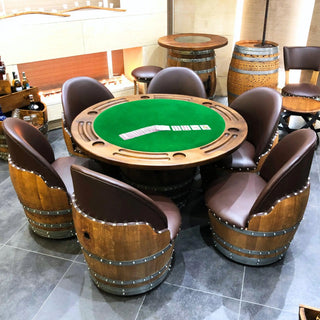
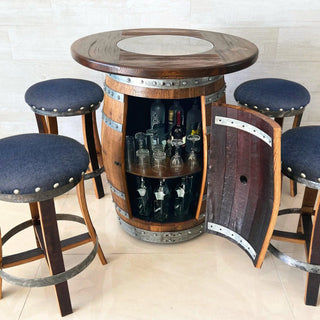
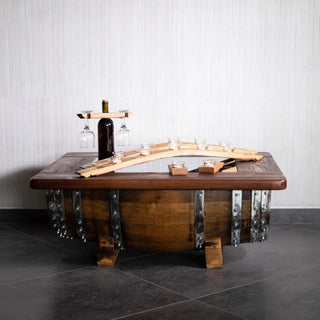
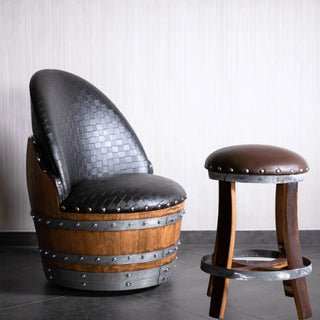
How long does barrel furniture last? Properly built wine barrel furniture made from authentic Bordeaux-type oak typically lasts 30 to 50 years indoors with normal household use, and well-maintained pieces routinely cross 75 years in service. The oak in a single 53-to-59-gallon wine barrel was already 80 to 150 years old as a tree, then air-seasoned for two to three years, then aged wine for two to five more years, then rebuilt into furniture by hands like those in our family workshop and finished for indoor use. By the time you put it in your sunroom or basement bar, the wood has been quietly proving its durability for over a century.
That is the short answer. The longer answer — covering what actually fails, when, and why — takes a bit more space. Here are the questions we hear from buyers who want the honest version, not the sales pitch.
Methodology
The lifespan ranges, year-by-year expectations, and failure-mode order in this post draw on three inputs: (1) the USDA Forest Products Laboratory's published decay-resistance ratings for white oak and related cooperage species, (2) our own family workshop's observations across 1,500-plus delivered pieces and the longer history of our customer correspondence, and (3) traditional cooperage trade publications on barrel construction and second-life durability. Where a stated range (for example "30 to 50 years") is given, it represents the realistic working window for an indoor-kept piece under normal household humidity and use, not a guarantee. Where a specific figure is cited (for example the wood's age and seasoning period), it reflects industry-standard cooperage practice rather than a measurement of any single piece.
Why does authentic wine barrel oak last so long?
Quercus oak species used in cooperage — French Quercus petraea and Quercus robur for Bordeaux-type barrels, American Quercus alba for whiskey and bourbon barrels — have closed-pore wood structure that resists moisture penetration, embedded grime, and microbial decay. The USDA Forest Products Laboratory rates white oak as Class 1 in natural decay resistance, alongside black locust and Eastern red cedar [Source: USDA Forest Products Laboratory, Wood Handbook, Chapter 14 — VERIFY current edition]. The wine aging process itself selectively reinforces the wood: tannins from the wine cross-link with lignin in the staves, producing a denser, more chemically stable wood than freshly milled oak of the same species.
Reproductions made from oak veneer over plywood, pine "barrel look" pieces, or thin-stock oak that was never in a barrel do not have these properties and tend to fail at the 8-to-15-year mark.
What is the most realistic lifespan estimate?
For an indoor piece — bar, table, chair, bistro set — placed in a stable-humidity space like a man cave, sunroom, basement bar, or three-season porch with climate control, the realistic working lifespan is 30 to 50 years. With one mid-life refinish (typically a varnish refresh somewhere between years 12 and 20) the upper end of that range becomes likely. Pieces that get heirloom treatment — kept indoors, dusted regularly, occasional varnish refresh — have been documented over 75 years in private collections.
Outdoor exposure cuts this dramatically. We do not position our pieces for outdoor use because UV, freeze-thaw cycling, and direct rain will degrade even marine-grade spar varnish within 3 to 7 years, requiring constant maintenance.
What fails first?
In order of likelihood:
- Finish dulling on high-touch surfaces (years 8-15): The spar varnish on bar tops, chair seats, and tabletops gets micro-abraded and loses its satin sheen. This is cosmetic, not structural. A refresh restores it.
- Minor hoop loosening (years 5-20): Indoor humidity shrinks the wood slightly; hoops can shift a half-inch and need re-seating with a rubber mallet. A 30-minute job covered in our repair guide.
- Squeaks in joints under load (years 10-25): Two staves rubbing under repeated weight. Wax fixes the cosmetic version; a hidden dowel fixes the structural version.
- Surface scratches from accumulated use (any year): Easily blended.
- Stave cracking (rare, year 30+): Only if the piece is kept in a very dry environment (sub-25 percent humidity) for years. Prevention is a small humidifier in winter.
What essentially never fails: the oak itself. We have never seen a structural failure of the stave wood in pieces under 50 years old.
What should I expect at year 5?
Almost nothing. A 5-year-old piece in an indoor space looks slightly more amber than the day it arrived (oak warms with age), and the spar varnish has settled into a softer sheen. You may have re-seated one hoop. The piece looks essentially new.
What should I expect at year 15?
The wood color has deepened noticeably — pieces that started honey-amber are now medium chestnut. The finish on the most-used surface (typically a bar top) may be due for a refresh, which is a 2-hour weekend project or a $150-300 job for a furniture refinisher. One or two hoops have probably been re-seated. The piece looks like a beloved heirloom rather than new furniture, which most owners consider an upgrade.
What should I expect at year 30?
If well-maintained: the piece looks like an antique in active use. Color is now rich chestnut to dark walnut tone. The varnish has been refreshed once or twice. Any squeaks have been pinned. The original character of the staves — the wire-brushed grain, the cooperage char marks on the interior, the original hoop placement — is all still there. This is the point at which insurers often start treating the piece as a valued antique rather than ordinary furniture.
Does the piece gain character or lose it over time?
Gains, in nearly every dimension that matters. Oak develops a richer color with age due to slow oxidation of tannins and lignin — a process the wine industry has understood for centuries. The texture of wire-brushed staves deepens as varnish settles into the valleys. Hoop placement settles into permanent wear marks that look intentional. Wine and water marks that occur in the first decade become part of the piece's story. Owners who have had their barrel furniture for 20+ years almost universally describe it as more beautiful than the day they bought it.
What does not gain character: dings from being dropped during a move, deep gouges from sharp objects, and water damage that was left untreated for weeks. These are repairable but require more work than light maintenance.
Why does authentic Bordeaux oak outlast reproductions?
A few reasons compound. First, the wood itself: cooperage oak is selected for tight, even grain (typically 8-12 growth rings per inch), which produces denser, more dimensionally stable lumber than the 3-6 rings per inch typical of furniture-grade oak. Second, the air-seasoning: cooperage staves are air-dried 24-36 months in the open, which equilibrates moisture content and relieves internal stress in ways that kiln-dried furniture lumber cannot match. Third, the wine aging: 2-5 years holding wine pre-conditions the wood and deposits tannins that act as natural preservatives. According to published cooperage research compiled by the Fédération Française des Tonneliers and similar trade bodies [Source: Fédération des Tonneliers de France data — VERIFY], this combination produces wood with measurably higher rot resistance and dimensional stability than equivalent freshly-milled oak.
Reproduction pieces skip all three steps. They start with whatever oak the manufacturer can source, kiln-dry it in weeks, and assemble it into "barrel-shaped" furniture with no wine aging. The resulting product looks similar at first glance but fails at joints, warps in changing humidity, and shows finish failure within a decade.
Should I worry about humidity, sunlight, or heat?
Normal indoor conditions are fine. Specifically:
- Humidity: 30-50 percent is ideal, in line with ASHRAE's published indoor comfort range [Source: ASHRAE Standard 55 — VERIFY scope]. If your home runs below 25 percent in winter (common in dry climates with heating), a small humidifier in the room with your barrel furniture prevents stave shrinkage.
- Sunlight: Direct UV will fade the finish and bleach the wood over years. Indirect light is fine. A sunroom-placed piece will color-shift slightly over a decade but is not harmed.
- Heat: Avoid placing a piece within 18 inches of a heating vent or fireplace. The localized drying causes one stave to shrink while neighbors do not, opening seams.
These are the same rules that govern any solid-wood furniture. Authentic wine barrel pieces are actually more forgiving than fine furniture in most environments because the cooperage construction allows the wood to flex with humidity changes.
What is the maintenance commitment over a lifetime?
| Year | Typical maintenance | Time required |
|---|---|---|
| 1-5 | Dust, blot spills | 5 min/month |
| 5-10 | Possibly re-seat one hoop | 30 min total |
| 10-20 | Varnish refresh on high-use surfaces | 2 hours, once |
| 20-30 | Address one or two squeaks; second varnish refresh | 3-4 hours total |
| 30-50 | Periodic touch-ups; full refinish optional | A weekend, once |
Total lifetime maintenance for a piece you will own for 30 years: somewhere between 8 and 20 hours of work. For furniture that will likely outlast its purchase price by an order of magnitude, that is a remarkably low commitment.
So — will it outlast me?
For most owners, yes. A wine barrel piece purchased in your forties will be passed down looking better than when you bought it. A piece purchased in your sixties will be a generational object. We have built furniture for grandparents who told us they were buying it for the grandkids — that is the kind of family-workshop continuity the trade still allows. That is not a marketing line — it is the honest math of what authentic Bordeaux oak does over time.
Sources referenced
- USDA Forest Products Laboratory — Wood Handbook, natural decay-resistance ratings for white oak
- Fédération des Tonneliers de France (French cooperage federation) — cooperage oak properties [VERIFY direct citation]
- ASHRAE Standard 55 — indoor environmental conditions for human occupancy [VERIFY scope]
- Wine science literature on oak/wine chemistry (Vivas, Glories and related researchers on tannin and lignin cross-linking)