
Zero Waste, Zero Compromise: The OWWB Sustainability Story
“Sustainable” is one of those words you hear everywhere now.
It’s on packaging. It’s on websites. It’s in product descriptions. And if we’re being honest, sometimes it starts to feel a little… overused.
Like everything is technically sustainable, depending on how it’s framed.
So instead of throwing that word around, it’s probably better to just talk about what’s actually happening.
Because with wine barrel furniture—especially at Oak Wood Wine Barrels—it’s not really about branding something as “eco-friendly.”
It’s about what you’re working with… and what you choose to do with it.
It Starts With Something That Already Exists
Most furniture begins the same way.
New wood gets cut, processed, shaped, finished, shipped.
That’s just how the industry works.
Wine barrel furniture doesn’t start there.
It starts with something that’s already been used
A barrel has already done its job.
It’s been part of a winemaking process—sometimes for years. It’s held liquid, aged with it, changed over time.
And eventually, it reaches a point where it’s no longer useful for that purpose.
That’s where most stories would end.
Instead, this is where a second life begins.
Reusing Material Isn’t a Trend—It’s Just Practical
There’s a tendency to make sustainability feel complicated.
Certifications, labels, processes, all kinds of things layered on top of it.
But at its core, it’s actually pretty simple.
You take something that still has value… and you don’t throw it away
That’s it.
And when you’re dealing with oak—material that’s strong, durable, and already proven it can last—that decision becomes even more obvious.
Because you’re not working with something fragile or temporary.
You’re working with something that still has years of life left in it.
Why “Zero Waste” Isn’t Just a Phrase Here
When people hear “zero waste,” they sometimes think it’s exaggerated.
Like it sounds good, but there’s always some level of waste involved.
And to be fair, in most industries, that’s true.
But with wine barrel furniture, the goal is a little different.
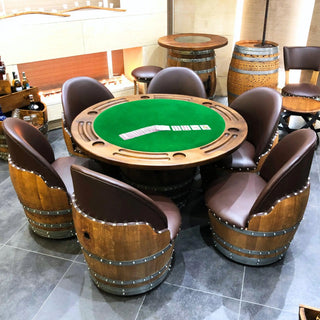
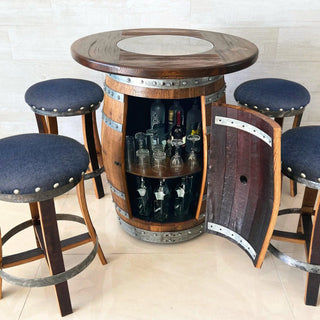
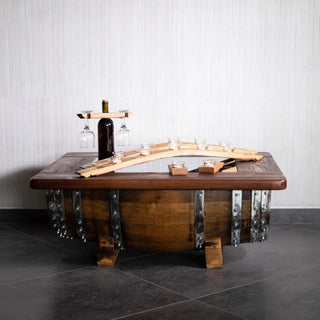
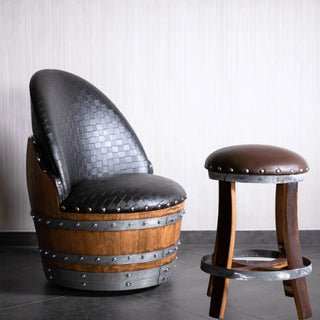
You’re not starting with raw material—you’re starting with a finished structure
That changes the equation.
Instead of cutting something down and shaping it into form, you’re working with something that already has form.
The staves. The curves. The structure.
So instead of creating waste, you’re preserving as much of that as possible.
And that’s where the “zero waste” mindset actually comes into play—not as a claim, but as a way of approaching the material.
No Compromise on Quality (This Part Matters More Than Anything)
Here’s where a lot of “sustainable” products fall short.
They focus so much on the process… that the end product feels like a compromise.
You get something that’s environmentally conscious—but maybe not as durable, or not as refined, or not something you’d actually choose otherwise.
That’s not the goal here.
It still has to be good furniture
Strong. Functional. Something you’d want in your space regardless of how it was made.
And this is where wine barrel furniture has an advantage.
Because the material itself—oak that’s already been used and aged—isn’t weaker.
If anything, it’s proven.
It’s already held up over time.
So you’re not sacrificing quality to make a better choice.
You’re starting with something that already meets that standard.
Why Longevity Is Part of Sustainability (Even If People Don’t Think About It That Way)
There’s another piece of this that doesn’t get talked about enough.
Sustainability isn’t just about how something is made.
It’s about how long it lasts.
A piece you keep for years is always better than one you replace every year or two
Even if the second one was cheaper.
Even if it was marketed as “eco-friendly.”
Because the cycle of replacing things over and over again creates its own kind of waste.
Wine barrel furniture tends to sit outside that cycle.
It’s heavier. More solid. Less likely to be something you swap out.
And that longevity becomes part of the story.
It Feels Different Because It Is Different
You can usually tell when something has a story behind it.
Not because someone explains it to you—but because it feels different.
There’s a certain weight to it
Not just physically, but in how it shows up in a space.
It doesn’t feel temporary.
It doesn’t feel like it was made to follow a trend.
It feels like something that already existed… and found its way into your home.
And that’s not something you can fake.
A More Natural Way to Think About Materials
A lot of modern furniture design focuses on control.
Uniform finishes. Identical pieces. Everything consistent.
Wine barrel furniture leans in a different direction.
It works with variation instead of trying to eliminate it
Different grain patterns.
Different tones.
Small marks that come from use.
Instead of treating those as flaws, they become part of the design.
And that shift—from controlling the material to working with it—is a big part of what makes the process more sustainable.
Where Oak Wood Wine Barrels Fits Into This
Oak Wood Wine Barrels isn’t just focused on creating furniture that looks good.
The process behind it matters just as much.
Sourcing. Selection. Preservation of material.
It’s about taking something that already exists and turning it into something functional without stripping away what made it valuable in the first place.
That’s the difference.
It’s not about creating something new from scratch.
It’s about continuing something that already had a life.
It’s Not About Being Perfect—It’s About Being Intentional
No process is completely perfect.
There are always variables. Always small differences. Always things that can’t be controlled 100%.
But the intention matters.
Choosing to reuse instead of discard
Choosing to work with existing material instead of starting over.
Choosing to create something that lasts instead of something that gets replaced.
Those choices add up.
Why This Matters More Now Than It Used To
People are paying more attention now.
Not always in a detailed, research-heavy way—but in a general sense.
They want to know where things come from.
They want to feel like what they’re bringing into their space has some level of meaning.
And this fits into that shift naturally.
Not because it’s trying to meet a trend—but because it already aligns with it.
At the End of the Day, It Just Makes Sense
That’s really what this comes down to.
You have a material that:
- Already exists
- Has already proven its durability
- Carries natural character
- Still has years of life left
And instead of discarding it… you turn it into something useful.
That’s not complicated—it’s just a better use of what’s already there
And when that results in something that looks good, works well, and lasts…
It doesn’t feel like a trade-off.
Our Links
- Explore sustainable wine barrel furniture collections — https://www.obarrel.com
- Shop handcrafted oak barrel tables, chairs, and décor — https://www.obarrel.com
- Browse reclaimed wood and barrel furniture pieces — https://www.obarrel.com
Other Resources to Check Out!
- EPA (Sustainable Materials Management & Reuse) — https://www.epa.gov
- Forest Stewardship Council (Responsible Wood Use) — https://www.fsc.org
- U.S. Forest Service (Wood Sustainability & Lifecycle) — https://www.fs.usda.gov
This blog post is for informational purposes only. While we aim to provide accurate and transparent insight into sustainability practices, sourcing methods, and material use, individual products and processes may vary. The reclaimed nature of wine barrels means that each piece may differ in appearance, structure, and characteristics. Availability, sourcing conditions, and environmental factors may also change over time. Always review product details and specifications directly to ensure alignment with your expectations and needs.