
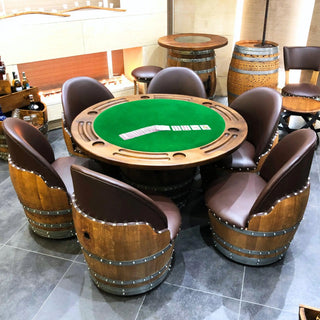
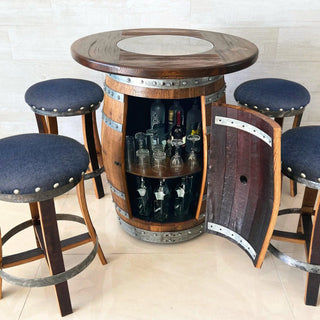
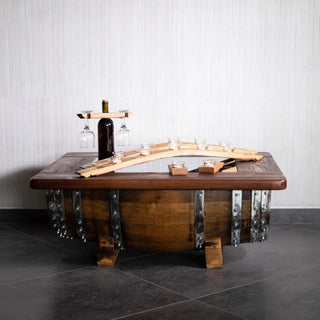
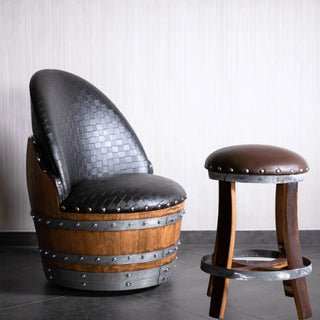
A home bar essentials list is usually padded with 20-plus items, most of which are nice-to-haves. The six items below are the ones that take a bar from "almost there" to "done." Each one solves a specific functional problem the bar itself cannot solve — footrest, seating, display, storage, ice, and atmosphere. Skipping any one of them is what produces the common feeling that a bar is "missing something." Each item below includes sizing criteria, price ranges, and what to actually look for. For curated picks from our family workshop, our favorites collection is here.
If you are still picking the bar itself, this slots into our broader 11 basement bar layouts walkthrough.
1. Footrail
A footrail is the brass or wood rail that runs along the base of the bar, 6-8 inches off the floor and 6-8 inches out from the bar face. It exists for one reason: standing and seated guests need somewhere to rest a foot. Without one, guests shift their weight every 5 minutes and look uncomfortable in every photo.
Sizing: Rail diameter 1.5-2 inches, length matching the bar front, height 6-8 inches from floor, distance from bar face 6-8 inches.
Materials: Solid brass (most traditional, $200-$500 for a 5-foot run), stainless steel (more modern, $150-$400), or solid oak to match a wood bar ($80-$200 if DIY, $200-$500 if commissioned).
Mistake to avoid: Mounting too low or too close to the bar. Both make the rail visible-but-useless. The rule: a person sitting at a stool should be able to comfortably rest a heel on the rail with the leg at roughly 60 degrees from the floor.
A 5-foot footrail in solid brass with brackets runs roughly $300-$450 retail. Worth the spend on any bar that gets actual use.
2. Bar stools
Bar stools determine whether the bar gets used or stared at. The two factors that matter most are seat height (matched to bar counter height) and backrest type (matched to how long guests will sit).
Seat height math: Counter-height stool seat = 24-26 inches for a 36-inch counter. Bar-height stool seat = 29-30 inches for a 41-42 inch counter. A built-around-a-barrel bar typically runs 41-42 inches at the countertop — bar-height stools, not counter-height.
Backrest: No back is fine for guests who sit for 15-30 minutes. Low back (lumbar only) is the sweet spot for 30-90 minute sessions. Full back is needed for 90-plus minute sessions, which most home bars get.
Sizing: 12 inches of horizontal space between stool centers (24-inch total space per stool). A 5-foot bar fits 2-3 stools comfortably; 4 is a squeeze.
Materials: Wine barrel stave stools (matched to a barrel bar) $200-$500 each; commercial-grade vinyl wrapped stools $150-$400 each; leather club-style stools $400-$900 each.
For most home bars, two stools is the practical maximum at one bar; if you need seating for four to six, add a separate lounge or pub table.
[Source: De Chiara, Panero, and Zelnik, "Time-Saver Standards for Interior Design and Space Planning" (McGraw-Hill), residential bar seating dimensions; Julius Panero and Martin Zelnik, "Human Dimension & Interior Space" anthropometric data on seat height and back-support geometry.]
3. Bottle display
A bottle display is where the home bar earns the word "bar." Without bottles visibly stored on or behind the bar, the piece reads as a piece of furniture in a room, not a bar. Three options work in residential space.
Option A: Back-bar shelving. Two or three shelves on the wall behind the bar, holding 8-25 bottles. Most common; works in most spaces. Add LED puck or strip lighting under each shelf.
Option B: Bar-top bottle rack. A wood or metal rack sitting on the bar countertop, holding 4-8 bottles. Best when no back-bar wall exists. Looks crowded if it holds more than 8 bottles.
Option C: Wall-mounted stave display. A reclaimed wine barrel stave mounted vertically as a 1-2-bottle accent display. Best as supplemental, not primary.
Sizing: A 30-inch wide shelf holds roughly 8 standard 750ml bottles spaced for easy grabbing. Two shelves cover most home bar needs.
Lighting: LED puck or strip lighting under each shelf at 2700K-3000K transforms the display from "shelf with bottles" to "bar focal point." Cost $20-$50 for plug-in versions; budget for it.
4. Glassware storage
Glassware in a kitchen cabinet 20 feet from the bar is the leading cause of bars that do not get used. Bring the glasses to the bar.
Hanging stem rack (overhead): The bartender's classic — wine and martini glasses hang from a rack mounted above or behind the bar, stems down. Holds 8-20 glasses depending on rack width. Looks the most "real bar." Requires 9-inch ceiling clearance below the rack so glasses do not interfere with the bartender's head.
Open shelf storage: Glasses upright on the same shelves as bottles (or a separate dedicated shelf). Easiest. Best for whiskey rocks glasses, highballs, and tumblers that do not need to hang.
Drawer storage: Lined drawer in the bar itself for glasses you do not want on display (everyday tumblers, water glasses).
Sizing: Plan 4-6 glasses per category you serve. A whiskey bar might need 8 rocks glasses; a wine bar might need 8 white wine glasses and 4 red wine glasses; a cocktail bar adds 6 coupes and 6 highballs.
Mistake to avoid: One huge set of universal glasses. Different drinks read better in different glasses; the right four shapes (rocks, highball, wine, coupe) covers 95 percent of what most home bars serve.
5. Ice handling and insulated pitchers
Walking to the kitchen freezer to scoop ice for every drink is the friction that kills a home bar's use rate. Solve it with an ice station at the bar.
Option A: Under-counter ice maker. Best for serious entertaining. Produces 25-50 lbs of ice per day, sits in a 15-inch wide cabinet bay, requires a water line and 110V outlet. Cost $1,200-$2,500.
Option B: Insulated ice bucket. Best for occasional entertaining. A double-walled stainless steel ice bucket holds ice for 4-6 hours without melting. Fill from the kitchen freezer at the start of the evening; refill once. Cost $50-$200.
Option C: Insulated thermal pitcher. For water service at the bar. Eliminates trips to the kitchen for water refills. Cost $40-$100.
Mistake to avoid: Skipping ice handling because the freezer is "right there." It is not; once a guest is at the bar, 20 feet to the freezer feels like a mile.
For a non-permanent setup, a high-quality insulated bucket + thermal pitcher combination runs $100-$300 and solves 80 percent of the problem.
6. Ambient lighting (not the main overheads)
A home bar with only overhead lights feels like a kitchen. Ambient lighting is what makes a bar feel like a bar — and it is the single most underspent category in most home bars.
Three light layers needed:
1. Pendants over the bar (2-3 fixtures, 32-36 inches above counter, 2700K-3000K, dimmable). Cost $80-$300 each.
2. Back-bar shelf lighting (LED puck or strip under each shelf, 2700K-3000K). Cost $20-$80.
3. Ambient room layer (wall sconces or table lamps in the lounge zone, no overhead direct). Cost $50-$300 per fixture.
Dimmer switches everywhere. Bar lighting should be variable from "prepping a cocktail" bright to "late conversation" dim. Single-pole dimmers cost $15-$30 each at any home improvement store.
Color temperature: Stay between 2700K and 3000K. Anything above 3500K reads as "office" and ruins the atmosphere.
Total realistic budget for proper ambient lighting on a home bar: $400-$1,200, depending on fixture quality. It is the single best dollar-per-impact upgrade after the bar itself.
[Source: Illuminating Engineering Society (IES), "The Lighting Handbook" (10th edition) and IES RP-29 on residential and hospitality lighting layers, recommended color temperatures, and dimming practices.]
[Source: National Sanitation Foundation / American National Standards Institute (NSF/ANSI) Standard 51 on food-zone materials and bar-tool surface requirements; American National Standards Institute bar and beverage-service equipment guidance.]
Summary table
| Item | Budget range | Why it matters |
|---|---|---|
| Footrail | $200-$500 | Comfort for standing and seated guests |
| Bar stools | $150-$900 each | Determines whether the bar gets used |
| Bottle display | $50-$400 | Makes the bar read as a bar |
| Glassware storage at the bar | $50-$300 | Eliminates kitchen trips |
| Ice handling | $50-$2,500 | Removes the biggest friction |
| Ambient lighting | $400-$1,200 | Transforms feel from kitchen to bar |
A finished home bar adds roughly $1,000-$3,000 in supporting pieces on top of the bar itself. That sounds steep until you compare it to the cost of a bar that nobody uses because it is too cold, too dim, too far from the ice, or too uncomfortable to sit at.
For our family workshop's curated picks across these categories — built around the same Bordeaux-type barrels we have shipped 1,527-plus times — our favorites collection is here.