
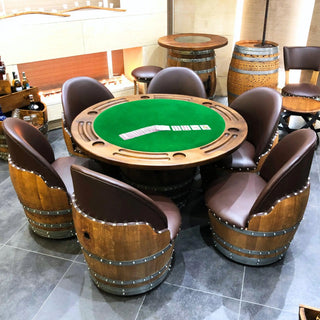
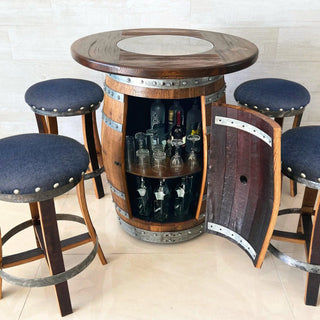
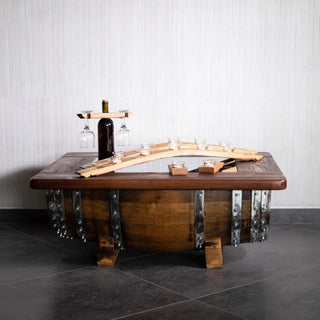
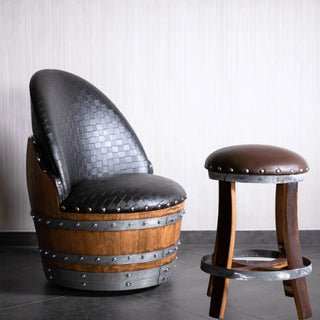
Home bar acoustic treatment is the single highest-impact upgrade most home bars never make. A basement or sunroom bar built with hard surfaces — concrete floor, drywall, glass, finished wood — produces a slap-back echo that makes conversation tiring within an hour and turns any audio into a wash of high-frequency harshness. The fix is not foam panels on the walls; it is a layered set of soft surfaces that disappear into the design. The steps below walk through how to do it without making the room look like a recording studio. Acoustics are one piece of the broader basement-bar design picture covered in our 11 basement bar layouts cornerstone post, and they pair directly with our 3-zone basement bar layout walkthrough. To anchor the room with a full barrel set that absorbs more than people realize, our full barrel set collection is here.
Time required: A weekend for major items; another weekend for fine-tuning. Skill level: Intermediate (some wall mounting; no electrical or framing).
Tools and materials
| Tool or material | Purpose |
|---|---|
| Tape measure | Room dimensions and material sizing |
| Decibel meter app (smartphone) | Before/after comparison |
| Drill, anchors, level | Mounting wall items |
| Stud finder | Locate solid mounting points |
| Painter's tape | Mock placements before commit |
| Wool or jute rug (8x10 min) | Floor absorption |
| Drapery (heavyweight, lined) | Window and wall absorption |
| Bookshelf with mixed-depth books | Diffusion |
| Upholstered furniture (sofa, chairs, ottomans) | Mid/low-frequency absorption |
| 2-4 framed canvas pieces | Disguised wall panels |
| Acoustic ceiling cloud (optional) | Direct overhead reflection control |
Step 1. Measure the problem first
Before adding anything, measure the room as it currently sounds. Open any decibel meter app, stand in the center of the bar, clap once sharply, and listen. A live room has audible ringing for 0.6 seconds or longer; a well-treated room rings for under 0.4 seconds.
Walk the perimeter and clap at each corner. The corners with the longest ring tail are bass-build-up points (typically the corner farthest from windows or openings). These are where bass traps, if you eventually add them, will do the most work.
Take a 30-second voice recording from the bar stool position. Save it. You will be glad to have an honest "before" reference when fine-tuning later.
Step 2. Start with the floor — biggest impact for the least visible change
The hardest surface in most home bars is the floor. Adding an 8x10 wool or jute rug under the lounge zone immediately drops reverb time by 0.1-0.2 seconds and cuts perceived harshness noticeably. Wool absorbs more than synthetic; jute looks rustic and matches well with reclaimed oak.
Two practical points: (1) Bigger is better — a 6x9 rug under a coffee table only is too small; the legs of all major furniture should sit on the rug. (2) A rug pad adds another absorptive layer; do not skip it.
Step 3. Add heavyweight drapery on any glass or echoing wall
Glass is the most reflective surface in a finished room. Even one window wall can dominate the acoustic signature. Heavyweight lined drapery (3-pass lining or heavier) hung 6 inches above the window frame and 12 inches wider than the frame on each side delivers serious absorption.
Drapery does not have to mean "fussy living room." Floor-length linen or canvas drapery on a black iron rod reads as masculine, modern, or rustic depending on the rest of the room. The acoustic effect is the same.
If you do not have windows, drapery on a wall — hung as a tapestry-style fabric panel — works almost identically. A 6x9 piece of upholstery-weight canvas hung as a wall hanging absorbs as much mid-frequency energy as a $400 acoustic panel.
[Source: Acoustical Society of America, Journal of the Acoustical Society of America (JASA) research on porous absorber performance of heavyweight textile drapery; ASTM C423 standard for sound absorption coefficient measurement.]
Step 4. Use bookshelves as diffusion, not decoration
A bookshelf packed with books of varying depth and height is one of the best diffusers in residential acoustics. The mixed surface depths scatter mid- and high-frequency reflections in a way that flat absorbers cannot. The recording studio version of this is a $1,200 wood quadratic diffuser; the residential version is a built-in bookshelf full of actual books.
For maximum effect: place the bookshelf on the wall opposite the bar (this is usually the wall that creates the slap-back echo from the bar countertop) and let the books project at varying depths. Avoid pristine matched book sets — the variety is what does the work.
Step 5. Disguise wall panels as framed art
If you need more absorption than rugs and drapery provide, fabric-wrapped panels mounted in standard wood frames look like canvas art and absorb like acoustic panels. Build them yourself or order pre-built "art acoustic panels" from a few specialty sellers.
A 24x36 panel placed at first-reflection points — the spots on the side walls where sound bounces from the speakers to the listener — does meaningful work. Find these points by sitting in your primary listening spot and having a helper walk a mirror along each side wall; mark the spots where you can see the speakers in the mirror.
Two panels per side wall covers the major reflection points. They do not need to span the whole wall.
Step 6. Ceiling treatment — the hardest sell, biggest payoff
The ceiling is the second-most-reflective surface in most basement and sunroom bars (after the floor). Most home bar owners avoid ceiling treatment because it looks industrial — but two disguised options work.
Option A: Ceiling cloud. A 2x4 foot fabric-wrapped panel hung 4-6 inches below the ceiling, centered over the seating area. From below it reads as a piece of architectural detail.
Option B: Coffered or beamed ceiling with fabric inserts. If you are renovating, frame a coffered grid and inset fabric-wrapped panels into the coffers. This looks intentional and architectural while doing real acoustic work.
For finished basements with limited ceiling height, even a single 4x8 piece of acoustic fabric stretched between two beams cuts ceiling slap dramatically.
Step 7. Hidden bass traps in the corners
Bass build-up in corners is the source of most "boomy" sound in basement bars. Standalone bass traps look exactly like recording studio equipment and ruin the aesthetic. Two hidden alternatives:
- Tall potted plants with dense leafy growth in the corners add some mid-frequency absorption and visually break up the corner.
- Floor-to-ceiling bookshelves in the corners, filled with books, function as a soft (though not deep-bass) corner trap.
For a serious music or home theater bar, you may eventually want real bass traps behind floor-to-ceiling drapery panels — the drapery hides the traps while letting them work.
[Source: GIK Acoustics technical guidance on corner bass trap placement and low-frequency absorption; RealTraps "Acoustic Treatment and Design for Recording Studios and Listening Rooms" white paper on residential room modes.]
Step 8. Furniture as treatment
Every soft furniture piece in the room is doing acoustic work. Upholstered sofas, fabric or leather club chairs, ottomans, and even barrel chairs with thick memory-foam upholstery absorb meaningful mid-frequency energy.
A full barrel set — bar, two stools, lounge chair, side table — built with hand-wire-brushed staves and finished with marine-grade spar varnish has more absorption than people expect. The textured stave surfaces scatter high frequencies, and the upholstered seats absorb mid frequencies. It is not the same as dedicated treatment, but it counts. Our family workshop's 1,527-plus shipped builds include a steady stream of customers who report that the room sounded noticeably calmer after the full set went in — a happy side effect of wire-brushed oak and upholstered seating.
[Source: Audio Engineering Society (AES) "Recommended Practice for Professional Audio - Subjective evaluation of loudspeakers in domestic listening rooms" on the acoustic effect of upholstery and textured wood surfaces in residential spaces.]
Our family workshop's full barrel sets are here — pieces designed to anchor a bar visually that happen to do acoustic work as a bonus.
Step 9. Measure again
After implementing 4-6 of the steps above, re-run the clap test and the 30-second voice recording. You should hear:
- Reverb ring dropped from 0.6+ seconds to under 0.4 seconds
- Voices sound rounder and less harsh
- Music sounds less "washed" and more localized
- One-hour conversations no longer end in vocal fatigue
If the room now sounds dead (no liveliness at all), back off — you over-treated. Pull one of the larger panels and listen again. The target is "warm and clear," not "studio dead."
Common mistakes in home bar acoustic treatment
Mistake 1: Overdamping. Foam panels on every wall produce a dead, lifeless sound that is actively unpleasant for conversation. The goal is reduced reverb, not zero reverb.
Mistake 2: Mounting treatment too low. Sound reflects off the upper portions of walls and the ceiling. Treatment should sit at ear height and above, not at baseboard level.
Mistake 3: Treating only the wall behind the speakers. First reflections come off the side walls and ceiling. The wall behind the speakers is usually the lowest-priority surface.
Mistake 4: Studio foam in a residential room. It works acoustically but looks awful and lowers home value. Fabric panels framed as art, drapery, rugs, and bookshelves do the same work without the studio look.
Mistake 5: Forgetting the floor. A bar with treated walls but a bare concrete floor still sounds harsh. The floor is almost always the largest single reflective surface.
Mistake 6: Ignoring the bass. Mid- and high-frequency treatment is what most DIY guides cover; bass build-up in corners is what most rooms actually need.
Quick recap
Measure the problem before buying anything. Start with rugs and drapery — biggest impact, lowest visual cost. Use bookshelves for diffusion. Hide panels as framed art at first-reflection points. Treat the ceiling, even if it is just a single ceiling cloud. Avoid overdamping. Stop when conversation is comfortable and music sounds clear.
For a barrel-anchored set that adds visual mass and meaningful absorption to the room, browse our full barrel sets here.