
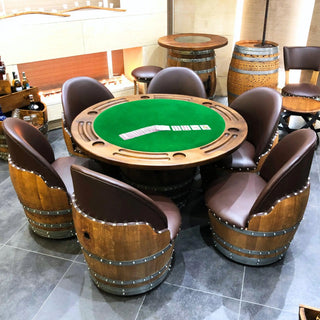
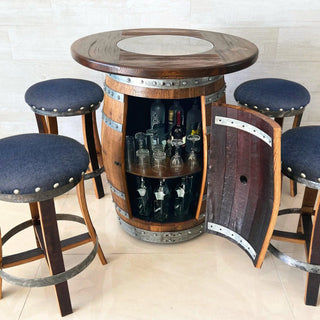

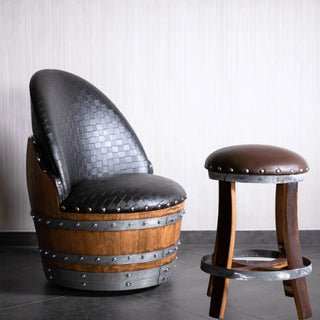
These are the nine questions to ask before buying barrel furniture from any workshop, marketplace seller, or retailer — covering sourcing, finish, damage on delivery, shipping, lead time, custom options, returns, dimensions, and weight. Each question below includes the right answer to listen for and the answer pattern that should make you pause. The list is built from the most common post-purchase complaints we hear in the category, almost all of which trace back to one of these questions not being asked up front. You can cross-check the answers below against our full lineup in the all-products collection.
If you've already read the Complete Buying Guide to Authentic Wine Barrel Furniture and How to Spot a Real Wine Barrel Chair (vs. a Lookalike), this checklist is the pre-purchase sequence to run before clicking buy.
1. Where do the barrels come from?
A real workshop will tell you the barrel's general source — typically a region (Bordeaux, Napa, Sonoma, Kentucky), a beverage history (red wine, white wine, bourbon, rye), and an approximate age (2-5 vintages). The answer doesn't need to name specific wineries (many sourcing deals are private), but it should be specific enough to confirm the barrel is real and reclaimed.
Good answer: "These are Bordeaux-type wine barrels, 53-59 gallon, retired from red wine production after 2-5 vintages. We source them through reclamation partners in California and France."
Pause if: The answer is "premium oak" or "imported oak" without any beverage or regional context. That language often means new oak boards milled to look like a barrel.
2. What finish do you use, and why?
The answer should be marine-grade spar varnish for any indoor barrel furniture that will see drinks, spills, or seasonal humidity changes.
Good answer: "Three coats of marine-grade spar varnish, sanded between coats. Spar stays slightly flexible, which matters on curved staves that move with humidity, and it handles drink spills better than standard polyurethane."
Pause if: The answer is vague ("a clear protective coat") or admits to wax-only finishing on a bar top. Wax alone will not survive normal drink use.
3. What happens if it arrives damaged?
Find out what the seller's policy is for damage in shipping and how long you have to report it. Barrel furniture is heavy and shipped by parcel or freight, so a clear inspection window is more important than a long warranty.
Good answer: "Upon arrival, check your order. If something is damaged or we made a mistake, tell us within 3 days with photos, and we will replace it free."
Pause if: The seller can't tell you how to report damage or how long you have to.
4. What is the lead time and shipping method?
Handmade barrel furniture is built in small batches. Heavy pieces (75 lb+) ship via freight on a pallet, not parcel. Curbside delivery is standard; white-glove placement is rare and usually extra.
Good answer: "In-stock standalone bars ship within 5 business days via freight to curb. Free shipping in the continental U.S. included. We notify you with tracking and an estimated delivery date once it's on the truck."
Pause if: "Ships in 24 hours" on a $1,500 handmade barrel bar. Either it's pre-built mass production (likely not handmade), or the shipping promise is unrealistic.
5. Can I customize it?
Most real workshops offer at least basic customization: branded heads, monograms, color staining, hardware upgrades, electrical pass-through for under-shelf lighting. Custom work usually adds 2-6 weeks of lead time and 15-40% of base price.
Good answer: "Yes — we can brand the head with your name or logo (laser-engraved), add a footrail, install electrical pass-through for under-shelf LED lighting, or build a matched pair of stools."
Pause if: No customization options at all on a "handmade" piece. That's a strong signal the piece is actually mass-produced.
6. What is your return policy?
Many makers of large, handmade pieces sell them as final sale, because it costs a lot to ship a heavy barrel piece back across the country. That means size, color and fit are the questions to settle before you order.
Good answer: "All sales are final, and that's in our written terms, which you can read before you pay. If it arrives damaged or we make a mistake, we replace it free when you tell us within 3 days of delivery."
Pause if: The return policy is not in writing before you pay.
7. What are the exact dimensions and weight?
A real workshop publishes the diameter (at the widest point, typically the bilge), the height (with the top installed), and the shipping weight. These matter because round freight items don't always fit through standard interior doors and stairwells, and freight delivery requires someone to move the piece from curb to room.
Good answer: "26 inches diameter at the bilge, 42 inches tall with the top installed. Ships at 145 pounds on a pallet — plan for two adults to move it from curb to room."
Pause if: Dimensions are vague ("approximately 24 inches") or weight is not disclosed at all. You need real numbers to confirm fit and plan delivery.
8. Will it fit through my door and down my stairs?
This is the question you ask yourself, not the workshop — but the workshop should be able to confirm clearance once you give them your door widths and stairwell turn dimensions. Most barrel bars are 24-26 inches diameter and clear standard 28-30 inch interior doors. Basement bulkhead doors and tight stair turns are the most common failure points.
Practical check: Measure your narrowest doorway and any stair turns. If the bar diameter plus 2 inches of finger clearance fits, it'll go in. If not, ask the workshop about delivery options before ordering.
Pause if: The workshop won't engage on fit questions or insists "it always fits." Round rigid furniture doesn't always fit, and reputable makers know that.
9. How do I care for it once it arrives?
A real workshop gives you specific care instructions: humidity range (35-55% relative), cleaning method (microfiber dry, mild soap for stains), refinishing cadence (light scuff and one fresh spar coat every 3-5 years on the top), and what not to do (no direct sun, no harsh chemical cleaners).
Good answer: "Indoor use only — basement, living room, man cave. Keep relative humidity between 35-55%. Wipe spills within a few minutes. Re-coat the top with marine spar varnish every 3-5 years."
Pause if: "No special care required." Not so with indoor Wine Barrel furniture.
The follow-up questions worth asking too
These are bonus questions that separate good workshops from great ones:
- Can you send shop photos or a behind-the-scenes look? A real workshop has nothing to hide and usually shares freely.
- Who actually builds these — is it really handmade by your family/team? Worth asking directly.
- Do you have customer photos in real rooms? Better than studio photos for understanding scale.
- What's the most common surprise customers report after delivery? A workshop that answers honestly (usually "heavier than expected" or "interior smell first few weeks") earns trust.
Summary scorecard
If you're cross-shopping multiple workshops, run this scorecard. A workshop that answers 8-9 well is worth buying from. A workshop that answers fewer than 6 well, or dodges any of them, is worth crossing off.
| # | Question | Workshop A | Workshop B |
|---|---|---|---|
| 1 | Barrel sourcing | ||
| 2 | Finish type | ||
| 3 | Damage on delivery | ||
| 4 | Lead time & shipping | ||
| 5 | Customization | ||
| 6 | Return policy | ||
| 7 | Exact dimensions/weight | ||
| 8 | Fit confirmation help | ||
| 9 | Care instructions |
How our shop answers these
For transparency, here's how Oak Wood Wine Barrels answers each:
- Sourcing: Solid oak Bordeaux-type Wine Barrels
- Finish: Spar varnish for protection
- Damage on delivery: Free replacement for damage or our mistakes reported within 3 days of delivery
- Lead time: In-stock orders ship within 5 business days; free shipping in the continental U.S.; larger orders delivered by appointment
- Customization: Call (832) 933-8787 to ask what is possible for your piece
- Returns: All sales are final (see our refund policy)
- Dimensions: Listed on every product page
- Fit help: Send us your doorway and stairwell measurements and we'll confirm
- Care: Indoor use only
We answer these questions because we built our reputation on answering them — and because the buyers who ask them are the ones who keep their pieces for decades.