
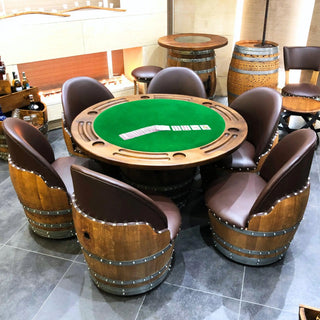
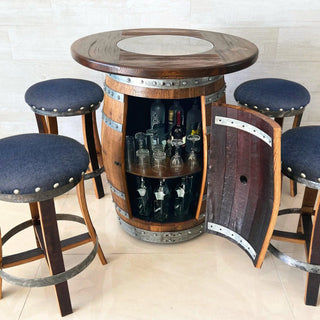
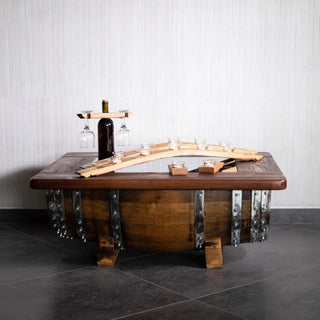
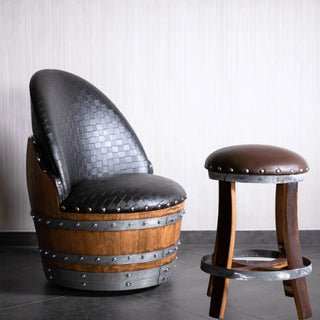
A built in barrel bar architect collaboration is a specification process where a wine barrel anchor piece is engineered into the millwork, plumbing, electrical, and HVAC of a finished space rather than placed as standalone furniture. The distinction matters: a freestanding wine barrel bar is a 1-2 week lead-time purchase that arrives, gets placed, and is done. A built-in barrel installation runs 8-16 weeks from architect's first drawing to final on-site assembly, requires coordination with the GC and the trades, and involves dimensional drawings, weight calcs, and pre-installation site visits. Our family workshop has shipped pieces into dozens of built-in projects (roughly 40+ since 2019, accounting for a small but high-engagement slice of our 1,527+ Etsy sales) in basement bars, finished lower-level lounges, and tasting rooms. The guide below covers the structural, mechanical, and scheduling realities. For project inquiries, contact our team at obarrel.com. For broader designer-and-trade context, see our designers specify authentic barrel furniture pillar guide, the P6 pillar hub.
This post is written for the architect, designer, or design-build GC who is specifying a barrel bar into an in-progress build. If you are a homeowner thinking about a built-in, share this post with your architect or design-build firm; the conversations below are the ones that need to happen before drawings get finalized.
Time required: 8-16 weeks total project timeline
Skill level: Professional (architect or design-build coordination required)
Lead time from our workshop: 4-8 weeks for built-in custom; 1-2 weeks for standard pieces
Step 1: Define Whether It Is Truly a Built-In
Many "built-in barrel bars" are actually freestanding barrel bars placed against a custom millwork wall. The distinction matters for cost, lead time, and complexity:
| Configuration | Description | Lead Time | Complexity |
|---|---|---|---|
| Freestanding | Barrel sits on floor; millwork behind/beside | 1-2 weeks | Low |
| Integrated | Barrel is anchored to floor and tied into adjacent millwork | 3-4 weeks | Medium |
| Fully built-in | Barrel is structural; plumbing, electrical run through; millwork wraps it | 8-12 weeks | High |
The fully built-in route is the smallest portion of our project volume but the most architect-driven. The integrated route is the most common for high-end residential.
Step 2: Lock Dimensional Specs Before Framing
The standard Bordeaux-type 53-59 gallon wine barrel we work with measures approximately:
- Height: 35 inches
- Diameter at the bilge (widest point): 27-28 inches
- Diameter at the heads (top and bottom): 22-23 inches
- Weight (empty, finished): 90-110 lbs
- Weight (with stave bar top and accessories): 140-180 lbs
For a built-in installation, the architect's drawings need to account for:
- Clearance to adjacent millwork: minimum 3 inches at the bilge to allow stave reveal
- Top surface height with stave bar top: 42 inches (standard bar height) requires the barrel to sit slightly recessed in the floor or on a 6-inch reveal-cut platform
- Floor load: 150-200 lbs concentrated; standard residential floor framing handles this without reinforcement, but slab-on-grade or commercial flooring is preferable
- Wall tie-in points: 2-3 anchor points to adjacent millwork at hoop locations
Send us a preliminary CAD or sketch with proposed clearances before final framing. We will return marked-up specs within 3-5 business days.
Step 3: Plumb and Wire Pass-Throughs
A built-in barrel bar with plumbing (a small bar sink or beer tap) or electrical (under-counter LED, a fridge below, a Glencairn warming drawer) requires pass-throughs through either the barrel head or the floor underneath.
Through-floor pass-throughs: Preferred for water and drain. The barrel sits over a 4-6 inch opening in the slab; supply, drain, and electrical come up inside the barrel and exit through a cut at the bilge.
Through-head pass-throughs: Used for electrical only. The top head of the barrel is removed during build, services are routed, and a sub-top is installed under the stave bar top.
The cuts must be specified on our shop drawings before the barrel is finished. Field-cutting a finished barrel is possible but not advised - the cut destroys the spar varnish seal and requires re-finishing on site.
Plumbing trades need to know: the barrel is reclaimed oak, not stainless. Any standing water inside the barrel will cause swelling and staining. We recommend a stainless or food-grade plastic basin liner for any built-in with a sink.
Step 4: HVAC and Humidity Coordination
The single most common failure mode for a built-in barrel bar is humidity drift. Reclaimed oak is dimensionally stable between 35-55% relative humidity. Below 30% RH, staves shrink and hoops loosen. Above 65% RH, staves swell and joints stress.
For built-in installations:
- Confirm the HVAC system holds 40-50% RH year-round (ASHRAE Standard 55 recommends 30-60% RH indoor for general occupant comfort; tighter 40-50% is the wood-furniture spec). Most finished lower-level spaces already do; check with the HVAC contractor.
- Avoid placing the barrel within 4 feet of a supply register that runs cold-and-dry in winter.
- Specify a hygrometer for the space (~$25) and include it in the punch list.
The full deep dive on indoor humidity for barrel furniture is in our humidity math post. The equilibrium moisture content (EMC) data the spec is built on comes from the USDA Forest Products Laboratory Wood Handbook (FPL-GTR-282), Chapter 4. Reference both in your spec book.
Step 5: Lighting Spec
Built-in bars almost always include integrated lighting. The recommended spec:
- Under-counter LED at 2700K, 400-600 lumens per linear foot
- Picture light or wall sconce above the back-bar at 2200K-2700K
- Optional in-barrel accent LED (a single warm-white strip inside the empty barrel, visible through a small reveal cut)
Cool-white lighting (3500K+) washes out the reclaimed oak tone and reads as restaurant-grade, not residential. Stick to warm.
Step 6: Pre-Installation Site Visit
For fully built-in installations, we coordinate a pre-installation site visit (or a video walkthrough with the GC) 1-2 weeks before delivery. The checklist:
- Confirm dimensions match shop drawings
- Confirm pass-throughs are roughed in correctly
- Confirm finished floor is level under the barrel position
- Confirm clearance for delivery (stairwell width, door height, elevator dimensions if applicable)
A 90-110 lb finished barrel does not require special handling, but a 35-inch-tall barrel with a stave bar top adds another 2-3 feet of vertical, which matters at landings and tight stairwells.
Step 7: On-Site Assembly
Standard barrels ship fully assembled. Stave bar tops, top rails, and accessory pieces ship separately and assemble on-site using our hardware kit. A two-person crew assembles a typical built-in barrel bar in 2-3 hours.
For fully built-in installations where the barrel is tied into adjacent millwork, the GC's finish carpenter typically does the millwork tie-in after we have set the barrel. We provide the anchor points and the dimensional spec; the carpenter executes the wrap.
Common Pitfalls Q&A
Q: What is the biggest mistake architects make on their first built-in barrel project?
The biggest mistake is treating the barrel as standard cabinetry. The barrel is a curved, reclaimed-wood, hand-finished piece. Tolerances are tighter than standard cabinetry on the dimensional side (the bilge is the widest point and varies barrel-to-barrel within a half-inch) and looser on the aesthetic side (each stave has unique wire-brush texture and color variation). Spec the average dimension and allow shop drawings to confirm the specific barrel.
Q: Can the barrel be cut for a custom shape?
Yes, with caveats. The top head can be cut out for an inset basin or a wine bucket recess. The bilge can be cut for a pass-through. The hoops can be removed and re-set. What cannot be done: removing more than 2 adjacent staves without compromising structural integrity, or splitting the barrel vertically (the curve depends on full-circumference compression).
Q: How does this affect the spar varnish finish?
Our standard exterior finish is spar varnish, which is UV-stable, water-resistant, and food-safe-once-cured. For a built-in with food service (bar sink, drink prep area), we apply additional coats on cut edges and pass-through openings. The interior of the barrel, if exposed, can be finished in matching spar varnish or left raw - the choice depends on whether the interior is visible.
Q: What is the warranty implication of modifying a finished barrel?
Standard warranty covers manufacturing defects on the as-built piece. Field modifications (cutting on site, drilling for plumbing not in the original spec) void the relevant portion of the warranty. The fix: spec all modifications upfront in the shop drawings.
Q: How do you coordinate with the GC's schedule?
The barrel is the slowest-lead item in a built-in bar build (4-8 weeks for full custom). It should be ordered as soon as architect's drawings are 80% complete. We can hold finished pieces in our workshop for 2-3 weeks while the GC catches up on adjacent millwork, but extended holds past 4 weeks accrue storage.
Q: What is the total cost premium for a built-in vs. freestanding?
Roughly 2-3x. A freestanding wine barrel bar in our catalog runs $1,200-$2,500. A fully built-in barrel installation, accounting for custom drawings, pass-through cuts, additional finishing, and pre-installation coordination, typically runs $3,500-$7,500 for the barrel piece alone, before GC and trade costs for the surrounding millwork and services.
Q: Are there commercial-code considerations?
For commercial installations (tasting rooms, restaurants, hospitality venues), local fire and health codes apply. The barrel itself meets standard residential code; the pass-throughs and the food-contact surfaces need to meet the local health department's wood-finish requirements. Spar varnish, fully cured, generally meets NSF/ANSI 51 food-equipment material standards and FDA 21 CFR 175.300 food-contact surface guidance once the cure is complete, but the specific accepted finish list varies by jurisdiction — confirm with local health authority and the relevant building code (most US jurisdictions follow IBC for commercial and IRC for residential) before specifying.
Q: Can you ship internationally for an architect's project?
Yes, on a per-project basis. Our standard offer is free U.S. shipping; international ships at-cost via freight. Lead time adds 4-6 weeks for ocean freight. Coordinate early.
Summary Specs for the Architect's Spec Book
| Spec | Value |
|---|---|
| Standard barrel dimensions | 35"H x 27-28" bilge x 22-23" head |
| Empty finished weight | 90-110 lbs |
| Loaded weight (with top, accessories) | 140-180 lbs |
| Floor load (concentrated) | 150-200 lbs |
| Bar top height (with stave top) | 42" |
| Adjacent millwork clearance | 3" min at bilge |
| Pass-through cut locations | Bilge or top head, spec on shop drawings |
| Finish | Spar varnish, multi-coat |
| Recommended interior RH | 40-50% |
| Recommended lighting | 2200K-2700K warm, 400-600 lumens/linear foot |
| Lead time (standard) | 1-2 weeks |
| Lead time (custom built-in) | 4-8 weeks |
| Warranty | Standard on as-built; field modifications void |
For a project inquiry, contact our team at obarrel.com. Share the architect's preliminary drawings (PDF or CAD) and the project timeline; we will return a feasibility note and a preliminary quote within 5 business days.
For the broader designer-and-trade resource set, see our trade-buyer FAQ and our designer specification guide.