
Short answer: Light reclaimed oak with warm, color-accurate LEDs (2700K to 3000K, CRI 90 or higher), directed across the wood at a low angle to show the grain and wine stains. Layer two or three sources on dimmers and keep heat and direct sun off the bottles. A horizontal piece such as Oak Wood Wine Barrels' 3-Bottle Stave Wall Rack ($175.50) is best seen under a picture light or with a strip of LED hidden underneath.
Prices as of October 6, 2026; each link shows live stock.
Why does the angle of light matter on reclaimed oak?
Because texture only shows up when light skims it. Lighting designers call this grazing: put the light close to the surface and point it along the wood, and every ridge of grain, saw mark and wine stain throws a tiny shadow. Light aimed straight at the wood fills those shadows and flattens that surface into a plain brown board.
Reclaimed barrel oak has more character than new lumber, including the wine stain. Wire-brushed tops, like the ones on our tables and round tops, lift the grain even more. That texture is the reason you want to pick barrel wood, so light it from the side, above or below, never straight on.
What color temperature flatters oak?
Warm white. The color temperature is measured in Kelvin (K):
- 2700K is the warm white of an incandescent bulb. That brings the amber out of the oak.
- 3000K is a bit crisper and still warm. It is a good choice if the room also has painted walls you want to look clean.
- 4000K and above is cool. It takes the warmth out of oak and can make it look gray.
- Candlelight is below 2000K, warmer than any standard bulb.
Also, check out the color rendering index (CRI). A CRI of 90 or higher makes wood tones and wine labels look almost as they would in daylight. Cheap strips with low CRI can make oak look muddy.
Which lighting schemes work for stave racks?
1. An LED strip under a horizontal rack
A warm LED strip beneath a horizontal rack throws light down across the bottles and grazes the wood below. Insert the strip into an aluminum channel with a frosted diffuser, or you will see a line of dots. LEDs put out very little heat at the light itself, so they can sit close to bottles.
2. A picture light over the rack
A picture light placed a few inches above a horizontal rack rakes light down the staves. Select one close to the length of the rack. The 3-Bottle Stave Wall Rack is 37.2 inches long. A light that's about that width will cover it evenly. Rechargeable models are easier to retrofit; hardwired lights can be put on a dimmer.
3. An angled spot on a vertical rack
A vertical rack like the 5-Bottle Stave Wall Rack ($247.50), at 37.2 inches high, is best served by one adjustable spot from the ceiling, directed down the length of the staves from slightly off-center. Don't point it straight on, which flattens the wood and puts glare on the bottles.
4. A soft wash for the whole room
A ceiling cove, a wall-washer or a single warm pendant provides base light for the room, so the accent lights don't create hard pools. Keep this layer dimmer than the accents; the racks should be the brightest thing in the room.
5. Candlelight on the tasting table
Nothing else gives that flicker. The Stave Candle Centerpiece ($24.95) holds five candles on a single Wine Barrel stave, votives included. Keep flames well away from bottles, labels and anything that can catch, and don't leave them burning in an empty room.
6. A lit display under glass
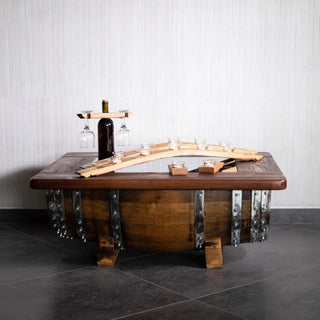
The Half-Barrel Coffee Table ($783) has a removable wood-and-glass top and a full-depth inside display. Set a tiny battery LED inside on a low setting, and it turns any bottles or corks you store there into a glowing centerpiece. Don't put a hot bulb in an enclosed space.
How do you put the layers together?
Use two or three of the above schemes, each with its own dimmer:
- Base light: the soft wash (4).
- Display light: strip (1), picture light (2) or spot (3) on every rack.
- Mood: candles (5) or the lit display (6) with guests in the room.
When you pull a bottle, turn the base up. When you pour for friends, turn it down. If all sources are at the same color temperature, the room looks designed rather than patched together.
What should you avoid near wine?
- Direct sun on bottles. Light can cause wine to develop off flavors, a fault called being light-struck, and clear or pale bottles are the most susceptible. Keep bottles out of the path of the window or use blinds.
- Hot fixtures near the racks. The warmest bottles are the ones closest to halogen and incandescent bulbs.
- Lights left on all day. Even LEDs are better switched off in an empty room.
- Mixed color temperatures in one view. A 2700K picture light beside a 4000K downlight looks like a mistake.
- Bare bulbs reflected in the finish. Our pieces are finished with spar varnish, which has a sheen. Point the lights so you see the glow on the wood, not the bulb reflected in it.
Which light suits which piece?
| Piece | Price | Shape and size | Light it with |
|---|---|---|---|
| 3-Bottle Stave Wall Rack | $175.50 | Horizontal, 37.2 in long | Picture light above or LED strip below |
| 5-Bottle Stave Wall Rack | $247.50 | Vertical, 37.2 in tall | One adjustable spot from above, slightly to the side |
| 9-Bottle Free-Standing Wine Rack | $490.50 | Free-standing on oak legs, 26 in wide, 26.2 in tall | A spot or lamp from one side so the curve casts a shadow |
| Half-Barrel Coffee Table | $783 | Display under a 35.4 in top | A battery LED inside, on low |
| Stave Candle Centerpiece | $24.95 | 37.2 in stave, five candles | Its own candlelight |
Sizes are ±5–10%, per the product pages. All Oak Wood Wine Barrels racks are handcrafted from Bordeaux-type oak Wine Barrels and finished with spar varnish. Wall racks have back hooks attached. Find more racks in Wall & Wine Racks.
To hang the racks first, see How to Build a Wine Wall Around a Reclaimed Stave Rack. See Wine Stave Rack Display Ideas for Cellars and Dining Walls for ideas on arrangement.
Frequently asked questions
What color light is best for a wine cellar?
Warm white between 2700K and 3000K with a CRI of 90 or higher so that wood and labels look true.
Is LED lighting safe for wine?
It's the standard choice, because LEDs produce very little heat at the light and very little UV. Nevertheless, turn off the lights when the room is empty.
How do you make the texture of reclaimed wood stand out?
Graze it. Put the light close to the surface and shine it across the wood, not straight at it.
Should wine cellar lights be on dimmers?
Yes. Bright helps when you're looking for a bottle; low makes the room feel like a tasting room when guests are there.
Can sunlight damage wine?
Yes. Light can cause off flavors, particularly in clear or pale bottles, so keep bottles out of direct sun.