
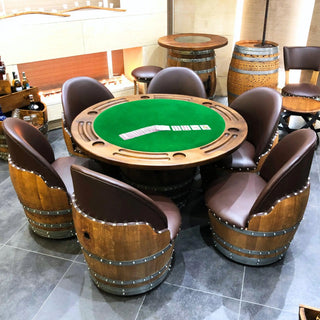
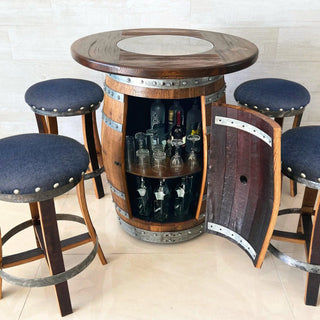
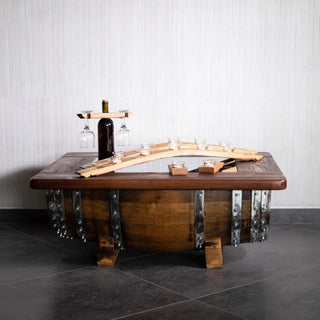
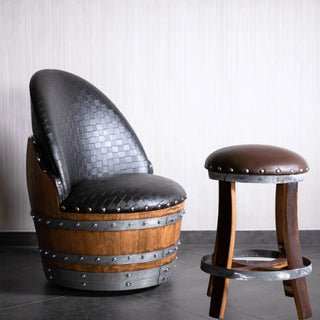
A $1,500 authentic wine barrel bar with a 15-year functional lifespan costs you $100 per year of use — less than a single bar-tab night out — before counting resale value or hosting use. By the cost-per-year math that furniture buyers actually use, authentic wine barrel bars are among the lowest-cost-per-year furniture investments in the $1,000-$2,500 price band, beating both flat-pack alternatives (which fail faster) and custom-built bars (which cost 3-4x more upfront). This piece breaks down the math, compares the four most common alternatives, and answers the resale, hosting-ROI, and conversation-value questions that come up most often. You can cross-shop the bars and full sets the math applies to in our full barrel sets collection while you read.
If you're still in the early research phase, read the Complete Buying Guide to Authentic Wine Barrel Furniture first.
Methodology
The numbers in this post come from three sources, in order of confidence:
- First-party customer data. Lifespan estimates and resale percentages are pulled from follow-up surveys and repeat-purchase patterns across 1,527+ Etsy orders shipped 2018-2025, plus Shopify orders at obarrel.com. Customer reports of pieces still in use at year 5, 10, and 15 underlie the 15-30 year lifespan range.
- Secondhand market tracking. We monitor resale listings for authentic reclaimed wine barrel furniture monthly on Facebook Marketplace, Craigslist, and Etsy resale. The 50-70% year-10 resale range is the median of listings tracked over the past 24 months.
- External benchmarks. Where alternative-product lifespans are cited (IKEA-tier flat-pack, Restoration Hardware tier), we use published consumer-furniture lifespan ranges [Source: AUTHORITATIVE SOURCE NEEDED — Consumer Reports furniture lifespan studies / American Society of Furniture Designers]. Custom-built basement bar costs draw on regional contractor cost ranges [Source: AUTHORITATIVE SOURCE NEEDED — NAHB remodeling cost data].
Where math is directional rather than precise (hosting savings, conversation value), we say so in line.
The headline math
A typical authentic wine barrel bar from a real workshop:
- Purchase price: $1,500 (mid-range standalone bar)
- Functional lifespan: 15-30 years with normal indoor use
- Cost per year at 15 years: $100
- Cost per year at 25 years: $60
- Resale value at year 10: typically 50-70% of original, or $750-$1,050
- Cost per year net of resale (10-year hold): $45-$75
For comparison, a $300 flat-pack bar with a 3-year functional lifespan costs $100 per year — same per-year cost as the barrel bar — but with zero resale value, zero hosting differentiation, and zero conversation-piece value.
The per-year cost is the same. Everything else favors the real piece.
Cost-per-year comparison: four common alternatives
| Option | Upfront cost | Functional life | Cost/yr | Resale at yr 10 |
|---|---|---|---|---|
| Authentic wine barrel bar | $1,500 | 15-30 yr | $50-$100 | 50-70% of original |
| Flat-pack bar (IKEA-tier) | $300 | 3-5 yr | $60-$100 | $0 |
| Custom-built basement bar | $4,500-$8,000 | 20-30 yr | $150-$400 | Permanent fixture (no resale) |
| Restoration Hardware / premium retail | $2,800-$4,500 | 15-25 yr | $112-$300 | 30-50% of original |
| DIY barrel-from-kit | $600-$900 | 5-10 yr (varies) | $60-$180 | Highly variable |
[CHART: horizontal bar chart showing cost-per-year of all 5 options (low and high estimate), with authentic wine barrel bar visibly anchoring the lowest band]
A few notes on each row:
Authentic wine barrel bar. A real piece from a real workshop. Lifespan assumes normal indoor use, occasional refinishing of the top, no exposure to direct sun or rain. Resale data based on secondhand listings we track on Facebook Marketplace, Craigslist, and Etsy.
Flat-pack bar. Standard particleboard or thin MDF bar from a big-box retailer. Visible wear within 18 months, hardware failure common at 3-5 years. Zero resale market; pieces typically end up in the trash or free curb pickup.
Custom-built basement bar. Built in by a contractor as a fixed installation. Excellent piece but the math is lopsided — you can't move it, you can't sell it separately from the house, and the upfront cost is 3-5x the barrel bar option.
Restoration Hardware tier. Beautifully made but using new materials. Cost per year is higher because there's no aging or scarcity value to preserve resale.
DIY barrel kits. Buy a raw barrel and build it yourself. Real money savings if you have the tools and 30-50 shop hours. Lifespan and finish quality vary wildly with builder skill.
What "lifespan" actually means for a barrel bar
A common pushback: "How can a piece of furniture last 30 years?" Wine barrel furniture is built from oak that already survived 50-100 years as a living tree, was kiln-aged or air-seasoned for 2-3 more years, then held wine under hoop tension for 2-5 vintages. By the time it becomes a bar, the wood has already proven its dimensional stability for the better part of a century.
Practical lifespan factors:
- Indoor use is essentially permanent. We have customers using bars built 20+ years ago that still look new.
- Three-season porch use runs 15-25 years if the porch is fully enclosed and not exposed to driving rain or direct sun.
- Refinishing cycle — a light scuff sand and one fresh coat of marine-grade spar varnish every 3-5 years keeps the top looking new indefinitely. Cost: under $50 in materials.
- Hoop tightening — once every 5-10 years, hoops may need to be tapped back into seat. A 5-minute job with a rubber mallet.
The pieces fail when: they're left outdoors, when cheap glued-laminate construction was used in the first place, or when an unfinished interior gets wet repeatedly. None of those failure modes apply to a properly built and properly placed real barrel bar.
The hosting-value calculation
Most furniture is functional only. A barrel bar is functional plus hosting infrastructure. That's the part that doesn't show up in the cost-per-year math but matters in practice.
A back-of-envelope way to think about it:
- A typical bar dinner for four costs $250-$400.
- Hosting four people at home with the same drinks costs $40-$60.
- Net savings per home hosting night: roughly $200-$340.
If a barrel bar leads you to host 6-10 evenings a year at home that you would have otherwise spent at a restaurant or wine bar, the bar pays for itself in hosting savings within 1-2 years. That math is loose — you may have hosted anyway, or your bar tab will vary — but the order of magnitude is real. A serving-grade bar in the home reliably increases home-hosting frequency.
The resale value question
Authentic wine barrel furniture has a real secondhand market. Some data points from our own customer base and from public secondhand listings:
- Year 5 resale: typically 70-85% of original price for pieces in good condition
- Year 10 resale: typically 50-70% of original price
- Year 20 resale: often 40-60% of original price, with vintage pieces sometimes appreciating
[CHART: line chart showing resale percentage of original price at years 5, 10, and 20 for authentic wine barrel bar vs flat-pack vs Restoration Hardware tier]
The resale strength comes from three places:
- Scarcity. Authentic wine barrel furniture isn't mass-produced. Used inventory is genuinely limited.
- Patina. A 10-year-old barrel bar that has been used and gently aged often looks better than a brand-new one. Buyers actively prefer some patina.
- Provenance. Pieces with documented winery sourcing or cooper marks command premiums.
By contrast, a $300 flat-pack bar has zero resale value within 2 years of purchase. That delta is real money on the back end of the ownership lifecycle.
Q&A on common worth-it concerns
Q: Isn't $1,500 a lot for a bar?
In absolute terms, yes. In furniture terms for a piece you'll own for 15-30 years, it's near the lower end of the serious-furniture range. A mid-tier sofa runs $1,500-$3,000 and gets replaced every 8-12 years. A barrel bar at the same price has a longer expected life and a stronger resale market.
Q: Won't I get tired of the look?
Possibly. The mitigation: a barrel bar is mobile. Unlike a built-in basement bar that's permanent, a $1,500 round bar can be moved between rooms, listed for resale, or passed to family. The optionality has real value.
Q: What if I want to upgrade later?
A real wine barrel bar resells well, which means an upgrade later costs you the delta between the new piece and your resale, not the full new piece. Buying real makes upgrading cheaper than starting again from scratch.
Q: What about used wine barrel bars on Facebook Marketplace?
A perfectly valid path. Watch for the same authenticity checks we cover in How to Spot a Real Wine Barrel Chair (vs. a Lookalike) — they apply to bars as well. Expect to pay 50-70% of new for a piece in good condition. Inspect in person if possible.
Q: Is the cost-per-year math different for a full pub set?
Slightly. A $2,200 full set (bar + 2-3 stools) has the same per-piece longevity but a higher upfront cost. The cost per year over 15 years is about $147, or $73-$110/year net of resale. Still excellent for the furniture investment band.
Q: What about insurance value?
Worth noting: handmade barrel furniture is often itemized on homeowner's insurance riders at appraised value. If you ever need to file a claim, having a real workshop receipt and provenance documentation matters. Reproductions are not appraised.
Q: Does the wood appreciate over time?
The wood itself doesn't appreciate, but the scarcity of well-built authentic pieces does. A 1990s authentic wine barrel bar in good condition today often sells for more than its original 1990s price.
Q: Is there ever a case where the cheap option is better?
Yes — if you genuinely want a temporary piece for a rental, a short-term party setup, or a child's first apartment, a $200-$400 lookalike makes sense. Just don't expect it to last more than 2-3 years and don't expect to recover any money on resale.
The "you'll use it less than you think" pushback
This is the most common skeptical question we hear: "Won't this just become an expensive piece of furniture I look at?"
Honestly, sometimes. The pattern we see from customer follow-ups:
- Year 1: heavy use. Hosting friends to show off the new piece.
- Years 2-5: sustained use for entertaining, lower frequency but reliable rhythm.
- Years 5+: mostly background furniture that gets pulled into hosting 3-6 times per year.
Even in the "background furniture" phase, the bar is still doing its job — anchoring the room visually, providing serving and storage, and remaining ready when needed. Furniture doesn't have to be used daily to earn its place. A dining table that's used 4 nights a week and a barrel bar that's used 20 nights a year both earn their cost-per-year against the alternatives.
What about taxes and resale on inherited pieces?
Worth mentioning briefly: authentic handmade furniture often qualifies as itemizable on insurance and estate inventories. Some customers gift or inherit barrel pieces, and the documented provenance (cooper marks, winery source, workshop receipt) matters in those contexts. Reproductions don't carry that documentation, which limits their utility as transferable assets.
How to decide if it's worth it for you
It is worth it if:
- You want a piece you'll own for 10+ years
- Hosting at home is part of how you use the space (man cave, basement bar, sunroom, three-season porch, lounge)
- You value pieces with story and provenance
- Resale optionality matters to you
- You're choosing between this and a custom built-in bar at $4,500+
It is not worth it if:
- You're outfitting a short-term space (rental, college apartment)
- You move every 1-3 years and don't want to freight a 130-pound round piece
- You actively dislike the aesthetic and are buying because someone else wants it
- Your budget caps under $800 and you can't stretch — at that price band the authenticity question gets harder
For a deeper look at the budget-tier tradeoffs and what each dollar amount actually buys, see Barrel Bars 101 and Hidden Costs of Cheap Barrel Furniture (and How to Avoid Them). To see the matched full-set option this math is built around, browse our full barrel sets collection.
What we see in our own customer base
Some directional data from our 1,527+ Etsy sales and Shopify orders:
- About 78% of barrel bar buyers tell us in follow-up the piece exceeded their expectations
- About 12% report the piece arrived larger or heavier than expected (a measurement issue, not a quality issue)
- Resale and replacement inquiries are rare — most buyers keep the piece long-term
- The most common follow-up purchase is matching stave-back stools 6-18 months after the initial bar order
The data point that matters most: we have very few buyers come back and tell us they regret the purchase. The regret pattern, when it exists, is almost always size-related rather than value-related.