
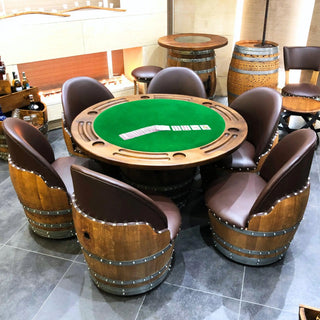
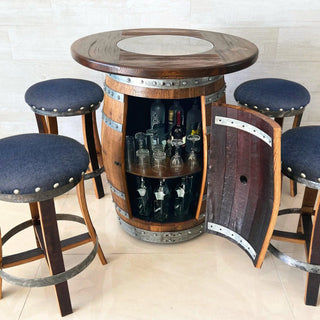
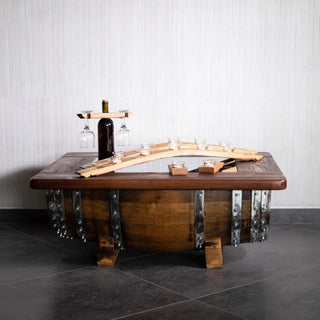
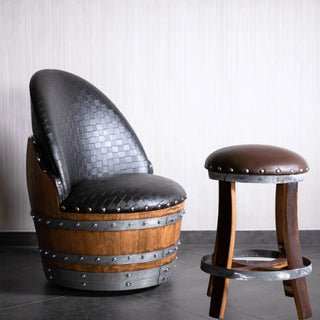
The best wine glasses for a home bar are a small, intentional set — a universal stem, a Bordeaux glass, a Burgundy glass, a white-wine glass, a flute or tulip for sparkling, and a small port glass — chosen for shape rather than brand cachet. Build the lineup around how you actually pour, then store the stems where they live: on a stem rack mounted to your wine barrel bar, or behind glass-front doors built into a barrel cabinet. We talk about this with customers every week in the workshop, and the right glassware does more for a barrel bar than almost any other upgrade. If your bar is built around our reclaimed-oak wall wine racks, the glass program below will sit naturally beside it.
A note before the list: glass shape matters because it directs aroma to the nose and wine to a specific part of the palate. The International Organization for Standardization published a normalized tasting-glass specification (ISO 3591:1977, "Sensory analysis — Apparatus — Wine-tasting glass") precisely because shape changes perception [Source: ISO 3591:1977, ISO Catalogue]. You do not need a dozen shapes. You need the right six or seven.
1. The Universal Stem (Your Daily Driver)
A universal wine glass is the one you reach for most nights — for many drinkers, the majority of pours. Bowl volume around 17–20 oz, a tulip-tapered rim, a medium-length stem. It handles a Tuesday Pinot Noir, a soft Chianti, or an aromatic white without overthinking. Buy six identical ones first. The workshop owners pour from a universal stem more than anything else, and our customers tell us the same. If you only ever bought one shape, this would be it.
Pair with: house reds, soft whites, anything by the glass.
2. The Bordeaux Glass (For Big Reds)
The Bordeaux glass is tall, with a generous bowl that narrows slightly at the rim — built to soften the tannin and lift the cassis and cedar in Cabernet Sauvignon, Bordeaux blends, Malbec, and bold Syrah. Bowl capacity is usually 21–25 oz. The height also makes a Bordeaux glass photograph beautifully against the dark oak of a barrel bar, which matters when you are pouring for guests.
Pair with: Cabernet, Bordeaux blends, Napa reds, Malbec.
3. The Burgundy Glass (For Delicate Reds)
The Burgundy glass is wider and rounder, with a tighter rim, designed to concentrate the aromatics of thin-skinned, perfume-driven varietals — Pinot Noir, Nebbiolo, Gamay, aged red Burgundy. The wide bowl gives the wine surface area to open up; the tapered rim funnels cherry, rose, and forest-floor notes to the nose. Burgundy glasses tend to be the most fragile in the lineup, which is one reason a behind-door cabinet earns its keep.
Pair with: Pinot Noir, Nebbiolo, Beaujolais, Burgundy.
4. The White Wine Glass (Cooler, Tighter, Smaller)
White wine glasses run smaller — typically 12–16 oz — with a narrower bowl that keeps the wine cool and preserves acidity. A Sauvignon Blanc, a Picpoul, an unoaked Chardonnay all show better in a glass that does not let temperature climb. Have at least four of these on hand. If you entertain in summer, have six.
Pair with: Sauvignon Blanc, Pinot Grigio, unoaked Chardonnay, Albariño.
5. The Oaked White / Chardonnay Glass
A slightly wider white-wine glass — closer in profile to a small Burgundy glass — for oaked Chardonnay, white Rioja, aged white Burgundy, and richer Rhône whites. The extra bowl softens the oak and lets butter and stone-fruit notes breathe. If you do not drink oaked whites often, skip this and use a universal stem.
Pair with: oaked Chardonnay, white Burgundy, Viognier, aged Semillon.
6. The Sparkling Glass (Tulip, Not Flute)
The flute is on its way out at most serious tables. Sommeliers increasingly pour Champagne and traditional-method sparkling into a tulip — a narrower white-wine shape — because the wider bowl releases the aromatics that a flute traps. Keep four. Use them for prosecco on Saturday and grower Champagne on New Year's Eve. The Comité Champagne (the official trade association of Champagne producers) has long recommended a tulip-shaped glass over the traditional flute for tasting because the wider bowl better releases the wine's aromatic complexity [Source: Comité Champagne, "Champagne and the Senses" tasting guidance, champagne.fr].
Pair with: Champagne, cava, prosecco, crémant, English sparkling.
7. The Dessert / Port Glass
A small, narrow stem — 6–8 oz — for fortified and sweet wines. Vintage Port, tawny Port, Sauternes, Madeira, late-harvest Riesling. Two or four is plenty. These also double for a small pour of aged spirit if you do not own a tasting glass yet, which makes them a versatile addition to a bar that bridges wine and bourbon.
Pair with: Port, Sauternes, Madeira, ice wine.
Summary Table: The 7-Glass Home Bar Set
| Glass | Bowl Size | Best For | Recommended Quantity |
|---|---|---|---|
| Universal | 17–20 oz | Daily pours | 6 |
| Bordeaux | 21–25 oz | Cabernet, big reds | 4 |
| Burgundy | 23–30 oz | Pinot Noir, Nebbiolo | 4 |
| White (standard) | 12–16 oz | Sauvignon Blanc, Pinot Grigio | 4–6 |
| Oaked white | 16–20 oz | Chardonnay, white Burgundy | 2–4 (optional) |
| Sparkling tulip | 8–12 oz | Champagne, prosecco | 4 |
| Dessert / port | 6–8 oz | Port, Sauternes | 2–4 |
A 26-glass set covers virtually every bottle a serious drinker opens at home, fits inside one cabinet, and leaves room behind it for a few decanters.
How to Store Glassware On and Around a Barrel Bar
Glasses break when they are hunted for. Build storage that puts each shape in its lane.
Under-counter stem rack. A two- or three-bay stem rack mounted to the underside of the bar top — inverted — keeps the universal stems and white glasses within arm's reach. Reclaimed oak holds a brass or stainless stem rack beautifully; pre-drill, do not force the screws.
Glass-front cabinet doors. If your wine barrel bar has an interior cavity, glass-front doors turn it into a display case for the Bordeaux, Burgundy, and sparkling glasses. They stay dust-free and visible. We build a number of our barrel bars with this exact configuration — customers love opening the door and seeing the lineup the way a sommelier sees a service station.
Drawer insert with felt dividers. For dessert glasses and any specialty shapes, a single shallow drawer with felt dividers keeps them upright and silent. This is also the right home for decanter funnels, foil cutters, and stoppers.
Stave-mounted wall rack. If counter space is tight, a wall-mounted stave rack near the bar holds eight to twelve stems vertically. It also visually anchors the room. Our wall wine racks are designed for exactly this kind of pairing — same reclaimed Bordeaux oak as the bar, same hand-wire-brushed grain.
Crystal vs. Glass: Does It Matter?
For a daily-driver universal stem, modern lead-free crystal (Tritan, Crystalline) is the sweet spot — thin rim, durable bowl, dishwasher safe. For your show pieces (Bordeaux, Burgundy, Champagne), a hand-blown lead-free crystal will be noticeably lighter and clearer, but it is also noticeably more fragile. Mix tiers: durable workhorses for Tuesday, fine crystal for occasions. The U.S. FDA regulates ceramic and crystal hollowware for lead leaching under 21 CFR Part 109, and California's Proposition 65 warnings have effectively pushed major manufacturers toward lead-free formulations for daily-use glassware [Source: U.S. FDA, "Guidance for Industry: Lead in Food, Foodwares, and Dietary Supplements"; California Office of Environmental Health Hazard Assessment, Proposition 65 listings].
Choose Your Setup If…
Choose a 12-glass starter set if… you are new to wine, mostly pour reds and whites, and want one universal + one Bordeaux + one white + one sparkling shape.
Choose the 26-glass full set if… you host monthly, drink across regions, and want every bottle in its right shape.
Choose the 40+ glass enthusiast lineup if… you run vertical tastings, store collectible bottles, and want backup of each shape so a broken Burgundy glass does not derail Saturday.
Care, Cleaning, and Why This Matters for the Bar
Wash crystal warm, rinse cold, dry with a lint-free linen. Never store glasses rim-down on bare wood — moisture trapped at the rim will eventually mark even sealed oak. Our barrels are finished with spar varnish for moisture resistance, but the right habit is still inverted on a stem rack or upright on a felt insert.
Build your glass program once, and it will serve the bar for a decade. The barrel will outlast the glassware twice over — our Bordeaux-type 53–59 gallon barrels are sourced from working wineries, hand-wire-brushed in our family workshop, and finished to live indoors for generations. The glassware is how the wine actually reaches the table. Treat it with the same care you brought to the bar itself.
For more on the wine-lifestyle decisions that come after the bar is built — stave rack installation, cellar design, dinner-party flow — start with our pillar guide on wine stave rack display ideas, the hub for the P3 wine-lifestyle series. And when you are ready to add storage above or beside the bar, the wall wine racks collection is the natural next piece.