
Your cart

Your cart is empty


Explore our range of products

The Complete Buying Guide to Authentic Wine Barrel Furniture (2026)

Wine barrel furniture is functional decor built from retired oak wine barrels — typically 53 to 59-gallon Bordeaux-type barrels that have already held wine for two to five vintages before being repurposed into bars, chairs, tables, cabinets, and storage pieces. A genuine wine barrel furniture buying guide should help you separate authentic, fully reclaimed barrel construction from glued laminate lookalikes, set realistic budgets for each category, and understand what one of these pieces will actually look and live like in a man cave, basement bar, sunroom, or three-season porch.

This guide is the hub for our barrel furniture coverage. It covers what an authentic barrel piece is, how it's built, the major product categories, what to inspect before buying, and how to budget. You can browse the full lineup of wine barrel pieces in our shop's all-products collection, or use the cluster links throughout this post — including Barrel Bars 101, How to Spot a Real Wine Barrel Chair, Bordeaux Oak vs. American Oak, and Are Wine Barrel Bars Worth the Price? — to drill into specific categories.

Who this guide is for

If you are furnishing a basement bar, building out a man cave, dressing up a sunroom, or sourcing a single statement piece for an indoor hosting space, this is for you. It is not a guide to whiskey-barrel novelty items at big-box retailers — those products almost never use full reclaimed barrels. The pieces discussed here weigh real weight, smell like real oak and wine, and are built from staves that aged actual wine for years before becoming furniture.


What "wine barrel furniture" actually means

A wine barrel is a sealed wooden vessel — almost always white oak — used to age wine. After a barrel is retired from a winery (most are pulled from service after 2-5 vintages because the oak influence fades), it can be broken down, cleaned, and rebuilt into furniture. Authentic wine barrel furniture is built from the staves, heads, and hoops of these retired barrels, not from new oak boards milled to look the part.

The result is a piece with a few non-negotiable characteristics:

  • Curved staves. Each stave was bent by steam and fire to form a barrel's bulge. That curve is permanent and cannot be faked with flat lumber.
  • Wine-stained interior. The inside of every stave is purple, deep red, or rust-brown from years of contact with wine.
  • Char marks or toast. Most barrels are fire-toasted inside by the cooper. You can see and smell the toast.
  • Iron hoops. Three to six rolled-steel bands wrap the body. On furniture, they are usually riveted in place.
  • Heads with cooper marks. The flat circular ends often carry the winery's burn-brand, lot number, or vintage stamp.

If a piece has none of these, it is not a real barrel — it is barrel-themed furniture made from cabinet-grade plywood or laminated oak strips. That distinction drives most of the price gap you'll see between $300 imports and $1,500-$2,500 handcrafted pieces.


How an authentic barrel piece is made

Understanding the build sequence makes the price tags rational. Here is how the family workshop at Oak Wood Wine Barrels builds a typical full barrel bar from a sourced Bordeaux-type wine barrel.

1. Sourcing

Retired wine barrels come from wineries that buy new oak each vintage and rotate older barrels out. The 53-59 gallon size is the global standard for fine wine — sometimes called a barrique (Bordeaux), a hogshead, or a standard wine barrel depending on region [Source: AUTHORITATIVE SOURCE NEEDED — Wine Institute / OIV barrel format standards]. We focus on Bordeaux-type barrels because the oak species and toasting profile produces darker stave coloring and tighter grain, which photograph and finish beautifully.

A reputable workshop tracks barrel provenance — you should be able to ask which winery a barrel came from, even if you do not need the answer.

2. Breakdown and cleaning

The cooper or shop hammer-drives the hoops loose, lifts the heads, and lays out each stave. The interior is scraped to remove tartrate crystals (the white wine-acid deposits) and lightly cleaned. The wine staining is preserved — it is the entire visual point of the piece.

3. Cut, shape, and joinery

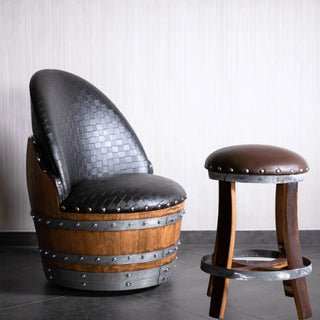
For a bar, the cooper rebuilds the body around an interior frame and adds a top, often using the original barrel head as the bar surface. For a chair, the upper third of a barrel is sawn off and cut into a half-moon back, with a hardwood seat platform built inside. For storage cabinets, doors are cut into the body and hinges mortised into the staves.

4. Sanding and wire-brushing

Staves are commonly hand-wire-brushed — this raises the grain, accents the toast lines, and removes loose splinters without erasing the historic surface. Then a multi-grit sanding sequence on contact surfaces (tops, seats, footrests) makes them smooth without sanding through the wine stain on visible faces.

5. Finishing

A quality piece is finished with marine-grade spar varnish. Spar is the right choice for indoor barrel furniture because it stays slightly flexible — important on curved oak that expands and contracts with the seasons — and it is far more drink-spill and humidity-tolerant than standard polyurethane. Typically three coats, sanded between.

6. Hardware and assembly

Hoops are re-set and either riveted or screwed. On bars, a footrail is often added in matching iron. Casters, hinges, glass racks, and electrical pass-throughs are added depending on the model.

Total build time runs 20 to 60+ shop hours depending on the piece. A full standalone barrel bar takes the longest. A simple barrel cooler or stave-art piece is much faster.


The major product categories

There are roughly nine categories of wine barrel furniture. Below is the comparison table to use when planning a room.

Category Typical price range Footprint Best for
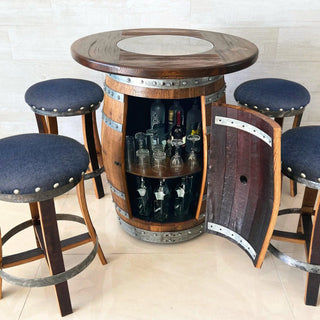
Single barrel bar (standalone) $1,200-$2,000 24" diameter, 42"-44" H Anchor piece in a basement or man cave
Pub set (bar + 2 stools) $1,500-$2,500 30-36" zone Tight bonus rooms, small lounges
Bistro / counter-height set $900-$1,800 30-36" zone Sunrooms, three-season porches
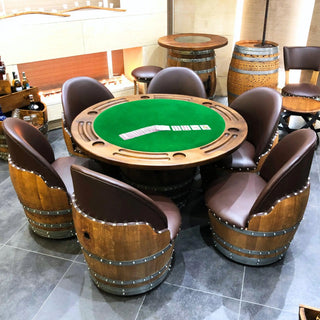
Barrel chairs $450-$900 each 26-30" W Reading nooks, fireside pairs
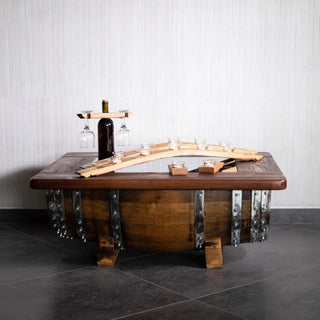
Coffee / wine tables $400-$1,100 Varies Lounge centerpieces
Wine racks (full / half barrel) $300-$800 Wall or floor Dedicated wine storage
Cabinets / liquor storage $700-$1,600 24"-30" body Hidden bar service
Coolers and ice tubs $250-$500 Tabletop or stand Hosting and parties
Stave-only pieces (art, shelving) $100-$400 Wall Accent decor on a budget

The pillar truth here: most rooms only need one or two real barrel pieces to read as a barrel room. Stack three or more and the look starts to feel themed rather than curated.


Authentic vs. reproduction: the six checks

Roughly 60-70% of "barrel furniture" sold online — especially on big-box marketplaces — is not built from a real barrel. Here are the six checks we recommend before any purchase.

  1. Stave curvature. Run your finger along an outside stave. It must curve continuously, not in flat segments.
  2. Wine staining. Ask for a photo of the inside surface. It should be purple, red, or rust-brown — not blonde oak or stain-painted.
  3. Hoop fit. Real hoops sit deep in cooper-cut grooves. Decorative hoops sit flat on the surface and are often visibly screwed on.
  4. Weight. A full single barrel bar weighs 100-160 lb. A "barrel bar" that ships under 60 lb is laminate or hollow.
  5. Smell. A real piece smells faintly of toasted oak and old wine. Glued plywood smells like glue.
  6. Provenance. A real workshop will tell you the barrel's general source (Bordeaux-type, ex-red wine, vintage range). Vague answers are a flag.

For a deeper inspection sequence, see How to Spot a Real Wine Barrel Chair (vs. a Lookalike).


Wood types: what to ask about

White oak (Quercus alba for American oak, Quercus robur / Quercus petraea for French/Bordeaux oak) is the only wood used at scale for wine barrels. Per the [American Oak Cooperage industry overview, Source: AUTHORITATIVE SOURCE NEEDED — Cooperage Cooperative], white oak's tyloses-blocked pores make it watertight without sealant — the reason it has been the global wine and spirits barrel wood for centuries [Source: AUTHORITATIVE SOURCE NEEDED — USDA Forest Products Lab characterization of Quercus alba tyloses].

You will see three primary lineages in barrel furniture:

  • Bordeaux / French oak — Tight grain, lower tannin, more aromatic. Common in fine wine barrels. Tends to finish darker.
  • American white oak — Wider grain, higher vanillin, more pronounced fire-toast. Common in bourbon barrels (per [TTB regulations, Source: AUTHORITATIVE SOURCE NEEDED — TTB.gov 27 CFR §5.143], bourbon must use new charred American oak). Janka hardness for white oak runs roughly 1,360 lbf [Source: AUTHORITATIVE SOURCE NEEDED — USDA Forest Products Lab Janka data].
  • Hungarian / Eastern European oak — Used in some European wines, increasingly available secondhand.

For the full breakdown including which one finishes better as furniture, see Bordeaux Oak vs. American Oak: What the Wood Means for Your Furniture.


Budget tiers: what each dollar amount actually buys

Under $400 — accent and entry tier

Stave art, single-stave shelves, small wall hooks, candle holders. These are great for testing the look in a room. Not structural furniture.

$400-$900 — chairs, small tables, coolers

A barrel chair lands in this band. So do coffee tables built from a half-barrel, wine racks holding 8-16 bottles, and ice tubs. Solid pieces that pair well with existing furniture.

$900-$1,800 — single bars and bistro sets

This is where standalone barrel bars start. A counter-height or pub-height bar with two matching stave-back stools generally lives at the lower end of this band; a full single barrel bar with footrail, glass rack, and integrated storage lives at the upper end.

$1,800-$2,500+ — full sets and statement pieces

Full barrel sets (bar + 2-4 stools), large cabinets with electrical pass-through for lighting, multi-barrel installations, custom-built pieces. These are anchor pieces that define a room.

For a cost-per-year analysis of whether the higher-tier bars hold their value, see Are Wine Barrel Bars Worth the Price? A Cost-Per-Year Breakdown.


Sizing for the room you actually have

A common mistake: buyers fall in love with a piece online without measuring the room. The most common regrets we hear about are barrel pieces that arrived larger and heavier than expected. Use the table below as a quick fit check.

Piece Approx. diameter / footprint Clear floor needed around it
Single barrel bar 24"-26" round 36"-48" walk space in front, 18" behind
Pub set with 2 stools 30"-36" working zone 48" front clearance for seated guests
Bistro / counter-height bar 28"-32" round 36" front clearance
Barrel chair 28"-30" W 30"-36" clear in front
Barrel cabinet 24"-30" W Door swing or drawer pull-out distance

Three-season porches and sunrooms generally need 8x10 ft minimum to comfortably hold a barrel bar set. Basement bars work in as little as 8x8 ft with a corner placement. For 11 worked basement layouts, see 11 Basement Bar Layouts Built Around a Single Barrel.


Construction details to inspect before buying

These are the details that separate a 15-year piece from a 3-year piece.

Top attachment

On a barrel bar, the top should be screwed or doweled into a hardwood frame that bears on the staves — not glued to the top hoop. Glued-only tops eventually pop.

Hoop fasteners

Hoops should be either pinned with cooper rivets or screwed into the staves at every stave. Hoops that only have 2-4 screws total will eventually shift.

Interior framing

A real bar has a hardwood interior frame holding the staves in compression. Without it, the staves rely entirely on the hoops, which is fine for a wine barrel under hoop tension but not ideal for a piece that will be loaded with bottles, glassware, and elbows.

Finish coverage

Look at the inside surfaces of doors and the underside of the top. If those are unfinished bare wood while the outside is glossy, the piece will absorb moisture unevenly and the staves can cup over time.

Hardware grade

Hinges and door pulls should be solid metal. Stamped sheet-metal hardware on a $1,500 piece is a tell that the maker cut corners somewhere they thought you wouldn't look.


Care basics (the short version)

Wine barrel furniture is easy to care for if you treat it like fine furniture. These are indoor pieces — barrel furniture should live indoors or in fully enclosed three-season spaces; direct sun and rain will damage the finish and shrink the staves.

  • Dust weekly. A microfiber cloth is fine. The wire-brushed surfaces trap dust.
  • Spill cleanup. Wipe spills off the spar varnish within a few minutes. Spar handles spills, but standing liquor will eventually mark even the best finish.
  • Re-coat the top every 3-5 years. A light scuff sand and one fresh coat of spar varnish keeps a bar top looking new indefinitely. Marine spar varnish is preferred for its UV inhibitors and elasticity on curved oak [Source: AUTHORITATIVE SOURCE NEEDED — National Wood Flooring Association / marine coatings industry guidance].
  • Humidity. Aim for 35-55% relative humidity. Below 30% the staves can shrink and the hoops loosen; above 65% the wood can swell [Source: AUTHORITATIVE SOURCE NEEDED — ASHRAE indoor humidity guidance for hardwood furniture].
  • Never refinish the inside. The wine staining is the value. Sanding it off destroys what you paid for. Cured spar varnish is considered food-safe for incidental contact once fully cured [Source: AUTHORITATIVE SOURCE NEEDED — FDA 21 CFR §175.300 / finish manufacturer SDS].

How to buy (the short version)

  1. Pick the anchor piece first. A bar, a pair of chairs, or a coffee table. Build the rest of the room around it.
  2. Confirm the maker is a real workshop. Ask where the barrels come from, ask for shop photos, look at long-form reviews — not just star counts.
  3. Verify lead time and shipping. Handmade barrel furniture is typically built to order. A 1-2 week lead time is normal for in-stock pieces; 4-8 weeks for custom.
  4. Confirm warranty. A real maker stands behind the joinery for at least 1 year. Many will repair pieces indefinitely for the cost of shipping.
  5. Measure your room and your doorway. A barrel bar is round and rigid. Standard 30" interior doors are fine; 28" doors are tight; basement bulkheads are case-by-case.
  6. Plan for the freight. Pieces over 75 lb typically ship via freight, not parcel. Make sure someone will be home to receive it.

A note about the workshop

Oak Wood Wine Barrels is a small family workshop. We have shipped 1,527+ orders through Etsy at a 4.9-star Star Seller rating, with a 94-product Shopify catalog at obarrel.com spanning $50 stave accent pieces to $2,500+ full barrel sets. We source Bordeaux-type wine barrels (53-59 gallon) and finish every piece in marine-grade spar varnish. Free U.S. shipping on most items; lead time is typically 1-2 weeks for stocked SKUs.

We are deliberately small. Every piece is built and inspected by family. That is why we can answer barrel-source questions, why our hoops are pinned at every stave, and why we still re-coat finishes by hand.


See also (P1 cluster)


FAQ

Are wine barrel furniture pieces safe for indoor use around food and drinks?
Yes. The barrels held wine — a food product — for years before being repurposed, and the spar varnish finish is considered food-safe once fully cured [Source: AUTHORITATIVE SOURCE NEEDED — FDA 21 CFR §175.300 / finish manufacturer SDS].

Can wine barrel furniture go outside?
No, not as a default. These pieces are designed for indoor spaces, man caves, basements, sunrooms, and fully enclosed three-season porches. Direct sun and rain will damage the finish and the wood within a season or two.

How long does an authentic wine barrel bar last?
A properly built barrel bar from a real workshop should last 15-30+ years with normal care. Periodic refinishing of the top extends the life indefinitely.

Will the bar smell like wine?
There is a faint oak-and-wine aroma when the piece is new. It fades to almost nothing within a few weeks of being in your home.

Do the hoops ever come loose?
On a well-built piece with pinned or screwed hoops, no. On glued-laminate reproductions, yes — frequently within the first year.

Previous post
Next post
Back to Our Blogs

Leave a comment

Please note, comments must be approved before they are published