
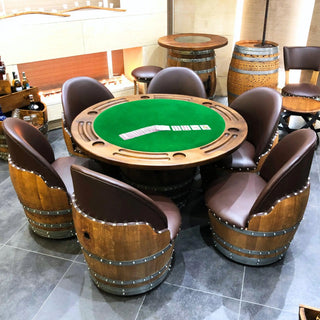
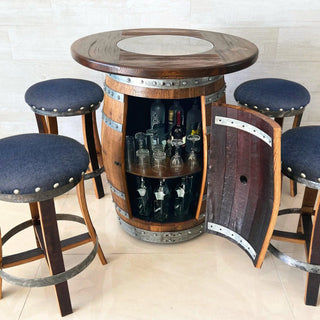
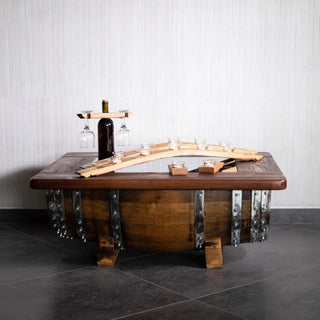
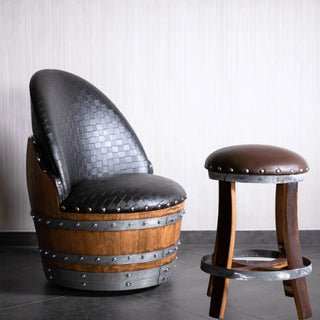
Wine barrel vs. whiskey barrel for furniture is the choice most bourbon collectors don't realize they have until they start shopping. The default assumption — "I drink bourbon, so my bar should be built from whiskey barrels" — is intuitive and almost always wrong. Wine barrels are thicker-staved, denser-grained, more dimensionally stable indoors, more available from working cooperages, and (counterintuitively) the wood many high-end bourbon producers themselves choose for furniture in their tasting rooms. This piece lays out the side-by-side, then answers the questions buyers actually ask once they start considering the wine-barrel option — the same authentic Bordeaux-type pieces in our full catalog.
The comparison at a glance
| Factor | Wine barrel oak | Whiskey / bourbon barrel oak |
|---|---|---|
| Typical barrel size | 53-59 gallons (Bordeaux/Burgundy) | 53 gallons (American standard) |
| Stave thickness | ~25-27mm (~1 inch) | ~22mm (~7/8 inch), often planed to 5/8 inch in furniture |
| Wood species | Mostly French or American white oak (Quercus) | American white oak (Quercus alba) |
| Char on interior | None (toasted, not charred) | Yes — visible blackened interior |
| Color (interior face) | Warm reddish-brown wine staining | Black char, amber where exposed |
| Smell | Faint wine, often imperceptible after finishing | Stronger bourbon/vanilla aroma |
| Grain | Tight, dense, often more uniform | Open grain with visible char layer |
| Indoor dimensional stability | Excellent | Good, but more variable due to char layer |
| Availability for furniture-grade barrels | Strong (active cooperage) | Tighter (high demand from craft distillers reusing barrels) |
| Typical use in fine furniture | Cabinets, bars, tables, chairs | Same, plus rustic/char-feature pieces |
The two materials look different, feel different, and behave differently as furniture over decades. Both are oak; that's where the similarity ends.
Why thicker staves matter for furniture
A standard Bordeaux-type wine barrel uses staves around 25-27mm thick (roughly 1 inch). American Standard Barrels (ASBs) — the 53-gallon barrels used for bourbon and most American whiskey — use staves around 22mm (about 7/8 inch), and when planed flat for furniture use, they often finish at 5/8 inch or less. The Independent Stave Company, the largest American cooperage, publishes ASB specifications that confirm the thinner stave standard.
What that means in practice:
- Cabinet shelves built from wine-barrel staves carry heavier bottle loads (10-20 bottles per linear foot) over decades without measurable sag.
- Bar tops built from wine-barrel staves hold their flatness better; they're less likely to develop the gentle warp that thinner whiskey-barrel staves can show after a few seasons of indoor humidity swings.
- Chair legs and bar stool legs built from wine-barrel staves are structurally stiffer for the same cross-section, which matters for seating that has to hold adult weight over the long term.
For furniture pieces that bear weight or span open distances, the thicker stave is the engineering answer.
Why bourbon drinkers care about the wine-stain interior
The inside face of a wine-barrel stave carries a warm reddish-brown stain from years of wine contact. Hand wire-brushing brings out the grain and lifts the surface; a spar varnish finish locks the color and the texture in. The result is a surface that reads warm and characterful without the visual heaviness of black char.
Bourbon collectors who've shopped both report the same thing: the wine-stained interior reads as a "host" surface for the amber of the bourbon bottle, where the black char of a whiskey-barrel furniture piece can fight the bottle visually. The bottles are the point; the furniture should frame them, not compete.
Why availability favors wine barrels
Used whiskey barrels are a contested resource. The same barrels are sold to Scotch, Irish whiskey, rum and tequila producers for second-fill aging after their first fill at a Kentucky bourbon distillery (by law, American bourbon must be stored in charred new oak containers, codified at 27 CFR 5.143). The result is that "furniture-grade" intact whiskey barrels are increasingly rare and often priced accordingly.
Working wineries, by contrast, retire barrels on a more predictable cycle and have less downstream resale demand. That makes furniture-grade wine barrels more consistently available — and consistently available at quality grades a cooper can verify, with intact heads, sound staves, and visible cooper marks.
Common questions bourbon buyers ask
Does wine barrel furniture smell like wine?
Wine barrel furniture has only the faintest wine aroma — and after the standard spar-varnish finish, most people can't detect it at all. The wine residue is in the surface fibers of the inner stave face, not throughout the wood. Finishing seals it. Place the finished cabinet in a room and after 48 hours of off-gassing, the smell is gone. By contrast, used whiskey barrels often retain a stronger residual aroma because the char layer is more porous and the spirit penetration is deeper.
Is the char visible?
Char is only visible on whiskey-barrel furniture. Wine barrels are toasted, not charred — the interior is heated to caramelize the wood sugars but not blackened. The interior face of a wine-barrel stave shows wine staining and toasted color, not the carbon-black layer that defines bourbon barrels. If you want visible char as a design feature, choose whiskey-barrel furniture; if you want a cleaner reddish-brown surface, choose wine.
Which is sturdier?
Both are durable, but wine-barrel staves are typically thicker (about 25-27mm versus 22mm for American whiskey barrels) and made from denser-grained European or American white oak coopered to higher dimensional tolerances. For furniture that bears weight — bar tops, cabinet shelves, chair seats — the thicker stave is structurally stiffer. For decorative pieces (small side tables, wall décor, accent items), the difference is academic. For weight-bearing pieces, wine wins.
Won't bourbon barrel furniture be "more on-theme" for a bourbon collection?
Many bourbon collectors expect to want the on-theme answer and change their minds once they see both materials in person. The wine-barrel piece reads as a frame for the bourbon collection; the whiskey-barrel piece reads as a duplicate of what's in the bottles. Most distillery tasting rooms — including several flagship Kentucky bourbon producers — actually use white-oak furniture without char features in their public-facing spaces for exactly this reason.
What about authenticity? Are wine barrels "real" barrel furniture?
Yes. Authentic furniture-grade wine barrels come from working wineries that have used them for actual wine aging. The barrels carry the wine staining, the cooper's mark on the head, and the structural character of having spent years cellared. The provenance is real; the production history is real; the wood has the same heritage as any other heritage cooperage. The only difference is what was inside it.
What's the price difference?
For cabinets and bars, wine-barrel pieces often run slightly lower because availability is better. For smaller decorative items where char is the selling feature, whiskey-barrel can run higher. Price is rarely the decider; aesthetic and structural fit are.
Will the wine-barrel furniture work in a room that already has whiskey-themed décor?
Yes, and often better than another whiskey-barrel piece would. A room with whiskey-themed art, bottles, glassware, and signage benefits from a furniture material that frames the theme rather than reinforces it. The reddish-brown wine staining harmonizes with the amber of bourbon bottles in a way that black char can compete with. Mixed-material rooms — wine-barrel furniture, whiskey-themed accessories — are visually richer than single-source rooms.
What about long-term care?
Both materials need the same indoor care: occasional dusting, a wipe-down with damp microfiber after spills, and re-application of a hard-wax or refresh of the spar varnish every 5-10 years depending on use. Wine-barrel pieces tend to need slightly less refresh because the thicker stave and tighter grain are less prone to surface micro-cracking over time. Neither material is fragile; both are heirloom-grade if cared for routinely.
What about the smell of cigar smoke or pipe tobacco in a lounge?
Wine-barrel furniture finished with spar varnish handles cigar and pipe smoke as well as any sealed hardwood. The char layer in whiskey-barrel furniture is more porous and can absorb smoke odor over years, requiring more aggressive cleaning. For dedicated smoking lounges, the wine-barrel material is the easier long-term choice.
Choose wine barrel furniture if…
- You want the bourbon collection itself to be the visual focus
- You're choosing furniture that bears weight (bars, cabinets, chairs)
- You want consistent availability across coordinated pieces (matching bar, stools, side tables)
- You're building a dedicated lounge with cigar or pipe smoke
- You want the warm reddish-brown stain rather than the black char aesthetic
- You're investing in heirloom-grade furniture and want maximum stave thickness
Choose whiskey barrel furniture if…
- The visible char layer is a design feature you specifically want
- You're building a smaller decorative piece (single-stave wall art, signage)
- You want the stronger residual bourbon aroma
- The piece is specifically themed (e.g., a custom display for a single bourbon brand)
- You're a bourbon enthusiast for whom the literal whiskey-barrel provenance is the point
The bottom line for bourbon collectors
The reason bourbon drinkers increasingly choose wine-barrel furniture is not marketing — it's that the material does the job better. Thicker staves, denser grain, better indoor stability, more consistent availability, and a warm wine-stained interior that reads as a host surface for amber spirits. The bourbon stays the star; the furniture earns its place by being made from real, hand-worked oak with its own century-spanning craft tradition.
Browse the full catalog of authentic Bordeaux-type wine-barrel pieces at obarrel.com — and for collectors at the 50-bottle threshold, our companion guide on barrel furniture setups for a 50-bottle bourbon collection walks through seven specific configurations.