
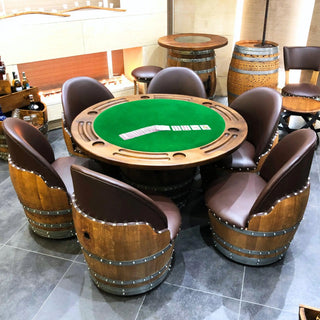
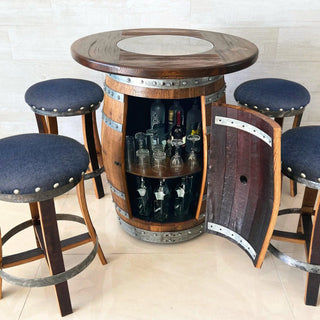
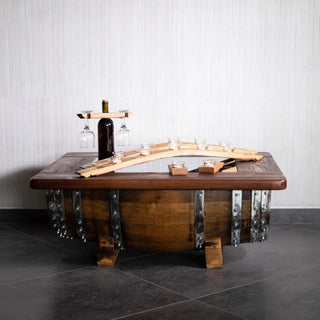
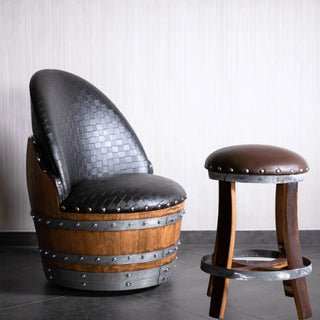
A home bar cleaning checklist that actually fits into one Saturday morning needs to do six things: empty and wipe down all surfaces, audit and re-polish glassware, inventory and date your bottles, inspect the iron hoops for slip, touch up the spar varnish if needed, and reset the bar's staging for the season. Below is the exact 45-minute sequence we use on our own family workshop bars. For specific finish or hoop questions on your own piece, reach our team here.
This refresh is built around a wine barrel bar specifically — the kind made from an authentic Bordeaux-type oak barrel with hand-applied iron hoops and a spar-varnish finish — but most of the steps apply to any quality wood-and-metal home bar. The total time budget is 45 minutes including the bottle-dating audit, which is usually the slowest step.
For background on what makes a quality barrel bar worth this kind of seasonal care versus a disposable lookalike, see our post #4 — Bordeaux Oak vs American Oak and our post #7 — Hidden Costs of Cheap Barrel Furniture.
Tools & Materials Table
| Item | Purpose | Where to Get |
|---|---|---|
| 3 lint-free microfiber cloths | Wipe-down, polish | Hardware store, 3-pack ~$10 |
| 1 spray bottle of warm water + 1 tsp white vinegar | Cleaning solution | Mix at home |
| 1 small bottle of food-grade mineral oil | Wood conditioning (optional) | Grocery store, ~$5 |
| 1 small can of spar varnish (matching sheen) | Touch-up | Hardware store, ~$15 |
| 1 small foam brush | Varnish application | Hardware store, ~$2 |
| 1 sharpie marker | Bottle dating | Already in junk drawer |
| 1 trash bag | Glassware retirement | Already in kitchen |
| 1 box stemware-safe storage | If retiring bottles | Optional |
Total cost of supplies (one-time): ~$35.
Time budget: 45 minutes.
Skill level: Beginner. No power tools, no chemicals harsher than vinegar.
Step 1 — Empty and Wipe Down (8 minutes)
Clear everything off the bar. Move bottles, glassware, decanters, coasters, and decor to a nearby table. Empty the interior cabinet if your barrel bar has one.
Spray the vinegar-water solution onto a microfiber (not directly on the bar — over-spraying can pool in the seams between staves).
Wipe in the direction of the wood grain. Top first, then the staves working top-down, then the iron hoops, then the base. The hoops accumulate fingerprint oil; a dry microfiber buffs them after the damp wipe-down.
Inspect for water rings, sticky spots, or scratches. Note them for Step 5 below — most water rings clear up with a light buff; deep scratches need varnish touch-up.
Step 2 — Glassware Audit (10 minutes)
Pull every glass off the bar and out of the cabinet. Inspect each for chips on the rim — a chipped rim is a discard, no exceptions (lip safety).
Wash any glass that has hazing or dust film. Hand-wash in warm water with a drop of unscented dish soap, dry immediately with a lint-free cloth (paper towels leave fibers; standard towels leave streaks).
Polish stemware over steam. Hold the bowl over a kettle's steam for 3 seconds, then buff dry with a microfiber. This removes water spots that dishwasher detergents leave behind.
Retire the orphans. That single highball from the set you broke last year? Donate it. Mixed-glassware sets read as cluttered on a curated bar. Aim for matched sets in each category.
Step 3 — Bottle Inventory + Dating (12 minutes — usually the longest step)
Inventory every bottle. Make a quick list — spirit, brand, approximate fill level. This is for your own reference and takes about 6 minutes if you have 15–25 bottles.
Date each open bottle on the back label with a sharpie: month and year first opened. Shelf life after opening:
- Whiskey, gin, vodka, tequila, rum (unflavored, 40%+ ABV): essentially indefinite
- Liqueurs (Cointreau, Campari, Aperol): 12–18 months
- Vermouth (open): 30–60 days refrigerated only — most home bars throw away cloudy vermouth they didn't realize had gone bad
- Wine bottles (open): 3–5 days max
- Sparkling (open): 24 hours max
Toss anything cloudy, off-smelling, or older than its shelf life. Vermouth and amari are the most common offenders.
Re-organize by category. Spirits in front, mixers in back, glassware on the side. Bottle silhouettes facing forward make for better bar photos.
Step 4 — Iron Hoop Check (3 minutes)
Walk around the barrel and look at each iron hoop. Are they tight against the staves? Has any hoop slipped down or up by more than 1/4 inch since last season?
Gently tap each hoop with the heel of your hand. A snug hoop returns a dull thud. A loose hoop returns a higher pitch. If you find a loose hoop, the fix is usually as simple as tapping it back into position with a rubber mallet (never a metal hammer — you'll dent the iron).
If a hoop has slipped more than 1/2 inch or is visibly bent, contact your workshop. On our pieces, hoop adjustment is a 5-minute fix; we can walk owners through it over email or replace the hoop if needed.
Step 5 — Finish Touch-Up (8 minutes, only if needed)
Identify any spots needing touch-up:
- White water rings on the top
- Scratches deeper than a credit card edge
- Dull patches where finish has worn thin
- Spots where moisture has caused finish to lift slightly
For minor dullness: rub a small amount of food-grade mineral oil into the dull area with a soft cloth. Buff to even sheen. This is not a long-term finish — it's a cosmetic refresh that lasts about 3 months.
For real finish wear (worn-thin patches): apply a thin coat of matching spar varnish with a foam brush. Two thin coats with a 24-hour dry between is better than one heavy coat. Most spar varnishes match the original satin sheen on a quality barrel bar — confirm sheen (satin, semi-gloss, gloss) before buying.
Step 6 — Reset and Re-Stage (4 minutes)
Put bottles back in their new organized order. Tall bottles to the back, short bottles to the front. Labels facing forward.
Re-stage the bar top. Replace decorative items with the new season's accent — for spring, that often means swapping out a heavy winter floral for a single small bud vase or a fresh herb in a small pot.
Photograph the refreshed bar. A before/after photo helps you spot what improved and gives you a reference point for the next refresh.
The 45-Minute Checklist (Printable)
- [ ] Clear bar surface (2 min)
- [ ] Wipe top, staves, hoops with vinegar-water microfiber (6 min)
- [ ] Inspect each glass; discard chipped (4 min)
- [ ] Hand-wash and steam-polish stemware (6 min)
- [ ] Inventory bottles (6 min)
- [ ] Date open bottles, toss expired (6 min)
- [ ] Check hoops for slip, tap snug if needed (3 min)
- [ ] Buff dull spots or touch up with spar varnish (8 min, if needed)
- [ ] Reset bottles, re-stage top (4 min)
Common Mistakes
- Using furniture polish or Pledge. Silicone-based polishes build up in oak grain and create haze over time. Vinegar-water and mineral oil only.
- Letting water pool in stave seams. Always wipe with a damp cloth, never a wet one. Wipe seams the direction of the grain immediately.
- Replacing hoops too aggressively. A loose-feeling hoop on a barrel bar is rarely a structural problem — it's usually seasonal humidity contraction. Tap snug; only call the workshop if it doesn't hold.
- Skipping the bottle date check. This is the step most owners skip and the most consequential — drinking vermouth from a 2-year-old open bottle is the difference between a great old-fashioned and a bad one.
When to Call the Workshop
If your barrel bar shows any of these — call before you DIY:
- Hoop has slipped more than 1/2 inch or is visibly bent
- A stave has cracked through (not just surface checking)
- Finish has lifted in sheets rather than dulled gradually
- The barrel itself rocks when leaned on
Our family workshop offers email-based diagnosis on these issues; in most cases the fix is straightforward and we can walk owners through it. Contact us here.
For year-round care beyond the spring refresh, see our pillar guide — 12-Month Care Calendar for an Indoor Barrel — which maps season-by-season tasks to keep your bar looking workshop-fresh.
Sources & references:
- U.S. Food and Drug Administration: 21 CFR 172.878 (food-grade white mineral oil) and 21 CFR 178.3620 (food-contact mineral oil).