
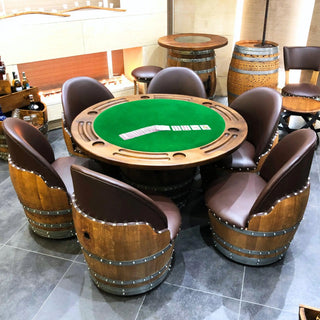
Building a bourbon collection happens in three predictable stages: Foundation (the first 10 bottles, $300–$500 invested), Exploration (25–50 bottles, $1,500–$5,000 invested), and Connoisseur (50–100 bottles, $5,000–$25,000+ invested). At each stage, what you buy changes — and so does the furniture math required to store, display, and pour from a growing library. This guide walks through what to add at each tier, why, and what kind of bar, cabinet, and storage layout fits each phase. A full barrel set — bar plus chairs plus side table — anchors the library from the first ten bottles forward, and our pillar hub on hosting a bourbon tasting on a wine barrel table covers the broader P4 bourbon-lifestyle culture.
A note before we start: collecting is not stockpiling. The best bourbon libraries are drunk from, opened with friends, and rotated through. A bottle that sits unopened for ten years is not a collection — it is a museum exhibit. Build to drink.
Tools and Materials (For the Whole Journey)
| Item | When You Need It |
|---|---|
| A barrel bar with display surface | Stage 1 |
| Glencairn / NEAT tasting glasses (4–8) | Stage 1 |
| Old-fashioned rocks glasses (4–6) | Stage 1 |
| Notebook for tasting notes | Stage 1 |
| Cabinet with door storage | Stage 2 |
| Wall shelving for overflow | Stage 2 |
| Glass-front display cabinet | Stage 3 |
| Climate monitoring (hygrometer/thermometer) | Stage 3 |
| Inventory app or spreadsheet | Stage 3 |
Time required: the journey is years, not weeks.
Skill level: Anyone with curiosity. Bourbon collecting has a low barrier and a deep ceiling.
Stage 1: Foundation (The First 10 Bottles)
Bolded step. Build a foundation that covers every major style at modest cost.
The first ten bottles teach you what you like. They should span:
- 1 low-rye bourbon (Buffalo Trace, Evan Williams Black Label)
- 1 high-rye bourbon (Bulleit, Old Forester 86, Four Roses Yellow Label)
- 1 wheated bourbon (Maker's Mark, Larceny, Old Fitzgerald)
- 1 Bottled-in-Bond (Old Grand-Dad Bonded, J.T.S. Brown, Heaven Hill BiB)
- 1 small batch (Knob Creek 9, Woodford Reserve)
- 1 single barrel (Eagle Rare 10, Four Roses Single Barrel — when you can find at MSRP)
- 1 cocktail-friendly higher-proof (Wild Turkey 101)
- 1 introductory cask strength (Wild Turkey Rare Breed, Maker's Mark 46 Cask Strength)
- 1 "stretch" bottle ($60–$90 for special occasions)
- 1 oddball or regional pick that interests you
Total investment: $300–$500.
What you learn at this stage: which mashbill family resonates with your palate (rye spice vs. wheat sweetness), what proof you naturally pour at, and which distilleries feel like home. Take notes — even three-word notes per bottle. Six months in, the notes are the most valuable thing in the library. Whisky Advocate's collecting columns recommend essentially this same starter framework — cover the styles broadly before chasing depth — as the foundation that prevents expensive early mistakes [Source: Whisky Advocate, "How to Start a Whisky Collection" feature archive, whiskyadvocate.com].
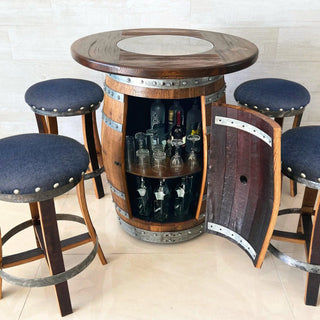
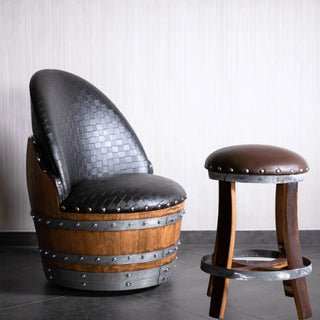
Furniture math at Stage 1: a wine barrel bar with a flat top surface (24–28 inches diameter) holds 10 bottles comfortably, displayed in a single ring with labels facing out. Inside the cabinet cavity, a single shelf holds backup bottles, glassware, and the basic toolkit. A matching chair or two and a side table complete the working bar — a full barrel set is purpose-built for this scale and grows with you.
Stage 2: Exploration (25–50 Bottles)
Bolded step. Deepen by style, geography, and producer.
Once the foundation is settled and you know what you like, exploration is about depth. The 11th-through-50th bottles fall into:
Distillery deep-dives. Pick two or three distilleries and own their lineup top to bottom. Buffalo Trace lineup: Buffalo Trace, Eagle Rare 10, Weller Special Reserve, Weller Antique 107, Blanton's, Stagg Jr., Sazerac Rye. Heaven Hill lineup: Evan Williams BiB, Elijah Craig Small Batch, Elijah Craig Barrel Proof (multiple batches), Larceny, Henry McKenna 10, Old Fitzgerald BiB. Four Roses lineup: Yellow Label, Small Batch, Single Barrel, Small Batch Select. Owning a full distillery vertical teaches you what house style means.
Cask strength expansion. Booker's, Stagg Jr., Elijah Craig Barrel Proof (collect three batches per year for vertical study), Maker's Mark 46 Cask Strength, Wild Turkey Rare Breed Rye, Knob Creek 12-Year. Cask strength is where bourbon shows its individual personality most clearly.
Single barrel deep dives. Blanton's (when found), Eagle Rare 10, Four Roses Single Barrel (try multiple recipes if your store does barrel selections), Russell's Reserve Single Barrel, Knob Creek Single Barrel Select. Single barrels reveal variation within a brand.
Bottled-in-Bond category. Henry McKenna 10, Old Grand-Dad Bonded, J.T.S. Brown Bonded, Old Fitzgerald BiB (Heaven Hill releases multiple ages), Evan Williams Bonded. The BiB designation — single distillery, single distilling season, minimum four years in a federally bonded warehouse, exactly 100 proof — is a quality and provenance guarantee codified under the Bottled-in-Bond Act of 1897 and current TTB regulation [Source: U.S. TTB, Bottled-in-Bond labeling provisions under 27 CFR Part 5, ecfr.gov], and the category rewards collecting.
Allocated chase bottles. As you find them at MSRP: Weller 12, Eagle Rare 17 (rare), Blanton's Gold, single Pappy releases. Do not pay extreme secondary prices in this stage — patience and distillery lottery participation will eventually land bottles.
Geographic exploration. Beyond Kentucky: Wyoming Whiskey, Westland (Washington), Garrison Brothers (Texas), Westward (Oregon), Smoke Wagon (Nevada). The American craft bourbon movement is now mature enough that geography matters.
Total investment: $1,500–$5,000 cumulative.
What you learn at this stage: house styles within distilleries, what age does to flavor in your preferred style, and where your palate falls on the rye-vs-wheat spectrum.
Furniture math at Stage 2: the bar top now holds 12–15 "current pour" bottles. Inside the cabinet, two shelves of backup and rotating inventory (15–20 bottles). A wall-mounted display shelf or a second cabinet handles the next 15–20 bottles, organized by distillery family. Total visible: 50 bottles, with room for 5–10 in reserve. Two or three glasses per style (Glencairn for nosing, rocks for casual pours, lowball for cocktails). Glass-front cabinet doors become valuable here — the library starts to deserve being seen.
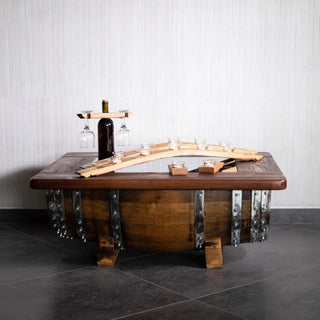
A typical Stage 2 setup: barrel bar + barrel side table + wall-mounted three-shelf display rack + a small humidor on the bar top if you also smoke. The full barrel set scales naturally; you add the wall display and the humidor as the collection grows.
Stage 3: Connoisseur (50–100 Bottles)
Bolded step. Curate, age, and chase.
Beyond 50 bottles, the collection becomes a curated library — not a wider net, but a deeper one. The next 50 bottles are about:
Verticals. Multiple vintages of the same release. Elijah Craig Barrel Proof: every batch (A, B, C) of every year you can find. Stagg / George T. Stagg: multiple years (the Buffalo Trace Antique Collection is released annually). Old Fitzgerald BiB: every spring and fall release. Vertical collections reveal how time and batch variation shape a single label.
Allocated and trophy bottles. As patience and budget allow: George T. Stagg (annual fall release), William Larue Weller (annual fall release), Thomas H. Handy (rye, annual fall), Eagle Rare 17 (annual fall), Sazerac 18 (annual fall), Pappy Van Winkle Family Reserve 15 / 20 / 23. The Buffalo Trace Antique Collection (BTAC) is released annually in the fall in extremely limited quantities, which is the structural reason these bottles command secondary-market premiums year after year [Source: Sazerac Co. / Buffalo Trace Distillery, annual BTAC release announcements, buffalotracedistillery.com]. These are the bottles that justify a bourbon lottery, distillery membership, and a network of trusted shops. Secondary market prices apply if you cannot win lotteries — set a personal budget cap and stick to it.
Rare and dusty. Pre-2014 Pappy bottles, original Stagg releases, early Booker's runs, A.H. Hirsch Reserve, original Old Fitzgerald releases from the Stitzel-Weller era. The "dusty" hunt is its own subculture — estate sales, abandoned liquor cabinets, bourbon societies. Auction sites are convenient but premium-priced.
International rarities. Japanese-bottled Stitzel-Weller, European-market Buffalo Trace releases, distillery-only bottlings purchased on travel. The global market is unevenly priced and rewards travel.
Closed distillery bottles. Stitzel-Weller (closed for distilling in 1992 — the spiritual home of pre-allocation wheated bourbon, and the source of much of the Pappy Van Winkle mythos), Old Crown, A.H. Hirsch (Pennsylvania), Old Charter (legacy juice) [Source: Fred Minnick, "Bourbon: The Rise, Fall, and Rebirth of an American Whiskey" (Voyageur Press); Kentucky Distillers' Association historical archive, kybourbon.com]. Bottles from closed distilleries are appreciating in cultural and monetary value annually.
Total investment: $5,000–$25,000+ cumulative, with the upper bound determined entirely by allocation chasing.
What you learn at this stage: what age really does to bourbon, how batches diverge within a single label, and where the line is between "great bourbon" and "great story." Many Stage 3 collectors realize that their everyday pours remain in the $30–$60 range; the allocated bottles are for the once-a-month occasion.
Furniture math at Stage 3: the library needs a system. A typical 100-bottle setup:
- The bar — 15 current pour bottles, label out, displayed and accessed
- Cabinet interior with glass doors — 25 backup bottles, organized by style or distillery
- Wall-mounted multi-shelf display rack — 30 bottles, organized chronologically or by family
- Climate-controlled cabinet or basement room — 30 allocated, dusty, and aging bottles, kept at 60–68°F and 50–65% RH, away from direct light
- Inventory spreadsheet or app — every bottle logged with purchase date, MSRP, current secondary value, batch info, and a "drink by" or "open at" note
The visual story is no longer a single bar; it is a room. Many Stage 3 collectors dedicate a basement bar, sunroom, library, or three-season room (climate permitting) to the collection. The bar still serves drinks; the surrounding furniture stores, displays, and protects.
What to Avoid at Each Stage
Stage 1: do not chase Pappy or Stagg. You will overpay for bottles you cannot yet appreciate. Build the foundation first.
Stage 2: do not buy duplicates of the same release "for resale" — bourbon is a drinking hobby, and the secondary market is volatile. If you want a duplicate, buy it to share with friends or to drink in five years.
Stage 3: do not let allocation chasing crowd out actual drinking. The collector who has 80 bottles and pours from only three has stopped collecting and started hoarding.
The Storage and Climate Question
Bourbon does not age in the bottle. Unlike wine, an unopened bottle of bourbon stays the same for decades — the spirit has stopped maturing the moment it left the barrel. Storage is about preserving, not aging.
The targets for long-term bourbon storage:
- Temperature: 60–70°F, stable. Hot conditions accelerate evaporation through the cork seal. Below freezing causes some bourbons to develop chill haze (cosmetic, not harmful).
- Humidity: 50–70% RH. Below 40% sustained will dry the cork; above 80% risks label mold.
- Light: dark or low warm light only. UV degrades color and possibly flavor over years.
- Position: upright. Unlike wine, high-proof spirits like bourbon can degrade the cork over decades of side-storage contact — the conventional collector recommendation is to keep bottles standing [Source: Whisky Advocate, standing-storage guidance for high-proof spirits, whiskyadvocate.com; DISCUS (Distilled Spirits Council of the United States), consumer storage guidance, distilledspirits.org].
These are the same conditions our reclaimed-oak furniture lives in comfortably, which is part of why a wine barrel bar makes such natural bourbon storage — same room, same conditions, same wood family. See our companion piece on wine cellar temperature and humidity for the deeper version.
When to Open the Allocated Bottle
A common Stage 2 / Stage 3 question: when do I open the Stagg, the Eagle Rare 17, the Pappy 15? The answer that has held up best across decades of bourbon collecting: open it for an occasion, with people who will remember it. Not when you bought it. Not on a Tuesday night alone. The bottle was made by humans for sharing. Closed bottles do not get better; shared bottles do.
We have customers who open one allocated bottle per year, on a fixed occasion — a birthday, an anniversary, the first cold night of fall. That ritual is the point of the library, not an interruption to it.
A Note on the Furniture That Makes the Library
A bourbon library deserves its setting. Real reclaimed Bordeaux oak — hand-wire-brushed staves, spar-varnish finish, real winery patina — gives the library the gravity it deserves. Manufactured "rustic" furniture reads thin under a 50-bottle collection; real barrel furniture grows into the role.
Our full barrel sets — bar, chairs, side table — are the most common Stage 1 starting point and grow with collectors through Stage 2 and beyond. Lead time 1–2 weeks; free U.S. shipping; 1,500+ Etsy sales and a 4.9-star Star Seller rating in our family workshop.
For more, see the 12 most iconic bourbons every collector should try, how to read a bourbon label, and bourbon and cigar pairing. Our P4 pillar hub on hosting a bourbon tasting on a wine barrel table is the broader guide to the whole library culture.