
What Happens to a Wine Barrel After the Wine Is Gone?
Most people never think about this.
You open a bottle of wine, pour a glass, maybe notice the flavor, maybe not… and that’s kind of where the story ends.
But behind that bottle, there was a barrel.
And that barrel wasn’t just sitting there for decoration—it had a job. A real one. Sometimes for years.
It helped shape the wine. It held it, aged it, changed it over time.
And then one day… it’s done.
Not broken. Not useless.
Just… finished with that part of its life.
So what actually happens next?
Because the barrel doesn’t just disappear.
It goes somewhere.
A Barrel Doesn’t “Wear Out”—It Just Stops Being Useful for Wine
This is the first thing that surprises people.
Wine barrels don’t get thrown out because they fall apart.
They get retired because they stop doing what winemakers need them to do.
The wood changes over time
At the beginning, the barrel has a big influence on the wine—flavor, aroma, structure.
But after a few years, that influence fades.
The wood settles. It becomes more neutral.
And for winemakers, that’s the signal—it’s time to move on to a newer barrel.
So the old one gets pulled out of rotation.
But here’s the thing…
It’s still solid. Still usable. Still full of life, in a way.
It just doesn’t belong in the vineyard anymore.
This Is Where the Story Splits (Because Not All Barrels Go the Same Way)
Once a barrel leaves the winery, it doesn’t follow one path.
There’s no single “next step.”
Some barrels stay in the industry a little longer.
Some get repurposed quickly.
Some… honestly, don’t get used to their full potential.
And that’s where things get interesting
Because depending on where it goes next, that same barrel can end up living completely different second lives.
Some Barrels Stick Around in the Alcohol World
A lot of people assume once a barrel is done with wine, that’s it.
Not always.
Some get reused for:
- Aging spirits like whiskey or rum
- Secondary wine processes
- Other fermentation uses
It’s kind of like a second career
Same material, different role.
But even that doesn’t last forever.
Eventually, the barrel reaches a point where it’s no longer useful in that world either.
And that’s when it really leaves the industry.
Some Take the “Quick Repurpose” Route
This is the part you’ve probably seen before.
Barrels turned into planters.
Or cut in half and used as decoration.
Or broken down into smaller wood pieces.
It keeps them in use… but it’s not the full story
Because when you cut a barrel down like that, you lose a lot of what made it interesting in the first place.
The structure. The shape. The strength.
It becomes something smaller.
Still useful—but not everything it could be.
And Then There’s the Path Most People Don’t Expect
This is where things shift.
Instead of breaking the barrel down… you build from it.
You take something that already has form, character, history—and turn it into something functional.
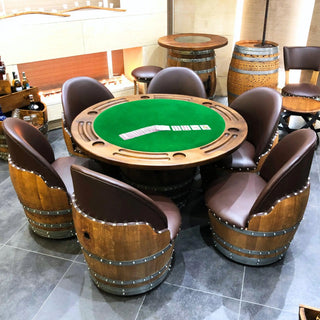
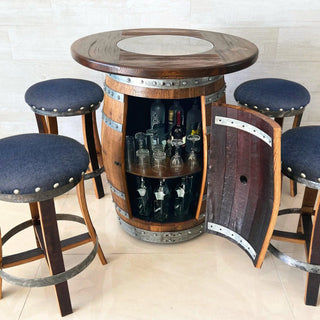
This is where furniture comes in
Not as decoration.
Not as a novelty.
But as something you actually use.
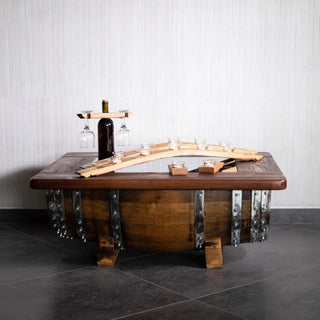
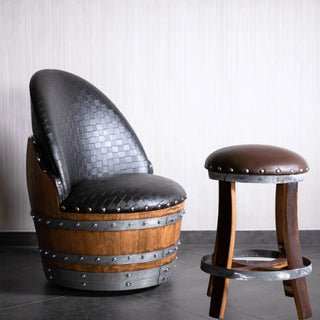
Tables. Chairs. Cabinets. Pieces that become part of a space.
And this is where the barrel really starts its second life.
It Still Feels Like a Barrel (And That’s the Point)
One thing that stands out right away with wine barrel furniture…
It doesn’t try to hide what it used to be.
The curves stay
The staves—the long wooden strips that form the barrel—are still there.
The shape is still there.
Even some of the markings from its past life show up.
And that’s intentional.
Because if you remove all of that… it just becomes regular wood.
And that’s not what makes it interesting.
There’s a Moment Where It Starts to Look Like Something Else
If you’ve ever seen one being worked on, there’s this point in the process where things shift.
At first, it’s just a barrel.
Then it’s cut, adjusted, shaped a bit…
And suddenly you can see it.
A table. A chair. Something else.
It doesn’t happen all at once
It’s gradual.
And honestly, that’s part of what makes the process so interesting.
You’re not building something from scratch—you’re uncovering what it could become.
The Marks, the Wear… That’s Not Damage
This is something people either love right away… or need a second to understand.
Wine barrel furniture doesn’t look perfect.
And it’s not supposed to
The marks, the slight variations, the way the wood looks like it’s been through something—that’s exactly what makes it work.
Because it has been through something.
Years of use. Exposure. Aging.
You can’t fake that.
And once you notice it, it’s hard to go back to furniture that looks too clean or too uniform.
Not Every Barrel Makes It This Far
It’s worth saying—not every barrel becomes furniture.
Some are too worn down.
Some don’t have the structure anymore.
Some just don’t work for what they need to become.
There’s still a selection process
Because once you turn it into something people will use every day, it has to hold up.
It’s not sitting in a quiet cellar anymore.
It’s part of a home.
That changes the standard.
By the Time It Reaches You, It’s Been Through a Lot
This is the part people don’t always think about.
When you see a finished piece of wine barrel furniture, you’re not looking at something new.
You’re looking at something that’s been through stages
- Time in a vineyard
- Years of use in winemaking
- Retirement from that process
- Selection for reuse
- Transformation into something functional
That’s a long path.
And even if you never think about it again… it shows up in the piece.
Why It Feels Different (Even If You Can’t Explain It)
This is probably the most interesting part.
Most people don’t analyze it.
They don’t walk into a room and think about the lifecycle of the material.
They just notice something feels different
It feels heavier.
More grounded.
Less temporary.
Like it belongs there in a different way.
And that’s not coming from the design alone.
It’s coming from everything that happened before.
Where Oak Wood Wine Barrels Fits Into This
At Oak Wood Wine Barrels, the focus isn’t just on making something look good.
It’s on continuing the story of the material.
Not restarting it—continuing it
Taking a barrel that already had a purpose… and turning it into something that fits into everyday life.
Without stripping away what made it interesting in the first place.
That’s why the pieces don’t feel identical.
That’s why they don’t feel replaceable.
It’s Not the End—It’s Just a Shift
The wine is gone.
That part is finished.
But the barrel isn’t done.
It just moves into something else
From vineyard… to workshop… to someone’s home.
And once you see it that way, it’s hard to think of it as just “furniture.”
It’s more like… a continuation of something that already had a life.
Our Links
- Explore wine barrel furniture made from real retired barrels — https://www.obarrel.com
- Shop handcrafted barrel tables, chairs, and décor — https://www.obarrel.com
- Browse rustic oak furniture with real history and character — https://www.obarrel.com
Other Resources to Check Out!
- Wine Spectator (Barrel Aging & Lifecycle Explained) — https://www.winespectator.com
- Wine Folly (How Barrels Affect Wine Over Time) — https://winefolly.com
- VinePair (What Happens to Wine Barrels After Use) — https://vinepair.com
This blog post is for informational purposes only. While we aim to provide accurate and helpful insight into the lifecycle and reuse of wine barrels, individual processes, sourcing methods, and product characteristics may vary. Due to the reclaimed and natural nature of the materials, each piece may differ in appearance, structure, and finish. Availability, sourcing conditions, and material variations may change over time. Always review product details and specifications directly before making a purchase decision to ensure the best fit for your needs and space.