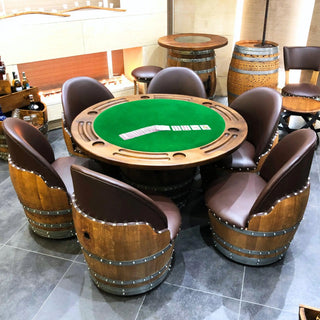
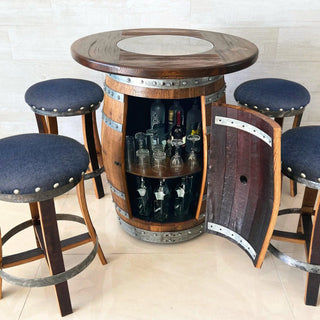
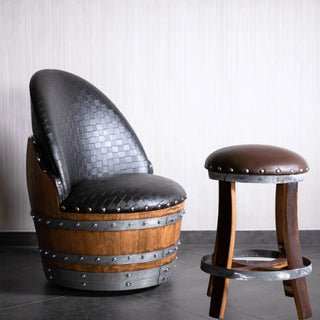
The right bar stool height for a wine barrel bar is whatever puts the seated guest's elbow 10-12 inches below the bar top — which works out to 24-26 inch counter stools for a 36-37 inch wine barrel bar, 28-32 inch pub stools for a 41-44 inch bar, and 33-36 inch spectator stools for a 44-46 inch bar with raised top. This reference covers the standard height matchups, the spacing math for arranging multiple stools around a round bar, footrail considerations, and sightline rules for hosting versus TV-watching setups. The dimensions here apply specifically to round wine barrel bars; straight-bar dimensions differ slightly. You can pair the right footrail or replacement top from our tops, rails, and accessories collection as you read.
This is the specs companion to Barrel Bars 101 and 11 Basement Bar Layouts Built Around a Single Barrel.
The height matchup table
| Bar height | Bar type | Stool seat height | Stool category |
|---|---|---|---|
| 30-32 inches | Bistro / table-height | 18-20 inches | Bistro chair |
| 36-37 inches | Counter | 24-26 inches | Counter stool |
| 41-44 inches | Pub / standard barrel | 28-32 inches | Pub / bar stool |
| 44-46 inches | Spectator / TV | 33-36 inches | Spectator stool |
A typical authentic wine barrel bar with no added base lands at 41-42 inches naturally — the height of a 53-59 gallon barrel plus a thin top is essentially pub height by accident. That makes the 30-inch pub stool the default pairing for most barrel bars on the market.
What the heights actually mean for guests
Counter height (24-26 inch stools, 36-37 inch bar)
The most family-friendly option. Easier to get on and off of, shorter fall if a guest loses balance, works with kids in the room. Pair with a barrel bar that has a raised base or platform that brings the working surface down to 36-37 inches. Better for casual basement bars than formal lounges.
Pub height (28-32 inch stools, 41-44 inch bar)
The default for wine barrel bars. Reads as a "real bar" because it matches the height of commercial pub bars. Best for adult-only spaces and lounges where the bar is meant to be the visual centerpiece. Slightly less comfortable for short guests but more visually impressive.
Spectator height (33-36 inch stools, 44-46 inch bar)
For wine barrel bars with raised tops designed for TV-watching from across the room. The extra height keeps the stool occupants' sightlines above the heads of people seated in front of them on a sofa or in lounge chairs. Used mostly in basements where the bar zone faces a TV wall.
Bistro height (18-20 inch chairs, 30-32 inch table)
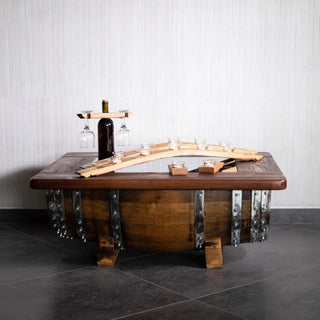
For wine barrel coffee tables and bistro tables built from half-barrels. Not technically bar stools — these are dining chairs paired with table-height surfaces. Common in sunrooms and three-season porches where a smaller bistro setup fits better than a full bar.
Spacing: how many stools fit around your barrel bar
A round wine barrel bar has roughly 75-82 inches of perimeter (a 26-inch-diameter barrel has 81.7 inches of circumference). But most of that perimeter is unusable — the host needs a serving side, and guests need air between them. Practical seating math:
- Per stool: 24-28 inches of bar perimeter per stool
- Air between stools: 6-8 inches of space between adjacent seats
- Host service zone: at least 36 inches of perimeter reserved for the host (or behind-the-bar service if the bar is pulled off the wall)
This works out to:
| Bar configuration | Comfortable stool count | Maximum stool count |
|---|---|---|
| Bar against wall (no host side) | 2-3 stools | 4 stools (cramped) |
| Bar pulled off wall (peninsula) | 2-3 stools | 3 stools (typical) |
| Bar in corner (45-degree placement) | 2 stools | 3 stools |
| Bar fully freestanding (island) | 3-4 stools | 4 stools |
Pushing past the maximum count makes guests feel jammed and host service awkward. The most photographed setups use 2-3 stools regardless of the configuration.
Sightlines for hosting
The seated guest at a barrel bar should be able to see:
- The host directly across the bar — the most important sightline. The bar's diameter (24-26 inches) plus the typical 30-inch lean-distance puts the host within easy conversation range.
- Other guests at the bar — guests at a round bar can see each other across the curve, which is one of the social advantages of round bars over straight bars.
- The room behind the bar — entries and exits should be visible from the guest stool position so guests can naturally turn to greet new arrivals.
What guests should not see directly from the stool:
- A blank wall up close — the bar against a flat wall with the guest staring into stucco from 36 inches away is visually dead. Add wall storage, art, or a mirror to give the sightline somewhere to go.
- The TV at an awkward angle — if the bar zone is meant to face a TV, the bar orientation needs to be planned for it. See the next section.
Sightlines for TV-watching
Bars positioned to face a TV need three sightline considerations:
Stool height vs. seated sofa height. A spectator stool at 33-36 inches puts the guest's eye level at about 50-54 inches above the floor. A standard sofa puts seated eye level at about 38-42 inches. The 10-15 inch difference means spectator stools see over the heads of sofa guests, which is what you want for an across-the-room TV.
Distance from TV. Set the bar far enough back from the screen that spectators can see it comfortably.
Angle off-axis. A TV viewed from more than 30 degrees off-axis looks washed out on most panels. Keep all stool positions within 30 degrees of straight-on to the TV.
The cleanest layout: TV mounted on one wall, sofa 8-10 feet directly across, barrel bar with spectator stools positioned 12-14 feet from the TV behind and slightly above the sofa. Guests at the bar see the TV over the sofa; guests on the sofa see the TV without obstruction.
Footrails: when you need them
When to add a footrail:
- Always on pub-height bars (41-44 inches) intended for sustained sitting
- Optional on counter-height bars (36-37 inches) since guests' feet usually reach the floor or the stool rung
- Never on bistro tables since chairs have their own foot positioning
Footrail spec for a barrel bar: a brass or wrought-iron tube, 1.5-2 inches diameter, mounted 7-9 inches above the floor and 12-14 inches out from the bar's base. Most workshops offer footrails as an add-on for $80-$200 depending on material.
Common spacing mistakes
Cramming four stools around a single wine barrel bar. Three is comfortable; four is jammed. If you need to seat four regularly, plan an L-shape or peninsula layout with extended counter rather than a single round bar.
Mismatching stool height to bar height. A 24-inch counter stool at a 42-inch pub bar puts the guest's elbow well below the bar surface — uncomfortable and visually wrong. Match heights using the table above.
Forgetting the host service side. A bar pulled off the wall as a peninsula needs 24-30 inches of host space behind it. Without it, the host serves from the front (guest side), which feels awkward.
Sitting too close to the TV. Spectator stools 6 feet from a 65-inch TV are too close — guests will feel pinned.
Skipping the footrail on pub bars. Sitting on a 30-inch stool with feet dangling for 30+ minutes becomes uncomfortable fast. Add the footrail.
How our bar accessories help
For customers who already have a barrel bar and want to upgrade the seating experience, our accessories collection includes footrails (brass and wrought-iron in matching dimensions), replacement tops in larger diameter for raised-spectator builds, and matched stool sets that pair correctly with our standard 42-inch pub bars and 36-inch counter bars. See our tops, rails, and accessories collection.
FAQ
Can I use kitchen counter stools at a barrel bar?
Only if your barrel bar is counter-height (36-37 inches). Standard kitchen counter stools are 24-26 inches and won't work at a 42-inch pub bar.
Do swivel stools work at a barrel bar?
Yes, but they limit how close the stool can sit to the bar's curve since the swivel mechanism needs clearance. Fixed stave-back stools sit closer to the bar visually.
Should the stools tuck fully under the bar?
Ideally yes when not in use, but a barrel bar's bilge (the widest middle section) prevents most stools from sliding all the way under. Industrial stools with narrow bases tuck closer than stave-back stools.
Is there a stool height that fits both pub and counter bars?
No. The 10-12 inch gap rule means each bar height needs a specifically matched stool height. There is no single compromise height; pick the bar height first, then match the stool.