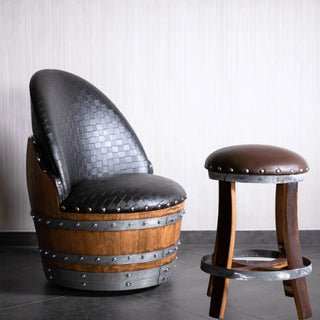
An evening bourbon ritual is six small choices — a chair you actually sit in, lighting that drops the room a stop, a glass shaped for nosing, a single deliberate pour, no phone within reach, and the time you protect to actually drink it slowly. The pour itself takes thirty seconds. The ritual takes an hour. The hour is the point. We have spent fifteen years in the family workshop building the furniture these evenings happen in — most often a reclaimed-oak barrel chair beside a barrel side table — and what the customers who write back say, year after year, is the same: the chair is what made the habit stick. The bourbon was already there. The ritual needed somewhere to land. The P4 bourbon lifestyle hub covers the broader culture; this piece is about the quieter end of it.
What follows is not a guide so much as a description of six elements that, when in place, turn an after-dinner pour from a nightcap into a closing chapter. Pick the ones that already exist in your home. Add the missing ones slowly.
1. The Chair
The chair is the foundation. It needs to be one specific chair — yours — in one specific spot you return to. Not the dining chair carried into the living room. Not the kitchen stool. A chair with weight, with arms wide enough to rest a glass, with a seat depth that lets you sit back rather than perch forward. Solid wood frame, leather or heavyweight upholstery on the seat, a back tall enough to support your shoulders.
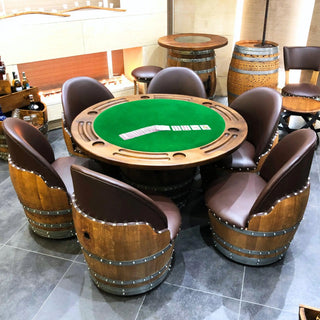
The chair has to be comfortable for an hour, not for a minute. This is where most evening rituals quietly fail: the seat is fine for ten minutes and torture by forty. Real barrel chairs — built from the staves of a working wine barrel, with a generous curved back and a deep seat — were originally designed in tasting rooms for exactly this hour. The curve cups the back; the wood gives the right amount of resistance; the height matches a barrel side table for the glass and the book.
You sit in this chair often enough that it becomes "your chair." Family members learn not to take it. That recognition is part of the ritual.
2. The Lighting
Lower than dinner. Warmer than dinner. The single biggest shift in atmosphere happens when the dining-room overhead goes off and one or two small warm lamps come on. Aim for 2700K bulbs maximum, ideally 2400K. A table lamp at sitting height beside the chair, perhaps a low picture light or sconce on the opposite wall, nothing overhead.
The effect is physical. Lower light triggers the body to settle — warmer color temperatures in the evening reduce the suppression of melatonin and align with the body's natural wind-down rhythm [Source: Harvard Health Publishing, "Blue light has a dark side," health.harvard.edu]. Conversation drops to a quieter register. The amber color of the pour reads gold in warm light, deep brown in cool light — and gold is the color the bourbon was made to look like.
Put every lamp in the room on a dimmer. The room you want at 4 PM and the room you want at 9:30 PM are not the same room.
3. The Glass
A Glencairn, a NEAT glass, a Copita, or a small old-fashioned rocks glass. The shape concentrates aromatic vapor toward the nose — which is where the majority of what we call "taste" actually happens, with olfaction (retronasal smell) carrying most of flavor perception according to chemosensory researchers [Source: Monell Chemical Senses Center research on flavor and olfaction, monell.org; National Institute on Deafness and Other Communication Disorders, "Smell Disorders" reference page, nidcd.nih.gov]. The wrong glass (a tall highball, a stemless wine tumbler, a coffee mug) does not destroy the bourbon, but it dulls it. You will smell less. You will taste less. The pour becomes a swallow.
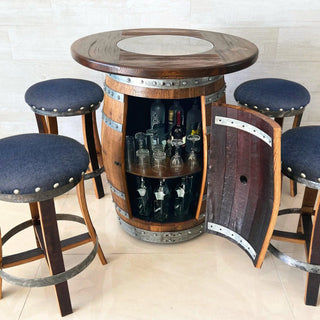
The glass should live within arm's reach when you sit down, not be hunted in a kitchen cabinet. A small under-shelf rack on the bar or a single glass on the side table waiting at the end of dinner are both fine. The point is no logistics between sitting down and sipping. The Glencairn glass — now a near-universal nosing glass for whiskey — was developed in Scotland in the early 2000s specifically to capture aroma in the bowl while focusing it through a narrower rim [Source: Glencairn Crystal Studio, glass history, glencairn.co.uk; Whisky Advocate, glass design coverage, whiskyadvocate.com].
4. The Single Pour
One pour. One and a half ounces. Not two ounces with the unspoken intention of "another in a few minutes." The single pour is the ritual's spine. It says: this is the amount of bourbon I am going to drink tonight, and I am going to drink it slowly enough that there is no need for a second.
What this does, over time, is change the relationship. The pour stops being volume and starts being attention. A serious cask-strength bourbon at 1.5 ounces, sipped over forty-five minutes with a few drops of water at the halfway mark, delivers more flavor and more pleasure than four ounces drained in fifteen minutes. The bottle lasts longer, too — a 750ml at one pour per evening lasts roughly seventeen evenings, which is a meaningful relationship with a single bottle.
Choose deliberately. The Tuesday pour is not the same bottle as the Friday pour. Wheated bourbon (Maker's Mark, Weller) on a cold night. High-rye (Bulleit, Old Forester 1920) when you want the spice to wake you up a little. A cask-strength single barrel (Stagg Jr., Elijah Craig Barrel Proof) when the week earned it. Match the pour to the evening.
5. No Phone
This is the hardest one. The phone has to be in another room, face down on the kitchen counter, in a drawer — anywhere that requires getting up. The ritual collapses the moment the phone is within reach, because the reach inevitably happens, and the next forty minutes become a half-listened scroll with a glass in the other hand.
What replaces the phone: a book. A magazine. A vinyl record on a turntable that needs to be flipped at the end of a side, which is a useful timer. A handwritten journal, if that is a thing you do. Music selected before sitting down — a single album, not a playlist that asks for skips.
The discipline is small and large at the same time. Small because the phone goes in a drawer. Large because the hour without the phone is, increasingly, the only hour of the day many of us experience without one.
6. The Time
Forty-five minutes to an hour. Not five minutes. Not as long as it takes to finish the pour quickly. The pour is sized so that it requires the hour.
The hour is what the ritual is actually about. The chair, the lighting, the glass, the pour, the absence of phone are all infrastructure. The hour is the thing they protect. It is the hour where the day ends, the body settles, the mind is allowed to wander, and the next day's first thought arrives unbidden — often more useful than the thought you would have had at your desk.
Many of our customers tell us that this hour, once established as a habit, becomes the most defended hour of the day. Family knows. The dog knows. The phone is in the drawer. The chair is yours.
A Note on the Setup
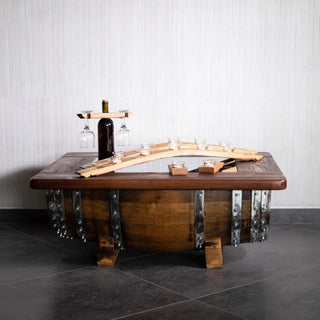
We build chairs and side tables that are designed for this hour, not designed to look like they are. The chair frame is real reclaimed Bordeaux oak — staves from working wine barrels, hand-wire-brushed to bring out the grain, spar-varnish finished to live indoors for generations. The seat is generous and upholstered for an hour of sitting, not a photograph. The side table beside it is the right height for a glass and a book, with enough surface for a small lamp.
The setup is not the ritual. But the setup is what makes the ritual possible. A barrel chair beside a barrel side table, under a warm lamp, with a Glencairn glass and a single pour, is a complete evening. Add a book and a closed phone drawer and the rest takes care of itself.
Our reclaimed-oak barrel chairs are built in our family workshop, by hand. The catalog is at obarrel.com if you want to see them — the most common pairing is a chair beside a matching side table, which is the entire footprint of the evening ritual.
For more on the broader culture of bourbon at home — collecting, pairing, label reading, library building — start with our pillar hub on hosting a bourbon tasting on a wine barrel table, the broader P4 bourbon-lifestyle guide.