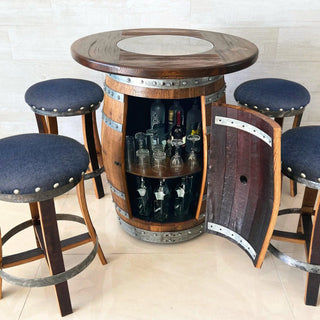
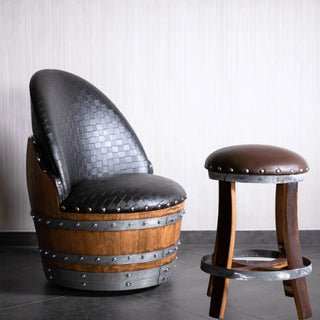
Short answer: The ideal lighting for a barrel bar layers three elements: warm pendants over the top, a focused light where you pour, and one accent that grazes the barrel or the bottles on the wall. Keep it warm, around 2700K, and put each layer on a dimmer. If the anchor is the Multi-Use Bar Set from Oak Wood Wine Barrels (from $1,476), hang pendants about 30 to 36 inches above its 35.4-inch round top, slightly off-center so they don't reflect in the glass.
Prices as of October 6, 2026; each link shows live stock.
A barrel is not a flat cabinet. It has a curve and hoops and often wire-brushed grain and wine stain. Low light from the side shows all of that. Flat, bright light from straight above hides it. The five schemes below are designed for different tasks. Most rooms need three of them, not all five. We've left out fixture prices because they vary too much by brand and store to be useful here.
What color temperature should bar lighting be?
For the room: warm white, about 2700K. Decorative fixtures can use very warm filament bulbs, about 2200K to 2400K. Cool white (4000K and up) makes oak look gray and turns a lounge into an office. With a high color rendering index (CRI 90 or more), bulbs show whiskey, wine and wood in their true colors.
Which 5 lighting schemes work around a barrel bar?
Every scheme has one job. Choose by the job you need done.
Scheme 1: a warm pendant pair over the round top
Layer: ambient. Best for: bars with a round top.
Two small pendants hang above the barrel bar's 35.4-inch round top, illuminating the surface without glaring into anyone's eyes. Hang them about 30 to 36 inches over the top. Position them slightly off-center: a pendant directly over the center of the glass will reflect as a bright spot. Usually, two pendants 18 to 24 inches apart look balanced over a single barrel.
Scheme 2: picture lights over the stave wall racks
Layer: accent. Best for: walls of bottles.
A picture light, mounted a few inches above a wall rack, casts light down the staves and hoops and across the bottle labels. It works on a 5-Bottle Stave Wall Rack ($247.50, 37.2 inches tall) or a Stave Trio Pack ($386.10), where the glasses on the glass rack catch the light. Use one fixture per rack or pair of racks, all at the same height.
Scheme 3: a focused light where you pour
Layer: task. Best for: anyone who mixes drinks.
There's no measuring a pour by mood light. Point one adjustable ceiling spot (or the brighter of your two pendants) at the side of the bar where you work. If you've got a shelf or rack above the bar, a warm LED strip underneath will light up the work surface without shining in your guests' faces.
Scheme 4: filament bulbs in cage pendants
Layer: signature. Best for: a bar that's the centerpiece of the room.
A barrel's metal hoops are echoed by cage pendants with LED filament-style bulbs. Keep the pendants dim and very warm, 2200K to 2400K, so they glow rather than light up the room. Use one over a single barrel or a row of three over a Double Bar Set (from $2,808: two barrels, two round tops, two foot rails). Choose one style of fixture for each room.
Scheme 5: grazing light on the barrel itself
Layer: sculptural accent. Best for: a closed barrel or a coffee table.
The barrel is the most sculptural thing in the room, so treat it like one when you light it.
- Uplight behind it. A small floor uplight 8 to 12 inches behind a closed barrel, like the one in the Bistro Pub Set (from $1,404), casts light up the curve and shadows across the hoops.
- A strip under the overhang. The round top extends about 4 inches beyond all sides of the 27.4-inch barrel. A warm LED strip tucked under that edge washes down the staves.
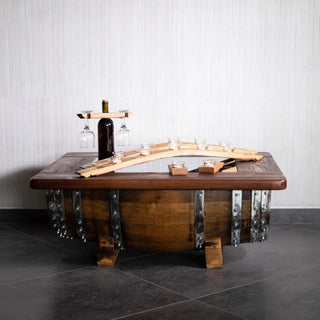
- Light inside the display. The Half-Barrel Coffee Table ($783) features a full-depth display under a glass-center top. A small battery LED placed inside lights up whatever you show there.
Can you light a barrel bar without an electrician?
Yes: begin with candles, plug-in lamps and battery LEDs. Candlelight is the warmest light there is, and it needs no wiring. The Stave Candle Centerpiece ($24.95) is a 37-inch stave with five votives (included). The Romantic Gift Pack ($132.50) includes two centerpieces, two single-candle holders and a 2-glass balance. Never leave burning candles unattended.
How do the five schemes work together?
| Scheme | Layer | Color temperature | Lights up |
|---|---|---|---|
| 1. Pendant pair | Ambient | 2700K | The round top |
| 2. Picture lights | Accent | 2700K | Stave racks and bottles |
| 3. Pour light | Task | 2700K to 3000K | The working side of the bar |
| 4. Cage pendants | Signature | 2200K to 2400K | Themselves, softly |
| 5. Grazing light | Sculptural | 2700K | The barrel's curve and hoops |
For most rooms, a simple plan is scheme 1, scheme 3 and either 2 or 5, each on its own dimmer. That takes you from a bright setup for game day to a dim after-dinner pour without changing a bulb. You'll find the bars themselves in Barrel Bars.
For more on how light interacts with wire-brushed oak, see Why Wire-Brushed Staves Look the Way They Do. For a cellar, see Wine Cellar Lighting That Flatters Reclaimed Oak.
Frequently asked questions
Should bar lighting be warm or cool?
Warm. Light around 2700K is flattering to oak, whiskey and skin. Cool white makes a lounge feel clinical.
How high should pendants hang over a barrel bar?
About 30 to 36 inches over the top, slightly off-center over a glass-center top to keep the bulb from reflecting in the glass.
Do I need an electrician?
Yes, for hardwired pendants, picture lights or ceiling spots, use a licensed electrician. Plug-in lamps, battery LEDs and candles do not require wiring.
Does lighting damage barrel furniture?
LED lighting is fine. Keep the barrel pieces out of direct sunlight from windows, and keep candles and hot bulbs away from the wood.
What's the cheapest way to add warm light to a barrel bar?
Candles. The Stave Candle Centerpiece ($24.95) holds five votives and ships free in the continental U.S. Oak Wood Wine Barrels ships in-stock orders within five business days.