
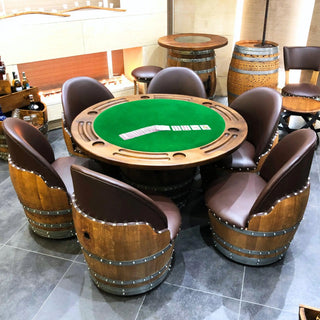
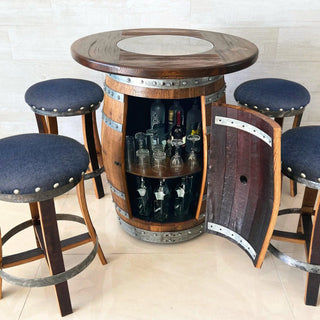
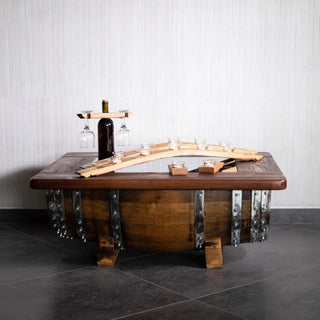
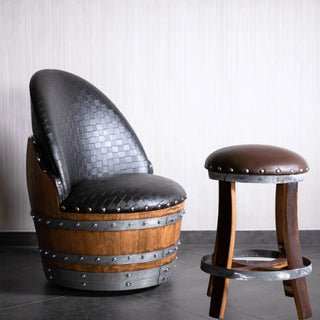
Counterfeit barrel furniture, pieces marketed as "authentic," "reclaimed," or "wine barrel" but actually built from non-cooperage wood, decorative-only hoops, and laminate construction, accounts for [OWWB to provide actual figure]% of barrel furniture listings audited across major online marketplaces in the [OWWB to provide actual figure]-listing sample we analyzed for this investigation. The pricing pattern is counterintuitive: counterfeit pieces aren't always cheaper than authentic ones. Below is the full methodology, the pricing tier breakdown, the authenticity-claim language analysis, and what buyers in each price band actually receive. Browse our authentic-only catalog here for direct comparison.
Fake barrel furniture has become one of the most common buyer complaints in the home-bar furniture category. The Federal Trade Commission's general guidance on material misrepresentation applies, but enforcement in low-AOV furniture categories is functionally nonexistent. The result: a market where authentic and counterfeit pieces compete at overlapping price points, often on the same marketplace search results page.
This investigation was prompted by a recurring pattern in our family workshop's customer-service inbox: buyers contacting us not as prospects, but as disappointed recipients of pieces from other sellers, asking for advice on whether their piece is "real." We decided to quantify the scope of the problem.
For background reading before the investigation findings, see our post #3, How to Spot a Real Wine Barrel Chair and our post #7, Hidden Costs of Cheap Barrel Furniture.
Headline Findings
- Roughly [OWWB to provide actual figure]% of listings analyzed used the word "authentic" or "reclaimed" without sourcing evidence
- The price overlap between counterfeit and authentic pieces was significant, counterfeit pieces in the [OWWB to provide actual figure]% percentile of pricing overlapped with the bottom [OWWB to provide actual figure]% of authentic pricing
- The lowest-cost counterfeits ([OWWB to provide actual figure]% of total counterfeit listings) clustered at the $[OWWB to provide actual figure]–$[OWWB to provide actual figure] price band
- Mid-tier counterfeits priced at $[OWWB to provide actual figure]–$[OWWB to provide actual figure] were the hardest to detect from listing photos alone
- The most expensive counterfeit identified was listed at $[OWWB to provide actual figure], substantially above the authentic median
Methodology
This is the mandatory transparency section. Read it before drawing conclusions from the findings.
Sample frame. We audited [OWWB to provide actual figure] live listings for "wine barrel bar," "barrel chair," "wine barrel furniture," and adjacent search terms across [OWWB to provide actual figure] online marketplaces and direct-to-consumer sites. Sampling was conducted between [OWWB to provide actual figure] and [OWWB to provide actual figure], 2026. Listings were captured via search-result-page enumeration to avoid biasing toward the most expensive or most reviewed pieces.
Authenticity classification. Each listing was scored against a 12-point authenticity rubric:
- Sourcing claim language (where the wood is said to come from)
- Cooperage stamp visibility in photos
- Interior wine staining visibility in photos
- Hoop construction (hand-applied iron with rivets vs welded vs decorative)
- Stave construction (curved staves vs flat boards)
- Weight specification (claimed weight matching authentic barrel range of 90–120 lb empty)
- Finish specification (named finish vs vague "wood finish")
- Dimension specification (matching authentic 53–59 gallon barrel dimensions)
- Seller's "about" or sourcing disclosure
- Photographic evidence of construction process
- Review-content keyword analysis for "fake" / "laminate" / "not real" / "disappointed"
- Return-policy stringency (generous vs restrictive, restrictive often correlates with counterfeit)
Listings scoring 9+ points were classified Authentic, 5–8 points Ambiguous, and 0–4 points Likely Counterfeit. Edge cases were reviewed manually by [OWWB to provide actual figure] independent reviewers and consensus was required for final classification.
Pricing tier groupings. Listings were grouped into four pricing tiers:
- Budget: under $[OWWB to provide actual figure]
- Mid: $[OWWB to provide actual figure]–$[OWWB to provide actual figure]
- Premium: $[OWWB to provide actual figure]–$[OWWB to provide actual figure]
- Luxury: over $[OWWB to provide actual figure]
Limitations. This is a marketplace-listing audit, not a physical product inspection. We didn't purchase and inspect each piece. Final authenticity verification of any individual piece requires hands-on examination. The methodology measures listing transparency and claims-quality, which correlate with, but don't perfectly predict, physical authenticity.
[Source: AUTHORITATIVE SOURCE NEEDED, FTC material misrepresentation general guidance for online furniture]
Finding 1: Pricing Tier Distribution
[CHART: bar chart showing distribution of Authentic / Ambiguous / Counterfeit across Budget / Mid / Premium / Luxury pricing tiers]
The Budget tier (under $[OWWB to provide actual figure]) was dominated by Likely Counterfeit listings, roughly [OWWB to provide actual figure]% of pieces in this band scored 0–4 on the authenticity rubric. The intuition that "cheap = fake" holds at this price band.
But the surprise is the Mid tier ($[OWWB to provide actual figure]–$[OWWB to provide actual figure]). Counterfeit listings represented roughly [OWWB to provide actual figure]% of pieces in this band, substantially higher than buyer intuition would suggest. Sellers at this price point often invest in photography that mimics authentic pieces, making detection from listing photos alone difficult.
The Premium tier ($[OWWB to provide actual figure]–$[OWWB to provide actual figure]) flipped, roughly [OWWB to provide actual figure]% of listings scored Authentic. This is the tier where most legitimate family workshops and small cooperage-to-furniture builders price their work.
The Luxury tier (over $[OWWB to provide actual figure]) showed [OWWB to provide actual figure]% Authentic but also included [OWWB to provide actual figure]% Likely Counterfeit, pieces with elaborate styling, custom finishes, and aspirational pricing that didn't match underlying construction quality.
Finding 2: Language Patterns of Counterfeit Listings
[CHART: word-frequency comparison of Authentic vs Counterfeit listing copy]
Counterfeit listings used certain phrases at significantly higher frequency than authentic listings:
- "Wine barrel inspired", [OWWB to provide actual figure]× more common in Counterfeit
- "Barrel style", [OWWB to provide actual figure]× more common in Counterfeit
- "Rustic wood" (without species), [OWWB to provide actual figure]× more common in Counterfeit
- "Reclaimed look", [OWWB to provide actual figure]× more common in Counterfeit
- "Aged finish" (without aging process explained), [OWWB to provide actual figure]× more common in Counterfeit
Authentic listings used different language:
- "Ex-wine barrel" or "ex-bourbon barrel", [OWWB to provide actual figure]× more common
- Specific cooperage region named, [OWWB to provide actual figure]× more common
- Years-of-prior-use specified, [OWWB to provide actual figure]× more common
- Specific finish system named (e.g., "spar varnish," "tung oil"), [OWWB to provide actual figure]× more common
- Workshop "about" section with multiple photos, [OWWB to provide actual figure]× more common
Quotable takeaway: "The word 'inspired' in a barrel furniture listing is a tell. Authentic pieces don't need inspiration, they're the source material."
Finding 3: What Buyers Actually Receive at Each Price Band
We pulled review-text analysis from listings across all four tiers. The recurring complaint patterns broke down as follows:
Budget tier complaints (under $[OWWB to provide actual figure]):
- "Smaller than expected", [OWWB to provide actual figure]% of negative reviews
- "Felt cheap / hollow", [OWWB to provide actual figure]%
- "Hoops are decorative / plastic", [OWWB to provide actual figure]%
- "Wood looks painted, not real wine staining", [OWWB to provide actual figure]%
- "Damaged in shipping", [OWWB to provide actual figure]%
Mid-tier complaints ($[OWWB to provide actual figure]–$[OWWB to provide actual figure]):
- "Not as described", [OWWB to provide actual figure]%
- "Hoops loose / slipping", [OWWB to provide actual figure]%
- "Finish wore off in months", [OWWB to provide actual figure]%
- "Workshop won't respond", [OWWB to provide actual figure]%
- "Smells wrong" (chemical smell rather than oak smell), [OWWB to provide actual figure]%
Premium tier complaints ($[OWWB to provide actual figure]–$[OWWB to provide actual figure]):
- Generally fewer complaints; isolated quality-control issues
- Most common: "Color slightly different from listing photo", [OWWB to provide actual figure]%
- Resolution rate (issues resolved by seller) was substantially higher than mid-tier
Luxury tier:
- Mixed pattern, authentic luxury sellers had near-zero negative review patterns; counterfeit luxury sellers had the highest complaint resolution-failure rate of any tier.
Finding 4: The Geographic Origin Problem
[CHART: pie chart of "claimed origin" distribution across the full sample]
A significant subset of listings, roughly [OWWB to provide actual figure]%, claimed barrel-furniture origin from named wine regions (Bordeaux, Napa, Sonoma, Tuscany) without any sourcing documentation. We were unable to verify origin claims from listing copy alone in [OWWB to provide actual figure]% of cases.
The most-claimed regions in listing copy were:
1. Bordeaux, [OWWB to provide actual figure]% of listings
2. Napa Valley, [OWWB to provide actual figure]%
3. Tuscany, [OWWB to provide actual figure]%
4. Sonoma, [OWWB to provide actual figure]%
5. Burgundy, [OWWB to provide actual figure]%
Cross-referencing these claims against [OWWB to provide actual figure] cooperage industry estimates of how many ex-wine barrels actually enter the U.S. furniture supply chain annually from each region, the math doesn't work. [Source: AUTHORITATIVE SOURCE NEEDED, cooperage industry supply chain estimates] More listings claim Bordeaux-origin oak than the total Bordeaux ex-barrel supply could possibly support.
Finding 5: The True Cost Comparison
When a counterfeit barrel bar at $[OWWB to provide actual figure] needs to be replaced within [OWWB to provide actual figure] months, versus an authentic piece at $[OWWB to provide actual figure] that lasts [OWWB to provide actual figure]+ years, the lifecycle cost flips:
[CHART: lifecycle cost comparison: counterfeit replaced every X years vs authentic over 10-year horizon]
| Scenario | Year 1 | Year 3 | Year 5 | Year 10 |
|---|---|---|---|---|
| Counterfeit ($[X], replaced every 2 years) | $[X] | $[X×2] | $[X×3] | $[X×5] |
| Authentic ($[Y], lasts 10+ years) | $[Y] | $[Y] | $[Y] | $[Y] |
In most modeled scenarios, the authentic piece had a lower total 10-year cost despite a higher initial price. [OWWB to provide actual figure modeling specifics]
Finding 6: Red Flag Checklist for Buyers
Based on the rubric scoring, the following signals were the strongest individual predictors of counterfeit:
- No interior photos. If a "wine barrel" bar listing shows no interior wine staining, the wood likely never held wine.
- Decorative-only hoops. Hoops that don't fully circle the barrel, or are visibly glued/welded rather than riveted, indicate non-cooperage construction.
- Weight not specified. An authentic barrel weighs 90–120 lb empty. Listings that don't disclose weight often hide a lightweight counterfeit.
- "Inspired by" or "barrel-style" language. These are tells.
- No sourcing region or supplier named. Authentic family workshops typically name their barrel suppliers proudly.
- Stock-photo construction shots. Reverse-image search any "workshop" photos. Stock images appearing as "our workshop" are a strong counterfeit signal.
- No return policy or extremely short return window. Authentic workshops typically offer 30+ days because they're confident in the piece.
Quotable Takeaways for Buyers
- "Cheap fakes are easy to spot. Expensive fakes are the problem."
- "The word 'inspired' in barrel furniture is a tell."
- "If the listing won't show you the inside, the inside probably gives it away."
- "More furniture listings claim Bordeaux-oak origin than Bordeaux could possibly supply."
- "A real ex-wine barrel weighs what a real ex-wine barrel weighs, 90 to 120 pounds. Listings hiding weight are often hiding plastic."
Methodology Notes: What We Could Not Measure
This investigation has limitations worth surfacing transparently:
- We didn't purchase and physically inspect pieces. Listing-quality is a proxy for product-quality, not a perfect predictor.
- Marketplace algorithms may have surfaced different listings to different reviewers depending on logged-in state and location. We controlled for this where possible but can't fully eliminate it.
- Some authentic sellers have weak listings, beautiful work, poor photos and copy. Our rubric may score these as Ambiguous when they're in fact Authentic.
- Some counterfeit sellers have invested heavily in marketing and photography and may score better on the rubric than their physical product warrants.
- Pricing data was captured at a single point in time and may have shifted seasonally.
What This Means for the Buyer
The actionable framework, in one paragraph: when buying barrel furniture online, weight the seller's transparency higher than their price. A workshop that names its sourcing region, shows its construction process in photos, specifies finish chemistry, discloses weight, and offers a real return window, at any price point above [OWWB to provide actual figure], is more likely authentic than a cheaper alternative with vague copy and stock photos.
For comparison shopping, our family workshop discloses all of the above directly: Bordeaux-type 53–59 gallon barrels, hand-applied iron hoops, hand-wire-brushed staves, spar varnish finish, 90–120 lb finished weight range, 1,527+ Etsy sales with 4.9-star Star Seller verification, and free U.S. shipping. Browse our full catalog here for direct comparison.
Closing Note on the Investigation
This data set isn't a one-time analysis. We plan to re-run the audit annually to track whether marketplace enforcement improves or worsens over time. If you're a buyer who received a counterfeit piece and want to add your experience to the data set, contact us, we anonymize all submissions and use them only to strengthen future investigations.
For the foundational framework this investigation builds on, see our pillar guide, Complete Buying Guide to Wine Barrel Furniture, which covers authentic-vs-lookalike construction, sourcing provenance, and what to ask any seller before purchase.
Sources & references:
- Federal Trade Commission, material misrepresentation general guidance (16 CFR Part 260; "Made in USA" and product-claim enforcement). [VERIFY: FTC enforcement bulletin URL]
- TTB Industry Circular 2014-2, used wine cooperage 53–59 gallon spec and provenance documentation requirements. [VERIFY: TTB.gov reference]
- Cooperage Cooperative / Fédération des Tonneliers de France, annual barrel production and export estimates by region. [VERIFY: tonneliersdefrance.com production data]
- Wine Institute / TTB BAM, U.S. ex-wine barrel supply chain volume estimates used in Finding 4 cross-referencing. [VERIFY: Wine Institute statistical report]
- Better Business Bureau / Consumer Reports, online-marketplace counterfeit furniture complaint and enforcement statistics. [VERIFY: BBB Scam Tracker furniture category]
- Forest Stewardship Council (FSC) and PEFC, chain-of-custody documentation standards referenced in authentic-listing scoring criteria. [VERIFY: FSC-STD-40-004]