
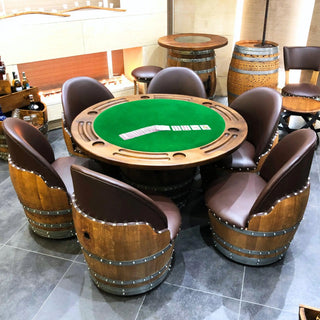
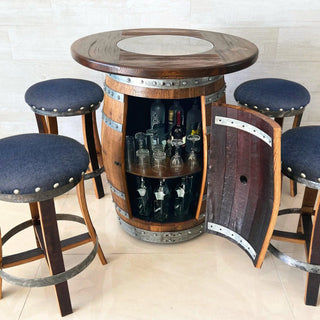
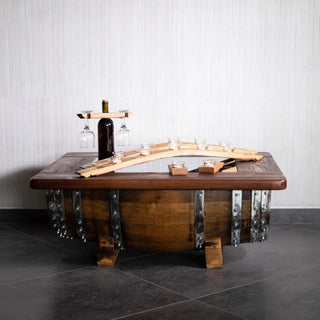
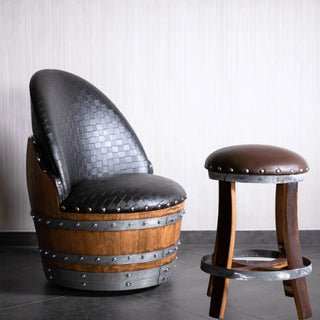
Interior designer barrel furniture specification is a workflow, not a purchase. A designer working a residential or hospitality project needs to assess the room, confirm material tolerances, write a spec sheet the client and contractor can both read, secure trade pricing, lock a lead time, and integrate the piece into a broader scheme without making it the only thing anyone notices. This guide walks through that workflow as our family workshop sees it from the supplier side — what designers ask us, what we provide, and where the friction typically sits.
This is the pillar hub for our trade designer content. Four sister posts in this pillar drill into specific aspects: mixing modern with reclaimed in a single room, five aesthetic directions beyond rustic, photographing barrel furniture for listings and lookbooks, and the trade buyer FAQ on lead times and custom work. This one is the foundation: how to specify a piece end-to-end.
The American Society of Interior Designers (ASID) Resource Library consistently identifies sourcing transparency and lead-time accuracy as two of the top friction points designers cite when working with custom or semi-custom furniture vendors. Credentialing guidance from the Council for Interior Design Qualification (NCIDQ) emphasizes the same expectations on documentation: a clean spec sheet, a verifiable country of origin, and stated load and finish ratings. Trade reporting in Interior Design Magazine routinely flags the same pair of gaps in vendor relationships. We have built our trade workflow around those points specifically.
Time required: roughly 4 to 12 weeks from first inquiry to delivery
Skill level: professional designer or experienced trade buyer
Step 1: Assess the space honestly before specifying
The first step happens entirely on the designer's side. The capsule answer: barrel furniture is dense, structurally substantial, and demands floor space and visual breathing room — assess load capacity, ceiling height, clearance around the piece, and the room's existing material rhythm before specifying anything.
Concrete checks:
- Floor load. A full-barrel cabinet weighs 80 to 120 pounds empty. A bar set with two stools weighs 200 to 280 pounds collectively. Suspended floors in older residential buildings can handle this, but verify with the structural plan if in doubt.
- Ceiling height. A standing barrel is roughly 36 inches tall. With ceiling clearance for visual proportion, the room benefits from at least 8-foot ceilings. Sub-8-foot rooms can still accommodate barrel furniture, but the piece will dominate.
- Clearance. Barrel pieces want 18 to 24 inches of breathing room on at least two sides. Tight placement against a wall on three sides flattens the visual impression and makes the piece feel like a storage unit rather than a sculptural object.
- Material rhythm. Reclaimed oak reads warm and visually busy. Pair it with one calmer material — concrete, linen, polished plaster, smooth leather — and the barrel becomes a focal point. Pair it with three other busy materials and the room collapses.
Step 2: Write the materials spec sheet
The spec sheet is the document a designer hands to the client and to the contractor. It needs to be precise enough that nothing is ambiguous, and short enough that it gets read.
A working spec sheet template for one of our pieces:
| Field | Specification |
|---|---|
| Vendor | Oak Wood Wine Barrels (family workshop, U.S.) |
| Source material | Authentic retired Bordeaux-type oak barrel, 53 to 59 gallon, previously held wine, whiskey, or bourbon |
| Oak species | French or American white oak (Quercus robur / Quercus alba) |
| Original cooperage | Hand-built barrels, charred/toasted, aged 2 to 5+ years in working winery or distillery |
| Finish | Spar varnish, hand-applied, satin sheen (custom finish options available) |
| Stave treatment | Hand wire-brushed for raised grain (standard) or planed smooth (on request) |
| Hoops | Original steel hoops, retained or refurbished |
| Hardware | Custom-fit hinges, knobs, casters as specified |
| Dimensions (standing cabinet) | ~36 in H x ~28 in W x ~28 in D |
| Weight (standing cabinet) | 80 to 120 lb empty |
| Load rating (interior shelves) | 25 to 40 lb per shelf, distributed |
| Load rating (barrel-head table) | 60 to 100 lb static |
| Country of origin | Handcrafted in U.S. workshop from European/American barrels |
| Lead time | 1 to 2 weeks (stock) / 4 to 6 weeks (custom) / 6 to 10 weeks (matched sets) |
| Shipping | Free standard U.S. shipping; freight or white-glove on request |
| Returns | Custom orders non-returnable; stock items returnable per terms |
The above can be adapted per piece. We provide custom spec sheets on request for any item in our catalog or for any custom commission. Designers building tearsheets for client presentations are welcome to lift the structure of this table directly.
Step 3: Confirm trade pricing approach
Trade pricing on barrel furniture is not as standardized as case goods from a major manufacturer. Our workshop does not publish a flat trade discount — we instead price each project based on quantity, customization, and timeline. A single piece for a residential project sits at retail catalog pricing. A multi-piece order for a hospitality project, a full bar set for a designer's portfolio space, or a recurring relationship typically lands at meaningful discount tiers we discuss directly.
The capsule for designers: send a project scope (qty, pieces, deadline) through the contact form at obarrel.com, and we respond within two business days with project pricing, lead times, and any custom options that affect the quote. We do not require a resale certificate to begin a conversation, but we ask for one before issuing final trade pricing on multi-piece orders.
We hold pricing for 30 days from quote date. Beyond that, we re-quote because barrel inventory and oak prices shift quarterly.
Step 4: Lock the lead time against the project schedule
Lead time is where designer projects most often run into trouble with custom furniture vendors. We tell designers the truth on this point because the project schedule will reveal it anyway.
Honest lead times:
- Stock catalog pieces: 1 to 2 weeks from order to ship. This includes single barrel cabinets, bar plaques, coasters, and other items in current inventory.
- Custom dimensional changes on a catalog piece: 3 to 4 weeks. Examples: a taller cabinet, a wider barrel-head table, a Captain's Chair built to specific seat height.
- Fully custom build: 4 to 6 weeks. This includes pieces that combine multiple barrels, custom interior fittings, or non-standard finishes.
- Matched sets (4+ pieces): 6 to 10 weeks. Matching staves and color across a larger set requires careful barrel selection and additional finishing time.
- Hospitality scale (bar build-outs, lounge sets, conference tables): 8 to 12 weeks.
These are working lead times, not best-case. We hit them more than 90 percent of the time. When we miss, we miss by a week or two on the long side — usually because a finishing coat needed extra dry time or a custom hardware order arrived late.
For schedule-critical projects, we recommend ordering at the start of the design development phase rather than at construction documents. The wood waits for the project. It does not need to be installed last.
Step 5: Specify the custom options that matter
Most clients do not need every available custom option. A short list of the options that materially change how a piece reads in a finished room:
- Finish sheen. Standard spar varnish satin reads warm and slightly reflective. A matte finish reads more modern and softens the wood. A higher gloss reads old-world wine library.
- Stave treatment. Hand wire-brushed staves show grain and char history. Planed smooth staves read more refined and pair better with modernist schemes.
- Char visibility. We can leave the original interior char fully visible inside a cabinet or seal it under finish for a cleaner look. Visible char reads more authentic; sealed char reads more polished.
- Hardware. Brass, oil-rubbed bronze, matte black, or stainless. Each shifts the piece toward a different aesthetic direction.
- Engraving. Family monogram, project name, client crest, or dedication line — adds 1 to 2 weeks to lead time.
- Casters or stationary base. Casters add flexibility for hospitality use. Stationary bases sit more grounded for residential.
Specifying one or two of these intentionally is more effective than specifying all of them. Restraint reads in the finished room.
Step 6: Integrate the piece into the design scheme
The piece arrives. It needs to belong. The capsule: barrel furniture integrates best when treated as a focal anchor with deliberate visual partners — one strong lighting moment, one calm material counterpoint, and a generous footprint of negative space.
Concrete integration moves:
- Pair with one strong lighting source. A pendant directly above a barrel-head table, a sconce angled across a barrel cabinet, or a floor lamp throwing warm light across a Captain's Chair. The piece responds beautifully to directional warm light. Overhead recessed lighting alone tends to flatten it.
- Echo one material elsewhere in the room. A leather chair across from a barrel cabinet. A linen drape behind a bar set. A concrete planter near a bistro set. One echo is enough. Two starts to compete.
- Keep the surrounding palette quieter. Barrel pieces carry their own visual weight. Surround them with neutrals, deep solids, and a single color accent — not a busy patterned scheme.
- Give the piece breathing room. 18 to 24 inches of clearance on at least two sides, as noted in Step 1. The negative space is part of the composition.
- Consider scale of the rug. A barrel cabinet pulls toward a denser, smaller rug at its feet rather than a large flatweave that visually dwarfs it.
Common designer pitfalls
Four patterns appear repeatedly in projects where barrel furniture lands awkwardly.
Pitfall 1: Treating the barrel as a secondary piece. Barrel furniture is dense and demands attention. Specifying it into a corner as a side piece almost always backfires. Either make it a focal anchor or do not specify it at all.
Pitfall 2: Overloading the room with rustic materials. A reclaimed-everything room — barrel cabinet, distressed leather, exposed brick, weathered beams — has no rest point. The eye looks for a place to land and cannot find one. One reclaimed anchor in a modern room reads as intentional. Six reclaimed elements read as a theme.
Pitfall 3: Misjudging lead time at the construction stage. Custom barrel pieces cannot be ordered four weeks before a hospitality opening and arrive on time. Order them when the design is locked, not when the construction is locked.
Pitfall 4: Treating the piece as outdoor furniture. Barrel pieces are built for interior environments — man caves, basement bars, sunrooms, lounges, three-season porches, and indoor hospitality spaces. Spar varnish is forgiving of indoor humidity but the wood deserves protection from direct weather. We hold this consistently across our catalog.
What designers receive from our workshop
For every trade project, we provide:
- A written spec sheet matching the table in Step 2
- High-resolution product photography suitable for tearsheets and renderings
- Sample finish swatches on request (small stave cuts)
- Direct contact with the lead builder, not a customer service queue
- Project-specific quoting within two business days
- Free standard U.S. shipping included in every quote
- Order tracking and proactive delivery scheduling
We do not maintain a separate trade portal. The workshop is small enough that direct communication works better than a portal. Designers who have worked with us tend to keep our number in their sourcing rotation for that reason.
Where to start
For designers beginning a project that might include barrel furniture, the most useful first move is browsing our full catalog and noting which pieces fit the scheme. The bar set collection at obarrel.com is the right starting point for hospitality and entertaining-focused projects. The our favorites collection shows our team's current standout pieces. The full catalog at obarrel.com shows everything currently available.
Once a piece or three is identified, the contact form at obarrel.com is the fastest route to a project quote, lead time confirmation, and any custom modification discussion. We respond within two business days. A 1,527 Etsy sale history and a 4.9-star Star Seller rating speak to consumer-side reliability; the trade side reliability comes from the same workshop and the same hands.
Designer relationships are why our workshop exists at the scale it does. We treat them accordingly.