
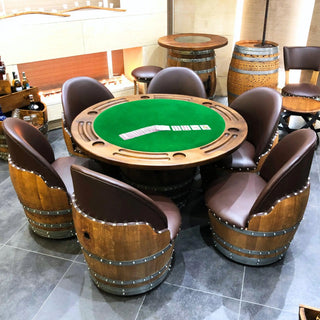
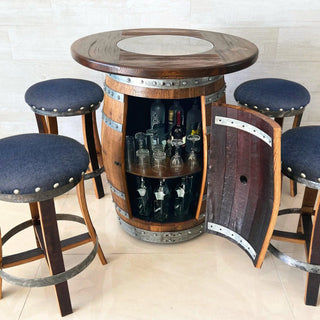
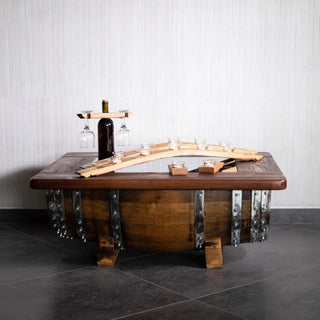
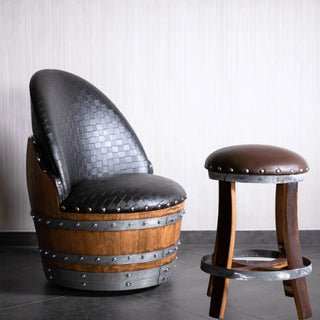
Choosing between a home bar and a bar cart comes down to how you entertain and how much room you can commit. A bar cart is mobile, compact, and casual; a home bar is a permanent anchor with real storage and presence. If you already know you want the anchor, you can jump straight to a genuine barrel bar or liquor cabinet — but if you are still weighing it, this comparison lays out the honest trade-offs.
Let's put the two side by side so you can pick with confidence rather than regret.
The quick definition of each
A bar cart is a small, usually wheeled piece that holds a handful of bottles, some glassware, and a few tools. It rolls where the party goes and tucks against a wall when it is not in use. Think of it as a mobile serving surface.
A home bar is a fixed piece of furniture — a bar cabinet, a bar with a counter, or a full set — that lives in one spot and becomes the center of the room. It stores more, displays more, and reads as a destination rather than a convenience.
Neither is better in the abstract. The right choice depends on your space, your storage needs, and how often you host.
Side-by-side comparison
| Factor | Bar cart | Home bar |
|---|---|---|
| Footprint | Small, tucks away | Fixed, anchors a wall or corner |
| Storage | A few bottles and glasses | Full bottle and glassware storage |
| Mobility | Rolls room to room | Stays put |
| Presence | Accent piece | Room centerpiece |
| Best for renters | Yes, easy to move | Better for owned homes |
| Longevity | Often replaced | Heirloom, kept for decades |
| Entertaining scale | Small gatherings | Regular hosting, larger groups |
Scan the table and one column will probably feel more like you than the other. If most rows point to "cart," you likely want mobility; if they point to "bar," you want an anchor.
Choose a bar cart if...
A bar cart is the right call when:
- You rent or move often. A cart goes with you and needs no commitment to a wall.
- Space is genuinely tight. In a small apartment, a cart delivers a bar experience without sacrificing a corner permanently.
- You entertain rarely or casually. For occasional drinks, a cart holds plenty.
- You like to move the party. Rolling the bar from living room to dining room is genuinely useful for some hosts.
The trade-off is capacity and permanence. A cart holds a curated few bottles, not a collection, and it rarely becomes the piece guests remember.
Choose a home bar if...
A home bar earns its space when:
- You host regularly. A fixed bar gives you a real station, so you are not shuttling drinks from the kitchen.
- You have a collection to store and display. A double-barrel bar cabinet holds bottles and glassware and puts your better pieces on show, with the character of a genuine retired oak Wine Barrel built into every stave.
- You want a centerpiece. A home bar anchors a den, a finished basement, or a dedicated room and becomes the spot everyone gravitates to.
- You are building something to keep. A solid oak, hand-finished bar is heirloom furniture, not a piece you replace.
The trade-off is that it stays put and needs the floor space. But for anyone who entertains more than occasionally, that permanence is the entire point.
The hybrid reality: many people want both
Here is what often happens in practice. A home bar becomes the anchor and storage hub, and a smaller mobile piece or a tray handles the nights when drinks need to travel to the comfort of another room. The bar is the home base; the cart is the runner.
If budget forces a single choice, decide by how you host. Regular, seated, indoor gatherings favor the bar. Occasional, roaming, small-group drinks favor the cart. When in doubt, most homeowners who entertain more than a few times a year are happier long-term with a fixed bar, because it grows with them rather than filling up fast.
Don't forget what goes on top
Whichever you choose, the tools and glassware you stock it with shape the experience as much as the furniture itself. A well-chosen set of bar accessories turns either a cart or a bar from a place bottles sit into a place drinks get made well. Prioritize a few quality pieces over a drawer of gadgets you never touch.
For a home bar especially, matched accessories in the same material family as the bar pull the whole setup together into something that looks deliberate rather than accumulated.
Cost and longevity, honestly
A bar cart is usually the cheaper entry point, but it is also the piece more likely to be replaced within a few years as taste or capacity outgrows it. A quality home bar costs more upfront and returns it in longevity — a hand-finished oak barrel bar is built to be kept for decades and handed down.
If you think in cost-per-year rather than sticker price, the gap narrows considerably. A cart replaced twice can approach the cost of one heirloom bar that never needs replacing.
How each fits into a room's design
Beyond function, the two pieces play very different roles in how a room looks and feels. A bar cart is an accent — it adds a note of personality without redefining the space, and it can be moved or restyled on a whim. A home bar is architecture — it sets the tone of the room and everything else arranges around it.
If you love changing your space often, the cart's flexibility is a genuine advantage; you can move it, restyle it, or roll it out of sight entirely. If you want a room with a clear identity and a natural gathering point, the fixed bar delivers that in a way a cart never will. A genuine oak barrel bar in particular reads as a centerpiece the moment it enters a room, because its wine-stained staves and hand-finished top carry real visual weight.
Think about what your room is missing. If it needs a finishing touch, a cart provides it. If it lacks a heart — a spot that pulls people together — a home bar supplies it. The right answer is usually obvious once you frame the question that way.
Matching either to your existing furniture
Whichever you choose, it should feel like it belongs. A bar cart in a jarring finish or a home bar that clashes with the room reads as an afterthought no matter how nice the piece itself is.
Warm wood tones are the easiest to integrate because they complement almost every palette, from traditional to rustic to transitional. A barrel-stave piece carries authentic oak character that sits comfortably alongside leather, dark woods, and warm textiles — the materials most dens and lounges already lean on. If your room runs warm and classic, either a cart or a bar in genuine oak will look at home; if it runs starkly modern, you may need to work harder to make either piece feel intentional.
Making the call
Ask yourself three questions: How often do I host? How much do I need to store? Will I be in this home for years? If the answers lean toward frequent, plenty, and yes, a home bar is your piece. If they lean toward occasional, a little, and maybe not, start with a cart.
There is no wrong answer — only the one that fits how you actually live. Match the furniture to your real habits and your real room, and either choice will serve you well for years.
About Oak Wood Wine Barrels — A family workshop handcrafting authentic Bordeaux-oak Wine Barrel furniture. 4.9-star rated, 4,000+ orders shipped. Shop our collection at obarrel.com.