
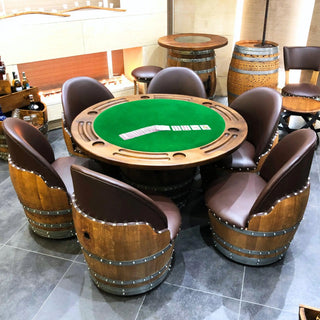
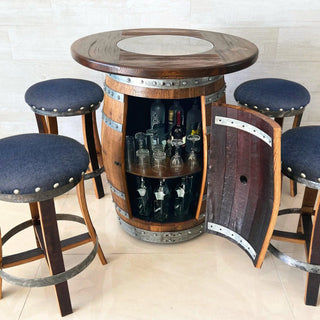
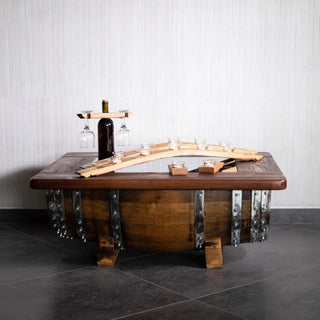
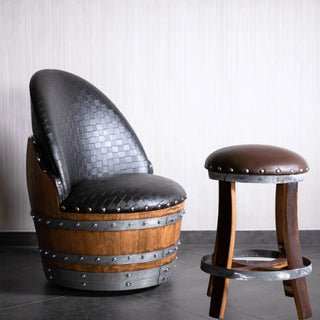
Modern rustic decor ideas usually fail in execution for one simple reason: they apply rustic everywhere instead of placing it deliberately. A room full of reclaimed wood reads as a theme. A modern room with one well-chosen reclaimed wine barrel piece reads as a designer's hand at work. The difference is restraint and ratio.
This guide lays out ten pairing principles for mixing modern interiors with authentic reclaimed barrel furniture. Each principle includes a short "do this / not that" moodboard sketch you can apply to a current project. The principles are drawn from how our family workshop sees barrel pieces land in real client rooms — both the rooms that succeed and the ones that fight themselves.
According to the American Institute of Architects' Home Design Trends Survey and ongoing reporting from sources like Architectural Digest, the dominant residential design direction since 2022 has been "warm minimalism" — clean lines, restrained palettes, and one or two pieces with material soul. Barrel furniture is purpose-built for that role.
1. The single reclaimed anchor in a modern room
The single most reliable move in mixing reclaimed with modern is to allow one piece — and only one — to carry the entire reclaimed story. The capsule: choose one substantial barrel piece, place it as the focal point of the room, and let everything else sit in a quieter modern register. The contrast is what makes both the piece and the room work.
Do this: A standing wine barrel cabinet against a smooth plaster wall, flanked by a modern slim-arm lounge chair in cream linen and a steel-and-glass floor lamp.
Not that: The same cabinet placed next to a distressed leather sofa, beneath exposed beams, on a sisal rug, with a reclaimed coffee table in front. Five reclaimed elements competing for the same eye.
2. Modern lighting on a rustic piece
Lighting is the easiest lever for modern-rustic balance. Pointing a deliberately modern light source at a reclaimed piece pulls the piece into the modern register without altering its character.
Do this: A matte black architectural pendant hung low over a barrel-head dining or bistro table. The pendant's hard geometry frames the wood's organic curve. Both win.
Not that: A wagon-wheel chandelier or a wrought-iron fixture above the same table. The wood doubles down on the rustic, and the room has nowhere to rest.
3. Neutral palette as the unifier
A neutral palette across walls, large furniture, and textiles unifies a mixed-material room more reliably than any single styling move. The capsule: choose two to three neutral colors (warm white, oatmeal, soft greige, deep charcoal) for 80 percent of the room's surfaces, and let the barrel wood supply the only saturated warm tone.
Do this: Warm white walls, an oatmeal slipcovered sofa, a charcoal area rug, and a reclaimed barrel cabinet as the room's only deep-toned wood element.
Not that: A jewel-toned accent wall, a patterned rug, and a saturated velvet sofa surrounding the same cabinet. The eye loses the cabinet and lands on the loudest pattern.
4. Scale balance: one big, several small
Reclaimed barrel pieces are large and dense. They want to be paired with several smaller modern elements rather than another single large modern piece. The capsule: balance one substantial reclaimed anchor with three to five smaller modern accents (lighting, side table, art, lamp, plant) rather than two equally weighted hero pieces.
Do this: A barrel cabinet flanked by a slim console with three small ceramic vessels and a low modern stool. The eye moves between the anchor and the smaller satellites without effort.
Not that: A barrel cabinet on one wall and a six-foot modern credenza on the opposing wall. Two heavyweights staring at each other across the room produce visual stalemate.
5. Material rhythm with deliberate counterpoint
Every material in a room sets a rhythm. Reclaimed wood reads as textured and warm. The room benefits from one calm material counterpoint placed at the same eye level.
Do this: Place a polished plaster or marble surface (a coffee table, a wall finish, a side console) within the same sight line as the barrel piece. The smooth material lets the eye rest before returning to the wood texture.
Not that: Surround the barrel piece with three other textured materials — woven rattan, distressed leather, jute rug. Four textures at once produce visual noise.
6. Mix metals with intention
Reclaimed barrel pieces include original steel hoops, which already supply a metal note. The capsule: when adding additional metal to the room, choose one finish (brass, blackened steel, polished chrome) and let the barrel hoops be the only secondary metal.
Do this: Brass cabinet hardware on a modern kitchen island, brass pendant fixtures, and the original blackened steel hoops on the barrel cabinet. Two metals, both deliberate.
Not that: Brass pulls, chrome lighting, oil-rubbed bronze plumbing fixtures, and the steel hoops. Four metals in one sight line fight each other.
7. Negative space as a design element
The most overlooked move in mixing modern with reclaimed is leaving room around the reclaimed piece. The capsule: a barrel cabinet placed with 24 to 36 inches of clear space on each side reads as a designed object; the same cabinet wedged between two other furniture pieces reads as storage.
Do this: Center a barrel cabinet on a clean wall with nothing else on the wall surface and a generous floor clearance to either side. Use a wall sconce or a small framed work above it, not a gallery wall.
Not that: Push the cabinet into a corner, place a chair tight against one side, and run a console along the adjacent wall. The piece disappears into the furniture mass.
8. Echo one organic curve elsewhere
The barrel's curved profile is its strongest visual signature. The capsule: echo that curve once elsewhere in the room — a rounded modern armchair, a circular mirror, an arched doorway, a curved sofa — and the barrel piece reads as part of an intentional shape language rather than an outlier.
Do this: A barrel-head dining table with curved-back modern chairs in a contrasting material (molded plywood, leather, woven cane). The curve repeats; the materials contrast.
Not that: The same barrel-head table with strictly rectilinear chairs, against a square pattern rug, beneath a rectangular pendant. The barrel's curve becomes the only round shape in a room of straight lines and reads as visually orphaned.
9. Texture contrast over color contrast
When in doubt, contrast the textures and harmonize the colors. The capsule: a reclaimed barrel piece in warm oak tones reads beautifully next to smooth linen, polished concrete, brushed plaster, or fine wool — all of which can share a similar warm-neutral color register while contrasting completely in surface texture.
Do this: A wire-brushed barrel cabinet in warm oak next to a cream linen drape and a polished concrete floor. All three sit in the same warm-neutral color family. The textures could not be more different.
Not that: A reclaimed barrel piece in warm oak next to a glossy red lacquered console. Color contrast plus texture contrast plus material contrast — three competitions at once.
10. Restraint as the final pass
Every mixed-material room benefits from a final restraint pass. The capsule: after the room is "designed," remove two to three objects. Empty surfaces, fewer textiles, and clearer sight lines almost always improve a modern-rustic mix.
Do this: A barrel cabinet, a single ceramic vessel on top, one framed work on the wall above, and a lamp on a small side table nearby. Four objects. The eye reads the composition cleanly.
Not that: The same cabinet with five ceramic vessels, a stack of books, a gallery wall above, a runner across the top, and two table lamps nearby. Twelve objects competing for attention.
Summary moodboard table
| Pairing principle | Do this | Not that |
|---|---|---|
| Single reclaimed anchor | One barrel piece + smooth modern surroundings | Reclaimed everything everywhere |
| Modern lighting on rustic | Matte black architectural pendant on barrel-head table | Wagon-wheel chandelier overhead |
| Neutral palette unifies | Warm neutrals + barrel as only saturated warm note | Jewel tones competing with the wood |
| Scale: one big, several small | One barrel anchor + 3 to 5 small modern accents | Two heavyweight pieces staring across |
| Material rhythm counterpoint | One calm material (plaster, marble) near the wood | Three textures piled together |
| Mix metals with intention | One added metal + original hoops | Brass + chrome + bronze + steel |
| Negative space | 24 to 36 inches clear on each side | Wedged between other furniture |
| Echo one organic curve | Curved chair, round mirror, arched opening | Strictly rectilinear everything else |
| Texture over color contrast | Same color family, contrasting textures | Color contrast plus texture contrast |
| Final restraint pass | Four well-chosen objects | Twelve objects competing |
Two project archetypes that work
Two specific modern-rustic project types come up repeatedly in our designer conversations, and both succeed reliably when the principles above are followed.
The basement bar lounge. A finished basement room serving as a private bar and entertaining space. The reclaimed anchor is a full bar set built from a barrel — cabinet, two stools, barrel-head serving surface. The modern register is supplied by linear LED cove lighting, a polished concrete or large-format tile floor, leather-upholstered seating in a deep solid color, and a single modern art piece on the main wall. The result reads as a sophisticated private bar, not a man cave cliché.
The sunroom or three-season porch. An indoor-facing sunroom or fully enclosed three-season porch hosting a bistro setup or a small lounge area. The reclaimed anchor is a barrel-head bistro table with two chairs, or a single Captain's Chair next to a small barrel-head side table. The modern register is supplied by clean-lined window treatments, smooth-finished floor surfaces, and one or two modern plants in simple ceramic pots. The room reads as both casual and considered.
In both cases, the reclaimed barrel piece is the only reclaimed material in the room. Everything else stays modern, neutral, and quiet around it.
Where reclaimed-modern projects most often go wrong
The single most common failure mode we observe is the "rustic theme room" — every surface and material chosen to amplify the rustic register, with no modern element to set up the contrast. The room ends up reading flat. Without contrast, even authentic reclaimed wood can look generic.
The second most common failure mode is the opposite — a strictly modern room with a reclaimed piece slotted in apologetically, as if the designer wanted to add warmth but lacked the conviction to commit. The reclaimed piece needs a real role in the composition, not a corner placement.
The third failure mode is mistaking distressed for reclaimed. Manufactured distressed furniture sold at retail does not carry the visual weight of an authentic retired wine, whiskey, or bourbon barrel. The original barrel's char marks, hand-applied hoops, and decades of liquid contact give the wood a depth that surface-distressed pine cannot replicate. If the reclaimed anchor is going to do real design work in a modern room, it has to be the real material.
Where to start
For designers building mood boards or sourcing the reclaimed anchor for a current project, the our favorites collection at obarrel.com is the right place to begin. The pieces in that collection are our family workshop's current standouts and tend to be the easiest to integrate into modern interiors because of their clean profiles and considered finishing.
For broader exploration, the full collection at obarrel.com shows every current piece. Each piece is handmade from authentic Bordeaux-type oak barrels and finished in our family workshop, so what arrives matches what the listing shows. That consistency is a real asset on a designer project where the client expectation is set at the spec stage.