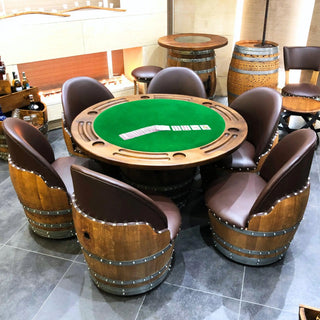
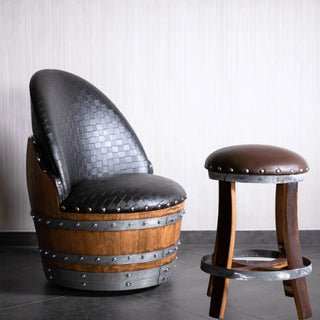
How to host a bourbon tasting at home comes down to four decisions made before the first guest arrives: which bourbons go in the flight, what you taste them out of, how you organize the scoring, and what surface you do it all on. The wine barrel table answers the fourth question — a 27-to-30-inch round of authentic Bordeaux-oak cooperage gives six guests a circular surface that puts every Glencairn glass at equal sightline, eliminates the head-of-table hierarchy, and ties the bourbon's origin story to the surface it is poured over. Bourbon, after all, is defined by federal regulation as a spirit produced from a grain mash of at least 51 percent corn and aged in new charred oak containers (27 CFR 5.143) — the wine barrel under your tasting flight is the closest furniture analog to the vessel the bourbon spent years inside.
The home tasting is a real format, not a workaround. The structure below mirrors how professional bourbon educators and distillery brand ambassadors run a tasting — adapted for a host kitchen, a 200-square-foot lounge, and a wine barrel table.
Tools and materials
| Category | Item | Notes |
|---|---|---|
| Surface | Wine barrel table (27-30 in. round) | Solid head or glass top |
| Glassware | One Glencairn per guest per pour | 3-5 per guest for a full flight |
| Glassware | One water glass per guest | Room-temp still water |
| Bourbons | 3-5 bottles for the flight | See Step 1 |
| Tasting mat | Numbered tasting mat with circles | 1 per guest |
| Score cards | Printed or app-based scoring sheet | 1 per guest |
| Pens | Black pens for note-taking | 1 per guest |
| Water pitcher | Room-temp still water for palate cleanse | Center of table |
| Bread basket | Plain water crackers or unsalted bread | Palate reset |
| Pour pitcher | 250 ml glass pitcher | For the second pour, optional |
| Spittoon | Small lidded glass or ceramic vessel | Optional, for serious tasting |
| Cheese/charcuterie | Mild cheddar, smoked gouda, salted nuts | Pairing course |
| Lighting | Overhead 2,700K pendant on dimmer | Set to 60-70% |
| Reference | Vintage chart or distillery map | Wall background |
Time required: 90 minutes of host prep on tasting day, 5 minutes per bottle for in-the-moment pours, 90-120 minutes of actual tasting time with six guests and four pours.
Skill level: Beginner. The decisions are about taste and structure, not technique.
Step 1. Build the flight.
A bourbon flight is a structured set of three to five pours designed to teach the palate something — by region, by mash bill, by age, by proof, or by barrel program. The flight is the lesson plan of the evening.
The five flight structures that work best for at-home tastings:
- By mash bill. A traditional rye-recipe Kentucky bourbon, a wheated bourbon, a high-rye bourbon, and a four-grain bourbon. Teaches the palate to identify grain bill differences.
- By age. Same brand or same mash bill at 4-year, 8-year, 12-year, and 15-year statements. Teaches the effect of barrel aging on color, viscosity, and oak-derived flavor.
- By proof. Same juice at 80, 90, 100, and barrel proof (115+). Teaches how proof affects palate weight and ethanol burn.
- By region. Kentucky bourbon, Tennessee whiskey, an out-of-state craft bourbon, an Indiana-distilled bourbon. Teaches regional and water-source differences.
- Single distillery vertical. Three to five expressions from one distillery (e.g., Buffalo Trace, Eagle Rare, Stagg Jr., Weller 12). Teaches a brand's house style.
For a first home tasting, the by-mash-bill or by-proof flight teaches the most in 90 minutes. Build the flight from least intense to most intense — lower proof and younger bourbons before higher proof and older. Palate fatigue is real; the strongest pour should land at the end, not the start.
Plan 0.5 to 0.75 ounces per pour per guest. For six guests across four pours, that is about 18 ounces of total bourbon — most of a single 750-milliliter bottle per pour, plus a little extra for second tastes.
Step 2. Set the table.
The wine barrel table is the foundation. Six guests around a 30-inch round sit shoulder-to-shoulder in a circle that makes every glass visible from every seat. There is no head of the table; every guest is at the same vantage. That equality is the social structure that makes group tastings work.
The setting per guest:
- Tasting mat at each seat. Numbered 1 through 4 (or 5), with a circle the size of a Glencairn base inside each numbered position.
- Three to five Glencairns stacked or lined up next to the mat. A guest can use one glass per pour and rinse, or use a separate glass per pour for side-by-side comparison.
- One water glass. Room-temperature still water, not chilled. Cold water shocks the palate.
- Score card and pen. A simple grid — color, nose, palate, finish, score (1-10), notes.
- Linen or paper napkin.
At the center of the table:
- Water pitcher. Room-temp still water for palate cleansing between pours.
- Bread basket. Plain water crackers or unsalted French bread. Plain cracker between pours resets the palate.
- The bourbons themselves. Bottles uncorked, labels facing out, in pouring order.
Skip flowers and tall centerpieces. The flight is the centerpiece.
Step 3. Choose the glassware.
The Glencairn glass is the working standard for bourbon tasting. The tulip shape concentrates the aroma at the rim, the short stem keeps hand heat away from the bourbon, and the wide base sits stable on the tasting mat. Riedel and other crystal-makers produce comparable nosing glasses; any of them work.
What does not work:
- Old-fashioned rocks glasses for serious tasting. The wide rim disperses the aroma and the bourbon dilutes too fast at room temperature.
- Snifters. The wide bowl is for brandy and cognac; bourbon's lower viscosity and higher proof get lost in the volume.
- Wine glasses. The proportions are wrong for spirits.
Plan one Glencairn per guest per pour. Six guests across four pours means 24 Glencairns if you do side-by-side. A starter set of 12 Glencairns ($60-$120) covers a six-guest tasting with two glasses per guest.
Step 4. Pour the first round.
The pour is small. 0.5 to 0.75 ounces — about a finger of bourbon at the bottom of a Glencairn. The goal is enough to nose, sip, and re-nose, not enough to drink for thirst.
The host pours each guest's first round in tasting order. The first bourbon goes in the position-1 circle on every guest's mat. Once all six guests have their pour, the host introduces the bourbon: name, distillery, mash bill, age statement, proof. Two sentences, not a lecture.
Then the tasting begins.
- Color. Hold the glass against the tasting mat or against a white surface (a folded napkin works). Note the color — straw, amber, copper, mahogany.
- Legs. Swirl gently. Watch how the bourbon coats the glass and slides back down. Thicker legs indicate higher proof or older age.
- Nose. Two short sniffs with the mouth slightly open. Note what comes up — vanilla, caramel, oak, leather, fruit, baking spice.
- First sip. Small. Roll across the palate. Note the texture (thin, oily, hot), the front-palate flavor, the mid-palate development, and the finish (short, long, dry, sweet).
- Water. Add one or two drops of water if proof is high. Water opens up the nose and palate on high-proof bourbon. Re-nose, re-sip.
- Score and notes. Record on the score card.
Total time per pour: 8-12 minutes for a thorough tasting with conversation, 4-6 minutes for a more casual flight.
Step 5. Cleanse the palate between pours.
A bite of plain water cracker and a sip of room-temperature water resets the palate between pours. Some hosts add a small piece of mild cheese (mild cheddar, smoked gouda) between pours for fattier palate cleansing — particularly useful between high-proof and lower-proof bourbons.
Skip strong palate disruptors during the flight: coffee, mint, citrus, spicy foods, anything heavily salted. Those courses come after the flight, not during.
Step 6. Pace the conversation.
Bourbon tasting is a social occasion, not a silent judging panel. The host's job is to keep conversation moving without letting it run over the pour itself.
Conversation prompts that work between pours:
- "What was the first thing you noticed on the nose?"
- "If you didn't know what this was, would you guess Kentucky or somewhere else?"
- "Where does this one rank against the one before it?"
- "What food would you pair this with?"
- "What's the most expensive bourbon any of you have ever tried, and was it worth it?"
Avoid:
- Quizzing guests on tasting notes they should "get."
- Long monologues about distillery history (one or two sentences per bourbon is enough).
- Letting any single guest dominate the conversation.
The host moves the table through the flight, introduces each pour, opens the conversation, then steps back and listens.
Step 7. Add the food pairing course.
After the flight is complete — typically 75-90 minutes in — bring out a small charcuterie or cheese board. The pairings that consistently work with bourbon:
- Smoked or sharp cheddar. Bourbon's vanilla and caramel notes complement the cheese's sharpness.
- Smoked gouda. Pairs with high-rye bourbons especially well.
- Aged manchego. Pairs with wheated bourbons.
- Dark chocolate (70%+). Pairs with older, oakier bourbons.
- Salted Marcona almonds. Universal bourbon pairing.
- Honeycomb on a cracker. Pairs with wheated and lower-proof bourbons.
- Cured meats — prosciutto, finocchiona salami, country ham. Pairs especially well with rye-forward bourbons.
Avoid sweet desserts with the flight — bourbon's residual sugar makes most desserts taste flat by comparison.
Step 8. The closing pour.
A final small pour of the guest favorite — vote by show of hands — closes the tasting. This is the pour where guests take their time, finish the conversation, and the formal scoring ends. 1-1.5 ounces, no scoring sheet, just enjoyment.
Why the Wine Barrel Table Is the Right Surface
A wine barrel table works for bourbon tasting because of three properties that few dining tables share:
- The round geometry. Every guest at equal sightline, no head of table, eye contact across the circle.
- The 27-to-30-inch diameter. Large enough for six tasting setups plus center accessories, small enough to keep the conversation intimate.
- The barrel-as-symbol resonance. Bourbon's federal definition requires new charred oak containers for aging (27 CFR 5.143). A wine barrel table is not literally the same vessel, but it is the closest furniture analog — the same craft, the same wood family, the same cooperage tradition. The surface tells the story.
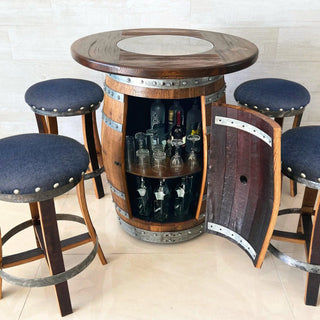
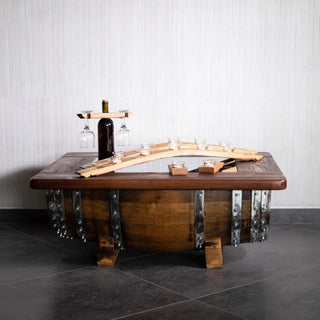
Solid barrel-head tops are best for casual tastings where the toast, the iron hoops, and the cooper's brand are part of the visual. Glass-top barrel tables work better when you want a smooth surface for tasting mats, score cards, and easy cleanup.
Common mistakes to avoid
- Pouring too much per pour. 0.5 to 0.75 ounces is the right amount. More than that turns the flight into a drinking exercise.
- Starting with the strongest bourbon. Palate fatigue ruins the rest of the flight. Build lightest to heaviest.
- Mixing whiskey categories in one flight. Scotch, Irish whiskey, Japanese whisky, and bourbon all want different palate calibration. Stick to bourbon (or all-American whiskey) for a focused flight.
- Using cold water for palate cleansing. Room-temperature water only.
- Forgetting to write down the tasting order. The host should keep one master sheet — bourbon name, pour order, score notes. The flight becomes a record for the next tasting.
- Letting a guest who already knows everything turn it into a lecture. Gently redirect with "what about you?" to a quieter guest.
- Running the flight too long. 90-120 minutes total is the right window. Past two hours, palates fade and conversation loses focus.
- Skipping water and food. Both are non-negotiable.
The Furniture Underneath the Ritual
Bourbon tasting at home is a small ceremony. The pour, the nose, the score, the conversation, the second taste — each step builds on the surface it sits on. A wine barrel table built from authentic 53-to-59-gallon Bordeaux-type cooperage stock — hand-wire-brushed staves, spar-varnish finish, the cooper's brand intact on the head — gives the ritual the gravitas it deserves. The table is older than any bottle on it. The wood has done its job once, holding wine for years inside a barrel; it does it again as the surface that holds the next generation of pours.
Our family workshop builds barrel tables in both solid-head and glass-top configurations. Free shipping in the continental U.S.; in-stock orders ship within 5 business days, then arrive 3 to 7 business days later.
Build the flight thoughtfully. Pour small. Pace the conversation. The table does the rest.