To host a wine tasting at home, choose four to six bottles around a single theme, set one glass per pour, give every guest a tasting mat with numbered circles, build a 90- to 120-minute flow that moves lightest-to-heaviest, and reset the palate between pours with water and plain crackers. That is the whole framework. Everything below is the detail that turns a casual pour into the kind of evening guests still talk about a month later. We build a lot of the surfaces these tastings happen on — a barrel table holds six glasses comfortably for four people without crowding — and the format that follows is the one our customers consistently report works in their own dining rooms and tasting nooks.
A well-run home tasting is not a performance. It is a structured pour that gives wine a chance to be discussed, compared, and remembered. The Court of Master Sommeliers Americas teaches a deductive tasting grid (color, nose, palate, conclusions) for exactly this reason: structure makes wine memorable and comparable across pours [Source: Court of Master Sommeliers Americas, Introductory Sommelier Course materials, mastersommeliers.org].
Tools and Materials
| Item | Quantity | Notes |
|---|---|---|
| Wine bottles | 4–6 | One theme; see Step 1 |
| Universal or varietal glasses | 1 per guest per pour, or 6 per guest if pre-poured | See glassware section |
| Tasting mats (printed) | 1 per guest | Numbered circles 1–6 |
| Spit bucket or "dump" pitcher | 1 per 2 guests | Opaque is kinder |
| Still water | 1 large pitcher | Room temperature |
| Plain water crackers / baguette | 1 plate per 4 guests | No flavoring |
| Pencils + scoring cards | 1 set per guest | Cheap pencils, not pens |
| Decanters | 1–2 | For older reds or tight youngsters |
| Foil cutters + waiter's corkscrew | 2 | Backup matters |
| Wine thermometer | 1 | Optional, useful |
| Notebook / index cards | Per guest | For the keepers |
Time required: 2 hours total (45 min prep, 90–120 min event, 30 min wind-down).
Skill level: Intermediate. You need to be comfortable opening, decanting, and serving — but you do not need to be a sommelier.
Step 1: Pick a Theme
Bolded step. A theme is what turns six bottles into a conversation. Without one, a tasting is a wine party. With one, it is an evening guests learn from.
Three formats work consistently:
- Vertical. Same producer, same wine, different vintages. (E.g., a Napa Cabernet from 2017, 2019, 2021.) Reveals how vintage and age change a wine.
- Horizontal. Same vintage, same region, different producers. (E.g., five 2019 Russian River Pinot Noirs.) Reveals producer style.
- Regional. Same grape, different regions. (E.g., six Chardonnays — Chablis, Sonoma, Margaret River, white Burgundy, Oregon, New Zealand.) Reveals what terroir actually means.
For a first home tasting, regional is the most forgiving. Differences are dramatic, conversation flows, and no one needs to remember which producer is which. Budget rule of thumb: $25–$45 per bottle, six bottles, splits among guests. Six bottles serves eight guests comfortably with 2-oz pours. Wine Spectator's flight-design coverage repeatedly returns to the same principle: a tight theme produces a better evening than a wider, less coherent selection [Source: Wine Spectator, "How to Plan a Wine Tasting at Home" feature archive, winespectator.com].
Step 2: Order the Flight
Bolded step. Light to heavy, dry to sweet, young to old. Reversing the order fatigues the palate before the best bottles arrive.
A reliable six-bottle flight order:
- Sparkling (palate opener)
- Crisp white (Sauvignon Blanc, Albariño)
- Richer white (Chardonnay, Viognier)
- Lighter red (Pinot Noir, Gamay)
- Bigger red (Cabernet, Syrah, Nebbiolo)
- Dessert or fortified (Port, Sauternes)
If your theme is single-varietal (e.g., all Chardonnay), order by oak/weight: unoaked → lightly oaked → fully oaked → aged.
Step 3: Set the Room and the Table
Bolded step. Cool, quiet, neutral light, no cooking smells. Wine is half nose. The room has to disappear so the wine can do the talking.
Practical setup:
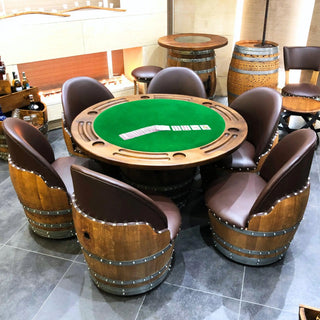
- Clear the dining table or pull out a round barrel table that seats four to six. Round tables make conversation effortless — there is no head of table, everyone is equidistant from every glass.
- Aim for 65–68°F room temperature so reds stay near 60–62°F in the glass.
- Use warm, dimmable lighting — bright enough to see color in the glass against a white background. Place a white card or folded napkin in front of each tasting mat for color assessment.
- No flowers with strong scent. No candles. No bread in the oven. Save the cooking for after.
- Quiet background music or none. Conversation is the soundtrack.
Step 4: Glassware Plan
Bolded step. One glass per pour is ideal; one glass per varietal style is acceptable.
Two workable approaches:
- Pre-pour all six glasses per guest, lined up left-to-right. Best for advanced groups doing comparative tasting. Requires 36 glasses for six guests — a lot of stemware.
- Single universal glass per guest, rinsed between pours with a splash of the next wine ("conditioning the glass"). Practical, less dramatic, perfectly acceptable.
If you are short on stems, four glasses per guest (sparkling, white, red, dessert) covers most flights without compromise. See our companion piece on the best wine glasses for a home bar for the seven-glass set most enthusiasts build toward. Decanter has covered the practical math of glass counts and table layout for home tastings in its hosting columns [Source: Decanter, "How to host a wine tasting at home" feature, decanter.com].
Step 5: Print the Tasting Mats and Scoring Cards
Bolded step. A numbered tasting mat tells guests where each pour belongs and gives them something to write on.
Each mat has:
- Six numbered circles (the diameter of your glass base)
- A short description box per pour (color, nose, palate, finish, score)
- Space for "I would buy this: Y / N" — the most honest line on the page
Scoring is optional but useful. The Wine Spectator 100-point scale or a simple 1–5 stars both work. The point is not to grade the wine; it is to give guests language and a way to remember.
Step 6: Open, Decant, and Temperature-Adjust
Bolded step. Open bottles in the correct order with enough lead time.
Lead times:
- Sparkling: open at pour
- Crisp white: open 10 minutes before pour, serve at 45–50°F
- Richer white: open 30 minutes before, serve at 50–55°F
- Lighter red: open 45 minutes before, serve at 58–60°F
- Bigger red: open 60–90 minutes before, decant if young or sediment-heavy, serve at 60–64°F
- Dessert/Port: open at pour
Use an ice bucket for whites, a wine fridge or cool basement step for reds. The single biggest red-wine mistake is serving "room temperature" at modern American room temperature, which is 72–74°F — far too warm. Cool reds 20 minutes in the fridge before service [Source: UC Davis Department of Viticulture and Enology, wine service temperature guidance, viticulture.ucdavis.edu].
Step 7: Run the Flow
Bolded step. Two-hour flow, six pours, structured pace.
- 0:00–0:15 — Arrival, water, sparkling pour
- 0:15–0:30 — Pour 1 discussion (color → nose → palate → finish)
- 0:30–0:45 — Pour 2
- 0:45–1:00 — Pour 3 + palate cleanser (crackers, water)
- 1:00–1:15 — Pour 4
- 1:15–1:30 — Pour 5
- 1:30–1:50 — Pour 6 (dessert)
- 1:50–2:00 — Group vote: favorite, biggest surprise, worst-value
Lead each pour with one sentence about what to look for. ("This one was aged 18 months in new French oak — see if you can find vanilla and clove on the nose.") Do not lecture. Ask questions and let the room answer.
Step 8: Palate Cleansers, Spit Buckets, and Pace
Bolded step. Spitting is normal, water is mandatory, food is a tool not the meal.
- Water: still, room temperature, refilled constantly. Sparkling water dulls the palate.
- Crackers or plain baguette: between pours 3 and 4. No butter, no salt, no flavoring. Plain wheat or rice crackers function as a neutral palate cleanser by absorbing residual oils and resetting the mouth between pours [Source: USDA FoodData Central, wheat cracker nutrient profile; Institute of Food Technologists, sensory evaluation literature].
- Spit bucket: opaque ceramic or pewter; a coffee mug per pair works in a pinch. Tell guests at the start that spitting is expected — it removes the awkwardness.
- Pace: 12–15 minutes per pour. Less and the wine does not open; more and the room loses focus.
Save the cheese, charcuterie, and real food for after the formal flight. Strong cheese is a tasting killer mid-flight.
Common Mistakes (and How to Avoid Them)
- Pouring too much. Tasting pours are 1.5–2 oz, not 5 oz. Six pours at 1.5 oz = 9 oz of wine per guest — enough to taste, not enough to dull the palate.
- Serving everything at 70°F. Whites get warm fast; reds are usually served too warm. Use a thermometer for the first three or four events until your eye calibrates.
- Going chronologically by what you bought, not by weight. Even a vertical needs to consider age — older bottles before younger, lighter vintages before heavier, generally.
- Letting one guest dominate. Use a round-the-table format: ask each guest one impression before opening the floor.
- Forgetting the scoring sheet at the end. Take a phone photo of each guest's mat. The data is part of the fun for the next tasting.
- Skipping the palate cleanser. Crackers and water are not optional. Without them, pour six tastes like a smear of pour three.
Choose Your Format If…
Choose a 4-bottle tasting if… it is your first time, your group is six or fewer, and you want a 90-minute event.
Choose a 6-bottle tasting if… your group is six to ten, you want a true regional or varietal spread, and you have budget for $150–$270 in wine.
Choose an 8-bottle "blind" tasting if… your group is experienced, you wrap bottles in foil, and you want a true sommelier-style deductive exercise. Add 30 minutes to the flow.
Where the Furniture Earns Its Keep
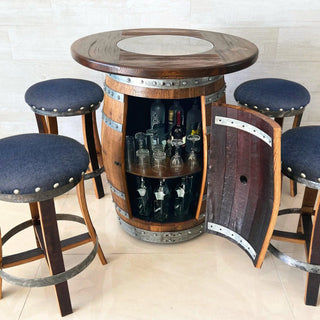
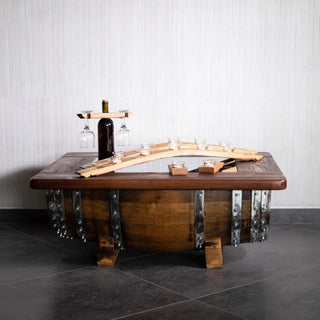
A wine barrel table is the right surface for a home tasting because the diameter naturally seats four to six, the height accommodates standing pours, and the reclaimed oak gives the room the visual anchor that turns "dinner" into "event." A round 28- to 30-inch top holds six glasses, two decanters, and a water pitcher without crowding. The base — a real Bordeaux-type 53- to 59-gallon wine barrel, hand-wire-brushed in our family workshop — also gives guests something to look at and ask about, which is exactly the right kind of conversation to seed in the first ten minutes.
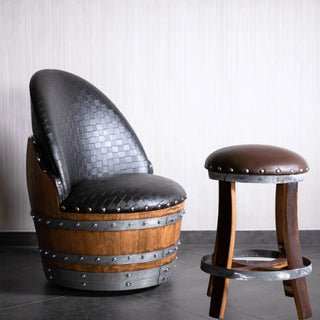
Our barrel tables are built with this use case in mind. Spar-varnish finish handles inevitable spills, the heft of a real wine barrel keeps the table stable under decanting, and the height pairs naturally with bar stools or low chairs for the wind-down hour.
A Short Note on Records
Keep an index card per event: date, theme, six bottles, group favorite, "I would buy again" votes. Six events in, you will have a quiet but real record of your own taste — and a head start on planning the next one. Our customers who host monthly tastings tell us this is the habit that turns a hobby into a practice.
For glassware specifics, see the companion piece on the best wine glasses for a home bar. For storage of half-finished bottles after the event, see our open-bottle storage guide for barrel cabinets. For everything that ties wine display, hosting, and lifestyle together, our pillar hub on wine stave rack display ideas is the broader P3 wine-lifestyle guide.