
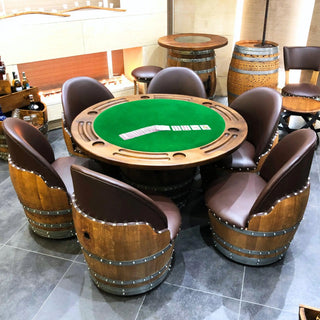
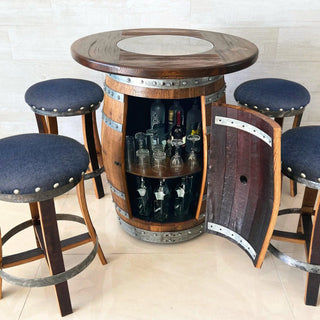
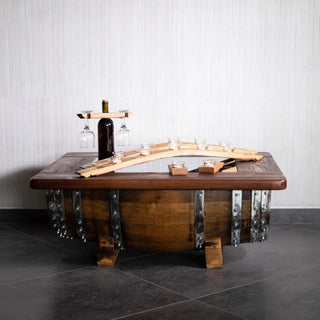
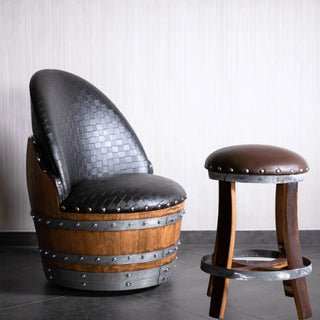
A real wine barrel chair is built from the upper half of an authentic 53-59 gallon wine barrel — its staves were bent over fire decades ago to hold actual wine, and the wine-stained interior is preserved as the visible feature. A lookalike is almost always glued laminate or thin oak veneer over plywood, shaped to suggest a barrel without ever having been one. Telling the two apart is the single most important skill when shopping for real wine barrel furniture, and it can mean a 5x difference in lifespan. You can compare authentic builds directly in our barrel chairs collection as a reference baseline.
Below is a question-by-question inspection guide, followed by a 10-point authenticity checklist you can take into any showroom or save before any online purchase.
Q1. What is the easiest single check?
Look at the inside of the chair back. A real wine barrel chair will show purple, red, or rust-brown wine staining on the interior surface of every stave. A reproduction will show clean blonde oak, painted stain, or — in the worst cases — printed wood-grain laminate.
This is the fastest single signal because wine staining cannot be faked convincingly. The pattern is uneven, follows the wood grain, and gets deeper near the head end where wine pooled.
Q2. How can I tell from a product photo?
Ask the seller for three specific photos:
- Close-up of the interior back surface. Look for wine staining.
- End view of any stave. Look for the curve and for any visible char or toast lines.
- A photo showing the hoop fit. Real hoops sit in a cooper-cut recess; decorative hoops sit flat on the surface.
If a seller cannot or will not produce these photos within a day, that is your answer.
Q3. Do the staves need to be curved?
Yes — and the curve must be continuous from end to end, not segmented. A real stave was bent under steam and fire to form a barrel, and that curve is permanent — the bending and toasting process is documented in standard cooperage practice. Lookalikes built from flat boards almost always show flat segments joined at angles, or a perfect machined arc that is too uniform to have come from a coopered barrel.
Run your finger along the outside of a back stave. If it feels like one continuous curve, it's likely real. If it feels like two flat planes meeting at a soft angle, it isn't.
Q4. What does the hoop tell me?
The metal bands wrapping a barrel chair tell you almost everything about authenticity. On real barrel furniture:
- The hoops are rolled steel, dark or rusted, not painted bright black.
- They sit deep in a groove cooper-cut into the staves.
- They are pinned with cooper rivets or screwed at every stave, not glued.
- They show working wear — hammer marks where the cooper drove them tight.
Decorative hoops on lookalikes are usually painted-black sheet metal, sit flush on the outside surface, and are held by 2-4 visible screws total.
Q5. What should the chair weigh?
A real wine barrel chair, built from authentic oak staves with a hardwood seat platform inside, weighs 35-55 pounds. A barrel-style chair built from plywood and veneer weighs 15-25 pounds. (White oak's specific gravity is roughly 0.68, which is why the real staves carry meaningful weight per inch of section.)
If the shipping weight on a "barrel chair" listing is under 30 pounds, it is almost certainly not built from a real barrel.
Q6. Does it smell like anything?
Yes. A real wine barrel chair smells faintly of toasted oak and old wine for the first few weeks in your home, fading to almost nothing over time. This is the aroma of decades of wine contact on toasted oak.
A glued laminate chair smells like wood glue and finish solvents for weeks and never develops the oak-and-wine note because there is no toasted oak inside.
Q7. What about the char marks inside?
Most wine barrels are fire-toasted on the interior before they are filled with wine — light, medium, or heavy toast depending on the cooperage. Toast levels affect tannin extraction and aroma, and a real barrel chair preserves visible toast lines on the interior surfaces.
You should see soft caramel-to-black banding on the inside, often more pronounced near the head end. You will not see this on a reproduction because it would have to be applied after the fact, which most factories don't bother to do convincingly.
Q8. How is a real barrel chair built?
The build sequence on a real chair:
- The upper third of a retired wine barrel is sawn off (about 28-30 inches up from the base).
- The cut barrel is laid on its side and the front opening is cut into a horseshoe shape.
- A hardwood seat platform is built inside, attached to the staves with hidden brackets.
- A cushion is added on top of the seat platform, or the platform is left bare for a more rustic finish.
- The piece is hand-wire-brushed to raise the grain, sanded on contact surfaces, and finished in marine-grade spar varnish.
If the seller describes a different process — particularly anything involving "barrel-style staves" or "barrel-inspired construction" — the piece is not built from a real barrel.
Q9. What does the joinery look like underneath?
Flip the chair (carefully). On a real barrel chair you will see:
- Wood seat platform attached with visible screws into the staves.
- Hoop rivets or screws clearly visible from below.
- A continuous ring base, not a separate manufactured base added on.
- Sometimes a small interior wood frame around the seat for additional support.
On a reproduction you will see a single manufactured plywood seat platform attached to a faux-stave wrap, often stapled rather than screwed.
Q10. Are there cooper markings I should look for?
Often, yes. Retired wine barrels frequently carry burn-brands or stamps from the original cooperage and the winery — vintage years, lot numbers, the winery's name, or the cooper's mark. On a real barrel chair, these marks are often visible on the inside or on the back panel. They are random, not centered, and not styled to be decorative.
If a chair's "cooper mark" is perfectly centered and reads like a font, it was likely added at the factory.
Q11. Can a reproduction ever be a good purchase?
Sometimes — if it is sold honestly. A well-built barrel-style chair from quality plywood and oak veneer, sold for $200-$400 with no claims of authenticity, can be a fine accent piece. The problem is when a $300 laminate chair is marketed as a "real oak wine barrel chair." That is where the deception costs you.
If you want the look and the price is under $500, ask the seller directly: "Is this built from a retired wine barrel, or is it new construction in a barrel shape?" An honest seller will answer either way. A dishonest seller will dodge.
Q12. What does a real wine barrel chair actually cost?
A handmade authentic wine barrel chair from a real workshop runs $450 to $900. Below $400, you are almost certainly looking at reproduction construction. Above $900, you are looking at custom features (matched pairs, upholstered cushions, branded heads).
For context, the chairs in our shop are built from the same 53-59 gallon Bordeaux-type wine barrels that our bars come from, by the same family workshop, and finished with the same spar varnish.
The 10-point authenticity checklist
Take this checklist to any showroom or save it before any online purchase. A genuine wine barrel chair will pass at least 8 of these 10.
- Wine staining is visible on every interior stave (purple, red, or rust-brown)
- Continuous curve on each stave, not flat segments
- Steel hoops sit in cooper-cut grooves, not flat on the surface
- Hoop fasteners are pinned or screwed at every stave
- Weight is 35-55 pounds, not 15-25
- Toast marks are visible on interior surfaces near the head end
- Faint oak-and-wine aroma present (especially on new pieces)
- Cooper markings or burn-brands somewhere on the piece (often)
- Joinery underneath shows hardwood platform screwed into the staves, not stapled into plywood
- Seller can tell you the barrel's general source (region, ex-red wine, vintage range)
Three red flags that almost always mean reproduction
If you see any one of these, treat the piece as a reproduction until proven otherwise:
- Listed shipping weight under 30 pounds for a "wine barrel chair"
- "Barrel-style" or "barrel-inspired" language anywhere in the product description
- Perfectly uniform staves, all the same width, all the same color — real barrel staves vary because they were made by hand
Why this matters for resale and longevity
A real wine barrel chair from a reputable workshop holds value. We routinely see secondhand authentic chairs resell at 60-80% of original price five to ten years after purchase. A reproduction has effectively zero resale value once it shows wear, which usually happens within the first two years as the laminate edges lift and the printed stain fades.
This is the part that makes the authenticity question worth the time. A $700 real chair that holds $500 of value in year 5 has cost you $40/year. A $300 reproduction that is worth $0 in year 3 has cost you $100/year. Real often costs less over time despite the higher sticker.
To shop only verified authentic builds, see our barrel chairs collection. For the full cost-per-year math, see Are Wine Barrel Bars Worth the Price? A Cost-Per-Year Breakdown and Hidden Costs of Cheap Barrel Furniture (and How to Avoid Them).
About Oak Wood Wine Barrels — A family workshop handcrafting authentic Bordeaux-oak wine, whiskey, and bourbon barrel furniture. 1,500+ Etsy sales, 4.9-star Star Seller rating. Shop our collection at obarrel.com.