
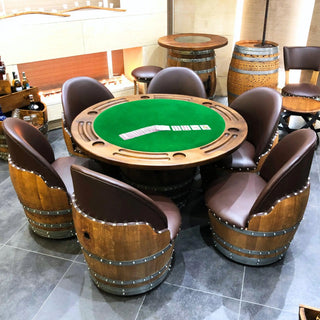
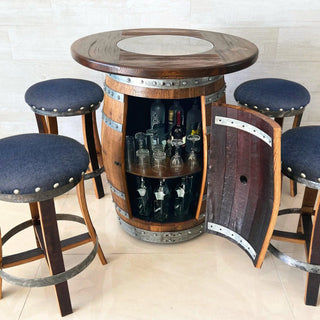
A bourbon label is a regulated document. This guide walks through what to look for, in the order you encounter it on the bottle, with a glossary at the end for the terms that take more than one sentence to explain. A bourbon library worth displaying on a wine barrel bar is a bourbon library where the buyer knows what every label actually means. Our pillar hub on hosting a bourbon tasting on a wine barrel table covers the broader bourbon-lifestyle picture.
Tools and Materials
| Item | Why You Need It |
|---|---|
| A bourbon bottle (or photo) | The label to read |
| Knowledge of TTB regulations | Decoded below |
| A pen | For notes — the back label often hides the best information |
| Patience | Some claims are marketing, not regulation |
Time required: 10 minutes per bottle the first few times; 30 seconds once trained.
Skill level: Beginner.
Step 1: Confirm It Is Actually Bourbon
Bolded step. Read the standard-of-identity line.
To be labeled "bourbon" in the United States, a spirit must meet five federal requirements:
- Produced in the United States (not just Kentucky — though 95%+ of bourbon is)
- Mashbill at least 51% corn
- Distilled to no more than 160 proof
- Aged in new charred oak containers (almost always new charred American white oak barrels)
- Entered into the barrel at no more than 125 proof
A bottle labeled "Kentucky Straight Bourbon Whiskey" meets all those federal rules and also follows Kentucky's own: the bourbon must be distilled in Kentucky and aged in Kentucky for at least one year, under Kentucky law (Kentucky Distillers' Association). A bottle labeled simply "American Whiskey" or "Whiskey Specialty" does not meet the bourbon standard — read carefully. The standard-of-identity line is usually on the front of the bottle, in small type near the bottom.
Step 2: Identify the Distiller vs. the Bottler
Bolded step. Read the "Distilled by" / "Bottled by" / "Produced by" lines.
These three terms have specific meanings:
- "Distilled by [Distillery Name]" with an address — the spirit was actually distilled at that distillery.
- "Produced by" — vague; the bottler may or may not have distilled it.
- "Bottled by" — the bottler did not necessarily distill it. The spirit may have been sourced from another distillery.
- DSP number — the Distilled Spirits Plant federal license number, prefixed by state. The DSP number on the bottle tells you exactly which licensed facility produced the spirit.
A "sourced" bourbon (purchased in bulk from a large distillery and bottled under a smaller brand's label) is not lower quality by definition — many excellent bourbons are sourced — but the label transparency tells you what you are actually drinking. A small brand with no DSP, no distillery address, and "Produced by" language is almost certainly sourced.
Step 3: Find the Age Statement
Bolded step. Look for the age in years, or for the "straight" designation.
By federal regulation:
- Any age statement is the age of the youngest spirit in the bottle.
- "Straight bourbon" must be aged a minimum of 2 years.
- "Straight bourbon" aged less than 4 years must carry an age statement.
- "Straight bourbon" with no age statement is a minimum of 4 years.
- An age statement like "10 years" means the youngest barrel in the batch is at least 10 years aged.
These rules are codified at 27 CFR Part 5 (27 CFR 5.74 and 27 CFR 5.143).
Older is not automatically better — over-aged bourbon can become bitter, tannic, and woody — but for most styles, 8–12 years is the sweet spot, and a printed age statement is a quality signal because the distillery has chosen to commit to a specific aging window rather than reserve the right to ship 4-year-old liquid under the same label next year.
Step 4: Check the Proof
Bolded step. Read the "Alcohol by Volume" and corresponding proof.
Proof = 2 × ABV. So 50% ABV = 100 proof. The proof tells you:
- 80 proof (40% ABV) — federal minimum for bourbon. Often softer, more cocktail-friendly.
- 86–92 proof — common everyday range. Balance between flavor and approachability.
- 100 proof — historically associated with Bottled-in-Bond bourbons (see glossary).
- 110–120 proof — cask-strength range without being barrel proof.
- Barrel proof / cask strength — the proof at which the spirit came out of the barrel, uncut by water. Usually 120–140 proof. Most intense flavor, requires water or ice to open up for most palates.
Higher proof is not automatically better. It is more concentrated — which means more flavor and more heat, both. Cask-strength bourbons reward attention and water; lower-proof bourbons reward casual pouring.
Step 5: Look for "Straight," "Bottled-in-Bond," or Other Designations
Bolded step. These are regulated terms with specific meanings.
- Straight Bourbon — aged minimum 2 years in new charred oak, no added coloring, flavoring, or other spirits.
- Bottled-in-Bond — must be: product of one distillery, one distilling season, aged minimum 4 years, bottled at exactly 100 proof, label must identify the distillery (27 CFR 5.88). The strictest, most transparent designation on bourbon.
- Single Barrel — every bottle in the lot comes from one barrel. Variation between bottles is expected and is part of the appeal. The label usually identifies the specific barrel and bottling date.
- Small Batch — unregulated marketing term. "Small" can mean anywhere from 10 barrels to 200, depending on the producer. Tells you less than you might think.
- Cask Strength / Barrel Proof — bottled at the proof it came out of the barrel, uncut by water. The terms are interchangeable.
Step 6: Decode the Mashbill (If Listed)
Bolded step. Find the grain composition — usually on the back label or producer's website.
A bourbon mashbill is the percentage breakdown of grains in the fermentation. The dominant flavor-affecting grain after corn (which is always at least 51%) is the "flavoring grain":
- Low-rye bourbon — 8–15% rye. Softer, sweeter, more vanilla-forward. (Maker's Mark is wheated; Buffalo Trace #1 is low-rye.)
- High-rye bourbon — 18–35% rye. Spicier, more peppery, cinnamon and clove. (Bulleit, Four Roses high-rye recipes, Old Forester.)
- Wheated bourbon — wheat replaces rye as flavoring grain. Softer, sweeter, more dessert-like. (Maker's Mark, Weller, Pappy Van Winkle, Larceny.)
- Four-grain bourbon — corn + rye + wheat + malted barley. Rare; complex. (Woodford Reserve Four Grain, some Bardstown Bourbon Co. releases.)
The mashbill predicts the flavor profile more reliably than almost any other label element.
Step 7: Note the Batch and Bottle Numbers (If Single Barrel or Limited Release)
Bolded step. The batch tells the story.
For single-barrel and limited-release bourbons:
- Batch number — identifies the production run. Important for releases like Elijah Craig Barrel Proof, which has multiple batches per year (A, B, C) with notably different profiles.
- Barrel number — for single-barrel releases, identifies the specific barrel. Bourbon enthusiasts trade notes on standout barrels.
- Bottling date — when the bottle was filled. Useful for chronological tracking in a collection.
- Warehouse and rick number — some bourbons (Eagle Rare, Blanton's) print the warehouse number and the rick (the shelf level inside the rickhouse). Higher rick = hotter aging = more oak character.
Step 8: Read the Back Label
Bolded step. The back label often has more useful information than the front.
The front of a bourbon bottle is designed to sell. The back is often where the regulatory information, mashbill notes, distillery story, and aging detail live. Read it every time. Look for: DSP number, distillery address, mashbill description, age and aging warehouse, master distiller signature, and any voluntary disclosures the producer chose to make. A producer that prints detail on the back is a producer with nothing to hide.
Common Mistakes (and How to Avoid Them)
- Treating "small batch" as a regulated term. It is not. It is a marketing word.
- Assuming "Kentucky" on the label means Kentucky-distilled. A bourbon must be U.S.-distilled to be bourbon, but a brand based in Kentucky may source from elsewhere. Read the DSP number.
- Confusing "straight" with "single barrel." Different categories. A bourbon can be straight without being single barrel, and (rarely) single barrel without being straight.
- Ignoring the age statement. A No-Age-Statement (NAS) straight bourbon is at minimum 4 years; older NAS bourbon was once a quality signal but is increasingly used to hide younger spirit.
- Trusting proof as a quality marker. Higher proof = more intensity, not more quality. Plenty of legendary bourbons sit at 90–100 proof.
A Short Glossary
- ABV — Alcohol by Volume. Proof = 2 × ABV. Example: 50% ABV = 100 proof. See also: Cask Strength.
- DSP — Distilled Spirits Plant. Federal license, prefixed by state code. See also: Distilled by, Bottled by.
- Mashbill — the grain recipe of the bourbon. Example: a wheated mashbill substitutes wheat for rye as the flavoring grain. See also: Low-rye, High-rye, Wheated.
- NAS — No Age Statement. The label does not declare a specific aging time. Example: current-release Buffalo Trace and Eagle Rare 10 take different approaches — NAS vs. labeled. See also: Straight.
- Rickhouse / Warehouse — the aging warehouse. Some are climate-controlled (Buffalo Trace Warehouse V), most are not. Example: a Blanton's bottle prints the warehouse and rick number. See also: Single Barrel.
- Single Barrel — every bottle from one barrel. Example: Blanton's Original, Eagle Rare 10. See also: Small Batch, Mashbill.
- Small Batch — unregulated; usually means a smaller-than-typical blend of barrels. Example: Knob Creek, Four Roses Small Batch. See also: Single Barrel.
- Straight — minimum 2 years aged in new charred oak, no additives. Example: "Kentucky Straight Bourbon Whiskey" on the front label. See also: Bottled-in-Bond, NAS.
- Bottled-in-Bond — 100 proof, single distillery, single distilling season, minimum 4 years, federally bonded warehouse. Example: Henry McKenna 10 BiB, Old Grand-Dad Bonded. See also: Straight, Single Barrel.
- Cask Strength / Barrel Proof — bottled at the proof it came out of the barrel, uncut. Example: Booker's, Elijah Craig Barrel Proof, George T. Stagg. See also: ABV, Mashbill.
Why This Matters for a Home Bar
A bourbon collection displayed on a real wine barrel bar is also a library. Each bottle is a small text — distillery, mashbill, age, proof, batch — and reading the label is how you organize the library. Customers who know how to read labels buy more intentionally, drink more attentively, and build collections that have a story rather than a count.
Our wine barrel bars are built to display this kind of library — Bordeaux-oak staves from working wineries, hand-wire-brushed grain, spar-varnish finish, optional glass-front cabinet doors for the bottles you want behind glass.
For more, see the 12 most iconic bourbons every collector should try. Our pillar hub on hosting a bourbon tasting on a wine barrel table is the broader guide.