
Short answer: The simplest basement bar consists of one barrel, two stools and a place on the wall for bottles. The Bar Set from Oak Wood Wine Barrels, starting at $1,615.50, includes a 27.4-inch barrel bar and two memory-foam stools. The Pub Set with 4 stools ($2,826) has a 35.4-inch round top for four to gather around. Here are 11 ways to fit a barrel in a space, from an 8-by-8-foot corner to an entire game room.
Prices as of October 6, 2026; each link shows live stock.
All product sizes below are from the product pages (allow ±5–10%). Our room sizes are planning estimates: furniture plus about 3 feet to walk behind anyone seated. Before ordering, measure your space.
What should a basement bar have?
Four things: a surface to pour on, a place for bottles and glasses, seats at the right height and enough floor to walk around the people sitting. All else is optional.
- A surface. A barrel bar is about 27.4 inches wide. Add a round top and you have 35.4 inches of serving space.
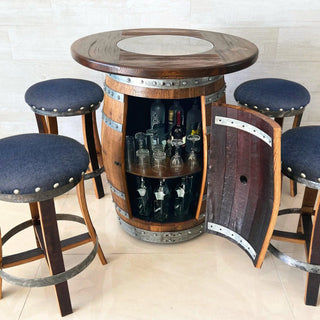
- Storage. The Multi-Use Bar ($1,237.50) is built to rest aging wine on its side, hang stemware and store spirits inside the barrel.
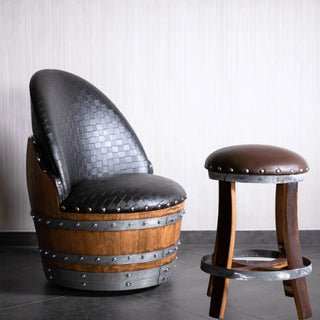
- Seats. The barrel stools in our bar sets are 27.6 inches tall with memory-foam seating.
- Floor space. First plan the walkway. If people can't get around a bar, they use it less.
How much room does one barrel need?
Use these footprints when you draw the room:
- Barrel bar, no top: approximately 27.4 inches wide.
- Barrel bar with round top: 35.4 inches across.
- Steel foot rail for a 59-gallon Wine Barrel: 37 inches square, outside measurement.
- Barrel stool: 18.9 inches square.
- Walkway behind seated guests: about 3 feet.
The whole setup is about 4 to 4.5 feet deep before the walkway, with one barrel and two stools on one side. For more math on clearance, see How Much Room Do You Really Need for a Home Bar?
The 11 layouts
1. The corner pour station (about 8 × 8 feet)
Place a barrel bar in a corner, slightly away from both walls, with two stools in a V in front of it. The Bar Set ($1,615.50 and up) excludes the top, but includes the bar and two stools. It's the cheapest complete barrel bar with seating. The DIY kit in layout 9 is cheaper, but you supply the barrel. The compromise: the host serves from the guest's side.
2. The peninsula (a wall at least 8 feet long, about 10 feet deep)
Position the bar 2.5 to 3 feet away from a long wall, so that the host is behind the bar and the guests face the host. The Pub Set with 2 stools ($2,151) includes cabinet storage, a round top and two stools. This is the layout that feels the most like an actual bar.
3. The center island for four (about 12 × 12 feet of open floor)
Put the four-stool Pub Set in the center of the room. With a 35.4-inch round top, there are about 111 inches of edge, so four stools get just under 28 inches each. Leave the full walkway on every side so guests can walk all the way around.
4. The back bar on wheels (a 5 to 6-foot stretch of wall)
The Top Shelf Bar Cabinet ($1,259.10) has multi-level bottle storage, hidden inside storage and wheels on the bottom. Park it against the wall and hang a Stave Trio Pack ($386.10) above it. One rack holds three bottles and eight wine glasses, while the other holds twelve glasses. Total: $1,645.20. Pull the cabinet out when guests come.
5. The under-stairs nook
A Bar Cabinet ($1,237.50) is 37 inches high and about 27.4 inches wide, with a door shelf. Before you commit, check two things: headroom where you'll stand to pour and room for the door to swing. Add a 3-Bottle Stave Wall Rack ($175.50) on the side wall. Total: $1,413.
6. The bistro corner with a foot rail (about 7 × 7 feet)
The Bistro Pub Set with 2 stools ($2,079) is a closed barrel, round top, steel foot rail and two stools. Two people sit with their feet on the rail. It's good for a corner by the TV wall, where the bar is for two, not ten.
7. The bottle wall
Home Bar Set #1 (from $2,565) adds two 5-bottle stave holders to the bar, the top and two stools. That gives you ten bottles on the wall at eye level. Each holder measures 37.2 inches tall by 8.5 inches wide. It makes a good bourbon shelf.
8. The glass wall
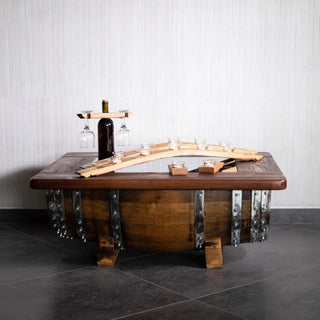
Home Bar Set #2 (from $2,538) replaces the bottle holders with a pair of trio displays: one for eight glasses and three bottles, one for twelve glasses. If your basement pours more wine than whiskey, choose this one.
9. Bring your own barrel
Already got a barrel? The DIY Bistro Kit ($801 and up) is the round top and foot rail, in a 59-gallon Wine Barrel size or a Whiskey Barrel size. It's $1,476 with two stools. No barrel included.
10. The drinks station for a game room (roughly 12 × 16 feet)
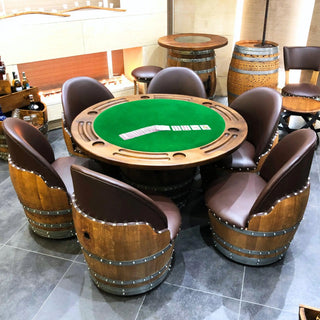
The barrel serves the room here instead of seating it. Set a Multi-Use Bar a few steps from the Game Table Set ($7,875): six barrel chairs, a 55.3-inch velvet poker table with cup holders and a removable dining top. Drinks are poured at the bar, not on the cards. Grand total: $9,112.50.
11. The adjustable-height bar
If the people sharing the bar are of very different heights, adjust the seat, not the bar. The Bar Set with Luxury Stools (from $3,266) combines the bar and top with two hydraulic stools that swivel and adjust from about 27 to 35 inches. Each stool is about 27 inches across, so allow a little more floor than either layout 2 or 3.
Which layout fits your basement?
| Layout | Anchor | Seats | Price | Plan for |
|---|---|---|---|---|
| 1. Corner station | Bar Set | 2 | from $1,615.50 | 8 × 8 ft |
| 2. Peninsula | Pub Set, 2 stools | 2 | $2,151 | 8-ft wall, 10 ft deep |
| 3. Center island | Pub Set, 4 stools | 4 | $2,826 | 12 × 12 ft |
| 4. Back bar on wheels | Top Shelf Bar Cabinet + Trio Pack | 0 | $1,645.20 | 5 to 6 ft of wall |
| 5. Under-stairs | Bar Cabinet + 3-bottle rack | 0 | $1,413 | headroom first |
| 6. Bistro corner | Bistro Pub Set, 2 stools | 2 | $2,079 | 7 × 7 ft |
| 7. Bottle wall | Home Bar Set #1 | 2 | from $2,565 | 6-ft wall |
| 8. Glass wall | Home Bar Set #2 | 2 | from $2,538 | 6-ft wall |
| 9. Your own barrel | DIY Bistro Kit | 0 or 2 | from $801 | 7 × 7 ft |
| 10. Game room | Multi-Use Bar + Game Table Set | 6 | $9,112.50 | 12 × 16 ft |
| 11. Adjustable | Bar Set with Luxury Stools | 2 | from $3,266 | 10 ft deep |
See all barrel bars and sets in Barrel Bars.
What are the trends in basement design for 2026?
We can't refer you to a survey, so in plain terms, here's what reads as modern in a basement bar:
- Freestanding over built-in. Furniture you can move or take with you. No plumbing to run.
- Warm oak with black steel. The Steel-Leg Center Table ($260.50) has a wire-brushed oak top with satin black steel legs.
- Glass to lighten the look. A wood-glass round top prevents the barrel from seeming heavy in a room with a low ceiling.
- Hidden storage. Cabinet doors and seats that lift up keep the mess out of sight.
- One anchor, not a theme. One real barrel comes across as a design choice. Ten barrel-themed knick-knacks come across as a theme room.
More style ideas? Check out 7 Stunning Barrel Bar Ideas for Rustic or Modern Spaces.
Frequently asked questions
Does a basement bar need a sink?
No. All barrel bars in these layouts are dry bars, with no plumbing or hookups. If you host often, always have a cooler nearby. Bring down ice and glasses on a tray.
How tall should a basement bar be?
Our barrel bars are about 37 inches without a top and 38.6 inches with the round top, a little above a 36-inch kitchen counter. That leaves about 9 to 11 inches from seat to top with 27.6-inch stools.
Can I start with the bar and add stools later?
Yes. Barrel stools are $337.50 each, so when the room is coming together, it's easy to add them one at a time. If you know you want two, buying them with a set costs about the same as adding them later.
How does a barrel bar get down to a basement?
First, measure the stairs and doors. The barrel is approximately 27.4 inches in diameter, and the 35.4-inch round top is removable. Oak Wood Wine Barrels ships in-stock orders within five business days, free within the continental U.S. Larger orders are delivered by appointment.
What is the best layout for a small basement?
The corner station (layout 1) or the bistro corner (layout 6). Each fits in about 7 to 8 feet each way and still has room for two.