
Short answer: Open shelves are better for the bottles you pour every week; closed storage is better for bottles you want to keep sealed, out of light, dust and curious hands. Most collections end up using both of these. Oak Wood Wine Barrels does not have a glass-front cabinet. The open option is a stave wall rack, such as the 5-Bottle Stave Wall Rack ($247.50); the closed option is a solid oak cabinet, such as the Top Shelf Bar Cabinet ($1,259.10); and for bottles under glass, there's the Half-Barrel Coffee Table ($783).
Prices as of October 6, 2026; each link shows live stock.
How do open shelves, glass cabinets and solid doors compare?
| Factor | Open shelves | Glass-front cabinet | Solid-door cabinet |
|---|---|---|---|
| Seeing the bottles | Full view | Good, with some glare | Only when the door is open |
| Dust | Collects on shoulders and caps | Kept out | Kept out |
| Light | Fully exposed | Reduced, depends on glass and room | Blocked |
| Kids and guests | Within reach | Discouraged, more so with a lock | Out of sight |
| Speed of access | Fastest | One door | One door |
| Best for | Bottles in rotation | Showing off rare bottles | Sealed and backup bottles |
The right choice has less to do with looks and more to do with three things: how often you drink from the collection, how much light the room gets, and who else is in the house.
Which is better for the bottles you actually drink?
Open shelving. You see what you have, you can reach it in a second and you know when a bottle is running out. Dust is a nuisance, not a problem, for bottles you open every week; wipe the shoulders when you pour.
A stave wall rack keeps the look warm. The 5-Bottle Stave Wall Rack ($247.50) is a vertical rack that accommodates any five bottles and is about 37.2 inches tall; the 3-Bottle Stave Wall Rack ($175.50) runs horizontally at the same length. Both are made of Wine Barrel staves and metal hoops. Both have back hooks installed; you provide the wall hooks. Five bottles is also a sensible rotation size: few enough that you finish what you open.
Which is better for bottles you're keeping sealed?
Closed storage. Dust isn't the big long-term threat; light is. Labels fade in direct sunlight over time, and a spirit can change color and flavor. Regular glass lets in a lot of light. In a sunny room, a glass cabinet protects less than people suppose. A solid oak door shuts out all the light.
However you store your sealed whiskey, do it upright. Long contact with high-proof spirit can break down a cork. That's why spirits stand and wine lies down. Keep the collection away from heat sources, too: a cabinet next to a fireplace or a heating vent is a bad home for anything you plan to keep.
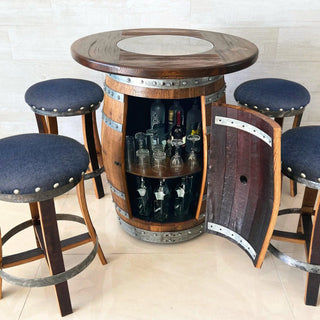
The Top Shelf Bar Cabinet ($1,259.10) is a solid Wine Barrel cabinet with multi-layer bottle storage, hidden storage inside, a door shelf and wheels, about 27.4 × 27.2 × 38.6 inches (±10%). The Bar Cabinet ($1,237.50) has much the same footprint and also has a door shelf.
Is there a glass option for whiskey?
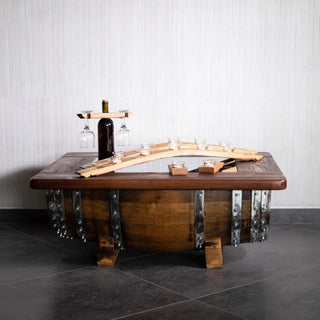
Yes, but it's a table, not a cabinet. The Half-Barrel Coffee Table ($783) has a removable top of wood and glass over a full-depth interior display, about 35.4 inches across. You look down into it, and a few special bottles sit in the middle of the room, dust-free, without taking up any wall space. Keep it out of direct sun for the same reason as any glass display.
What about kids, parties and curious guests?
Behind a closed door, bottles are out of sight, and for most guests, out of mind. If you need a lock, plan accordingly before you buy. Locks are not listed on our cabinet pages, so please call Oak Wood Wine Barrels at (832) 933-8787 before you order. Open shelves are good in homes where everyone who passes them is a grown-up.
When does a mix of both make sense?
Most of the time. Store the bottles you're drinking now on an open rack at eye level, and keep the sealed reserve behind a door. The rack draws the eye first, and the cabinet contains everything else without clutter.
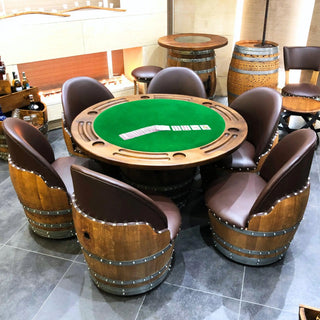
You can buy that combo in one order. Home Bar Set #1 (from $2,565) includes a Multi-Use Bar with a round top, two 5-Bottle Stave Wall Racks and two bar stools. The bar itself is built for laying down aging wine, hanging stemware and storing spirits. It's an open wall display and storage in the barrel, in matching oak.
How do you decide?
Choose open shelves if:
- you pour from the collection every week;
- the wall gets no direct sun;
- the visual interest of the room is already there, and the bottles are the accent.
Choose closed storage if:
- you store sealed bottles for the long term;
- the room gets direct sun at any point in the day;
- children or a constant flow of guests use the room.
Choose both if:
- the collection is a mix of daily pours and bottles you're saving;
- you're working toward a dedicated bar or library room.
| Piece | Price | Type | What it holds |
|---|---|---|---|
| 5-Bottle Stave Wall Rack | $247.50 | Open, vertical | Any five bottles |
| Half-Barrel Coffee Table | $783 | Under glass | Full-depth display below a removable top |
| Top Shelf Bar Cabinet | $1,259.10 | Solid door, on wheels | Multi-layer bottle storage, hidden storage |
| Home Bar Set #1 | from $2,565 | Both | Bar with top, two 5-bottle racks, two stools |
Shop open racks in Wall & Wine Racks and cabinets in Barrel Bars. Most items are in stock and in-stock orders ship within five business days. Cabinets and sets are delivered by appointment.
For a full room plan, see Turn a Formal Room You Never Use into a Bourbon Library Lounge or How to Set Up a Home Whiskey Bar with Barrel Furniture.
Frequently asked questions
Should whiskey bottles be stored upright or on their side?
Upright. Long contact with high-proof spirit can break down a cork. Wine is the one that lies on its side.
Does light damage whiskey?
The color and flavor of a whiskey can change with long exposure to direct sun, and labels can fade, so keep bottles out of the sun, on shelves or behind glass.
Is a glass cabinet worth it for a whiskey collection?
Yes, if you want to show off rare bottles and keep the dust off. In a room that gets direct sun, glass is not as good protection as a solid door.
How many bottles does a stave wall rack hold?
The 3-Bottle rack fits three, and the 5-Bottle rack fits five. The Stave Trio Rack, Bottle Display, holds three bottles plus eight glasses.
Can I lock a barrel bar cabinet?
No locks are listed on the cabinet pages. If you require one, ask before you order.