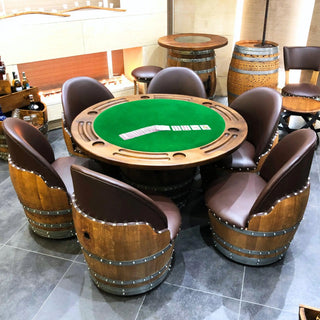
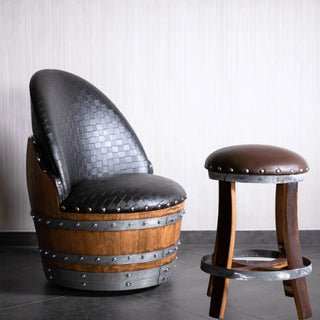
Hotel lobby bar design built around a reclaimed wine barrel works because the barrel does three things at once that hotel operators care about: it anchors a small footprint visually (54 inches diameter of presence in roughly 6 square feet of floor), reads as authentically crafted in photos guests post to social, and survives 5+ years of commercial wear because Bordeaux-type oak was built to hold liquid under pressure for two-plus decades. Below are 8 lobby applications hotel designers are specifying right now — from check-in alcove bars to evening cocktail anchors — with capacity benchmarks and sourcing notes for procurement teams. For volume hospitality orders, our family workshop ships free in the continental U.S.; request a hospitality quote here.
A wine barrel furniture piece in a lobby setting is not a one-size answer. The 53–59 gallon Bordeaux-type barrels we work with show up in dramatically different roles depending on the property's positioning — boutique versus full-service, urban versus resort, business-traveler versus leisure. The applications below are organized by lobby function, not by hotel category, so a 100-room boutique and a 600-room flag can both pull from the same playbook.
For background on why reclaimed wine barrels read differently than rustic-styled new wood, see our Bordeaux Oak vs American Oak post and our How to Spot a Real Wine Barrel Chair guide.
1. The Check-In Alcove Bar (Boutique Hotels, 50–150 Rooms)
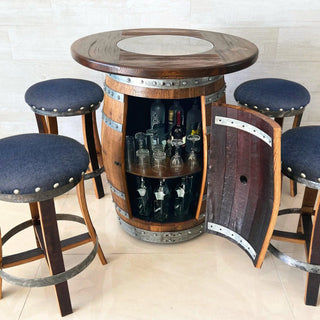
A single barrel bar tucked into the alcove beside the check-in desk turns the arrival sequence into a welcome ritual. Guests get a glass of sparkling or a local spirit pour while their key card is being keyed.
Footprint: 30 inches × 30 inches floor clearance for the barrel itself, plus 36 inches behind for staff access.
Capacity: 1 staff member, 1–2 guests served at a time. Designed for sequential service, not crowd-handling.
Sourcing notes: Look for a barrel bar with a deep top inset (4-inch lip) so the welcome pour doesn't slide during check-in chaos.
2. The Welcome-Drink Station (Resort Lobbies, 200+ Rooms)
For higher-volume properties, a self-serve welcome-drink barrel placed 12–15 feet from the front door catches arrivals during peak check-in windows (3–6 PM). Pre-poured glasses of sparkling wine, agua fresca, or a signature spirit sit on the barrel top in a chilled tray.
Footprint: Single barrel, 30 × 30 inches, with a 6-foot radius of clearance for guest flow.
Capacity: 40–60 guests per hour during peak.
Pairing: Most resorts pair this barrel with a second matching barrel 8 feet away holding a fruit-water station. Matching staves, matching hoop placement — consistency reads as intentional.
Sourcing notes: When ordering 2+ matched barrels, specify "matched grain set" with the workshop. A small family workshop can pull two barrels from the same coopering batch; a marketplace generalist usually cannot.
3. The Lounge Anchor (Lobby Bar Replacement)
Some boutique properties have moved away from the traditional full-length lobby bar entirely, replacing it with two or three barrel bars arranged in a triangle with low-back lounge chairs. The configuration reduces square-footage waste, increases conversational intimacy, and photographs better than a long bar with stools.
Footprint: Triangle pattern with barrels 8 feet apart, occupying roughly 100 sq ft total — versus 180 sq ft for a 12-foot bar with stools.
Capacity: 12 guests seated, 6–8 more standing.
Service model: Cocktail server brings drinks from a back-of-house bar. The barrels function as side tables / drink-rest surfaces.
4. Breakfast Service Coffee Bar
The same barrel that serves cocktails at 6 PM can be a self-serve coffee bar at 6 AM. Operators love the labor savings.
Setup: Airpot coffee dispenser on the top, condiments in a low caddy beside it, mugs stacked on a small adjacent shelf. Use a barrel with a closed top, not a half-barrel with a basin — coffee staining and the basin do not mix.
Footprint: 30 × 30 inches, plus 4 feet of standing clearance.
Capacity: 60–80 guests per hour with two airpots rotating.
Maintenance: Spar-varnish finishes wipe clean of coffee spills with a damp microfiber. Re-apply a thin coat of finish annually if the barrel sees daily service. (We cover this in detail in our post #11 — Lighting & Maintaining a Home Bar Built Around a Barrel.)
5. Evening-Cocktail Focus Piece (Lobby Programming Anchor)
This is the application getting the most attention in 2026 hotel design pubs: a single hero barrel bar positioned as the literal and visual center of the lobby's evening transformation. Lighting drops at 5 PM, accent uplights highlight the barrel, and a mixologist sets up at 5:30 for a 2-hour pop-up service window.
Footprint: Hero placement — center of lobby, 8-foot radius clear.
Capacity: 25–40 cocktails served per hour with a single mixologist.
Sourcing notes: This application needs the most visually striking barrel — pronounced wine staining inside, hand-applied wire-brushed staves on the exterior, original cooperage stamps still visible. These are the details that read in close-up photos guests will post.
6. The Reading-Lounge Side Tables
Pair small barrel side tables (half-barrels, 24 inches tall, 22 inches diameter) with high-back wingback chairs in a quiet corner of the lobby. This isn't a bar at all — it's a place to set down a coffee cup or a glass of port while reading. But it uses the same authentic-barrel vocabulary as the larger pieces, creating visual coherence across the lobby.
Footprint: 22 × 22 inches per table; pair with 28-inch chair clearance.
Capacity: 2 guests per seating cluster, 3–4 clusters in a typical lobby corner.
Why it matters: Repetition of authentic materials across scales is what distinguishes a designed lobby from a decorated one.
7. The Pre-Event Spillover Bar (Boardroom & Ballroom Hotels)
Hotels with active meeting business benefit from a barrel bar positioned just outside the main ballroom — a pre-function spillover spot for arriving conference attendees. Branded with a small custom signage plate, it doubles as the evening reception bar.
Footprint: Often two barrels side-by-side along a wall, occupying 6 linear feet.
Capacity: 80–120 attendees served in a 30-minute pre-function window.
Custom options: Many workshops will hand-burn a hotel logo into a stave or apply a brass plaque to the front of the barrel.
8. The Threshold Bar (Indoor-Lounge Edge)
For properties with an interior transition between two lounge zones — a great-room into a library, or a check-in hall into a fireside reading room — a barrel bar positioned at the threshold serves both sides without needing two bars. The barrel stays fully inside the building envelope; transitional placement is about traffic flow, not exposure. Authentic oak furniture should always be specified for interior, climate-controlled placement to preserve the spar-varnish finish.
Footprint: Single barrel, positioned at the threshold but firmly inside the climate-controlled envelope.
Capacity: 30–50 guests per hour during peak transition windows.
Capacity & Sizing Comparison
| Application | Footprint | Guests/Hr | Best Property Type |
|---|---|---|---|
| Check-in alcove | 30" × 30" + 36" back | 30–50 | Boutique, 50–150 rooms |
| Welcome-drink station | 30" × 30" + 6' radius | 40–60 | Resort, 200+ rooms |
| Lounge anchor (3 barrels) | 100 sq ft | 40 served, 20 standing | Boutique lifestyle |
| Coffee bar | 30" × 30" + 4' clearance | 60–80 | All daily-use |
| Evening cocktail focus | Center lobby + 8' radius | 25–40 cocktails | Lifestyle, urban |
| Reading-lounge tables | 22" × 22" each | 8–12 (passive) | Quiet luxury, library lobbies |
| Pre-event spillover | 6 linear feet | 80–120 in 30 min | Conference, ballroom |
| Threshold bar (interior) | 30" × 30" | 30–50 | Resort, lifestyle |
Procurement Notes for Hotel Designers
Authenticity matters more in hospitality than in residential. Guests photograph and post lobby details. A wood-laminate barrel-shaped product will read as fake in a phone photo, especially in good lighting. Specify ex-wine barrels with documented sourcing.
Lead times are tighter than you'd guess. Our workshop ships in-stock orders within 5 business days.
Finish matters for commercial wear. Spar varnish (the marine-grade finish used on wood boats) holds up to lobby-bar wear better than oil-only finishes. Ask the workshop what finish system they use and how often it needs re-application in a daily-use commercial setting.
Weight is a planning consideration. A finished barrel bar runs 110–140 lb. On wood-frame upper-floor lobbies, confirm load capacity. Lobbies on slab foundations have no issue.
Care is minimal but real. Wipe down with damp microfiber daily.
A Note on Sourcing From a Family Workshop
Most hotel designers default to commercial-furniture suppliers because of the apparent risk reduction. The trade-off: those suppliers usually sell barrel-shaped lookalike pieces, not authentic ex-wine barrels. For hospitality procurement, we offer volume pricing on 2+ pieces and direct workshop access. Start a hospitality conversation here.
For a deeper procurement framework covering tasting-room, distillery, and full-property hospitality installations, see our pillar guide — Tasting Room & Distillery: Authentic Barrel Furniture for Hospitality Spaces.