
A bourbon lounge home design lives or dies on three quiet variables: how the room sounds, where the seats face, and what the eye lands on first. Most home bars get the bottle wall right and the rest of the room wrong — a TV blaring over hard surfaces, a sectional pointed at the wrong wall, a beautiful barrel shoved into a corner where no one looks at it. This guide walks through the planning sequence professional residential designers use, adapted for a 150-to-300-square-foot dedicated bourbon lounge inside a basement, sunroom, three-season porch, or finished man cave. The goal is a room that hosts two to six people for an unhurried pour, with conversation that actually carries and a focal-point barrel piece that earns its placement.
Tools and materials
| Category | Item | Purpose |
|---|---|---|
| Measuring | 25-ft tape, painter's tape | Mark seating zones and walking lanes on the floor |
| Planning | Graph paper or floor-plan app | Scale layout at 1/4 in. per foot |
| Acoustics | Wool or natural-fiber area rug (8x10 or larger) | Primary floor absorption |
| Acoustics | Lined drapery panels | Window and hard-wall reflection control |
| Seating | Two club chairs OR loveseat + two chairs | Conversation grouping |
| Side surfaces | 18-22 in. side tables, one per seat | Glass parking, score cards |
| Focal anchor | Full wine barrel, half barrel bar, or barrel cabinet | Visual centerpiece |
| Lighting | Dimmable ambient + accent fixtures | Layered mood control |
| Wall finish | Wool felt panels OR bookcase + textiles | Reduce slap-back echo |
Time required: Planning and tape-out, 2-3 hours. Full build-out from empty room to finished lounge, 2-4 weekends depending on whether you are installing trim, lighting, or rugs.
Skill level: Intermediate. The acoustics math is light, but the layout decisions take judgment and a willingness to re-tape the floor twice before committing.
Step 1. Map the room and identify the dead zones.
Before you place a single chair, walk the room with painter's tape and mark the obvious constraints: door swings, HVAC registers, window placements, electrical outlets, and any structural columns. Bourbon lounges fail most often when the seating ends up under a return-air vent (cold draft on the back of a guest's neck) or directly across from a window that sun-glares the bottles at 4 p.m.
Tape a 36-inch walking lane from the door to the bar zone — that is the working clearance recommended by the National Kitchen and Bath Association for residential traffic flow. Inside the lane, nothing lives. Outside the lane, you have your useful square footage.
Step 2. Choose the conversation grouping.
Conversation distance is the foundational seating-plan decision. The functional range — close enough for a normal speaking voice over a glass, far enough that no one feels crowded — is 4 to 12 feet between facing seats, what designers call "social distance" in the original anthropological sense (Edward T. Hall, The Hidden Dimension, 1966). For an intimate lounge, hold to the 4-to-8-foot end of that range.
For two to six people, the three layouts that consistently work:
- Two club chairs + small round table between them. The intimate two-person pour. Chairs angled inward at about 110 degrees, 5 feet apart at the front edges.
- Loveseat + two chairs in a U. The classic four-top. Loveseat anchors the long wall; two chairs flank perpendicular, forming a U around a low coffee surface or barrel table.
- Two chairs + two-person bench + side stools. The flexible six-top for when guests rotate in and out.
Avoid the long parallel sofas-facing-each-other layout. It looks like a hotel lobby and makes a six-person tasting feel like a deposition.
Step 3. Treat the acoustics before you finish the walls.
A hard-floor, hard-wall room with a glass coffee table sounds like a racquetball court the moment three people start talking. You do not need a recording studio's worth of treatment, but you do need to put soft mass on at least three of the six surfaces of the room (floor, four walls, ceiling).
The minimum effective treatment:
- Wool or natural-fiber rug, 8x10 or larger. Covers the primary reflective surface. A pile depth of half an inch or more is what does the work.
- Lined drapery panels on any window. Even one window's worth of drapery cuts mid-frequency reverberation noticeably.
- One upholstered wall element. A tall bookcase loaded with books, a tufted upholstered headboard repurposed as a wall panel, or a row of wool felt acoustic panels behind the seating.
If the room has a TV that doubles as a sports-and-music surface, consider a wool felt panel directly behind the screen — that is where slap-back reflections originate.
Step 4. Decide the focal point — barrel or TV.
This is the decision most bourbon lounge home design plans dodge. A room cannot have two focal points. Either the wine barrel anchors the eye and the TV is secondary (mounted lower, sized smaller, recessed into millwork), or the TV anchors the eye and the barrel becomes peripheral.
The two working approaches:
- Barrel as primary focal point. Place a full 53-to-59-gallon Bordeaux-type wine barrel or a half-barrel bar on the wall opposite the main seating. Light it from above and below (see Step 6). The TV, if present, hangs on a perpendicular wall or recesses into a stave-clad surround. Guests look at the barrel; the TV serves the moment when a game is on.
- TV as primary, barrel as flanking anchor. TV centered on the main wall. A barrel cabinet, stave bottle rack, or full-barrel bar flanks one side as a service zone. The barrel reads as built-in cabinetry — present but supporting.
Whichever you choose, decide it before you place the seating. The conversation grouping orients toward the focal point, and reversing that later means moving every chair.
Step 5. Place the barrel where the light hits it.
A wine barrel placed in a corner under a return vent and a single ceiling can is wasted material. The stave grain on a hand-wire-brushed Bordeaux-type barrel only reads when light rakes across it at a low angle.
The placement rules:
- 3 to 5 feet of clearance in front of the barrel for guests to approach and use it as a service surface.
- 18 to 24 inches behind for a floor uplight or a back-bar shelf.
- Not directly under a recessed downlight, which flattens the curve of the staves and creates a hotspot on the spar-varnish finish.
- Within sightline of the primary seating, so the barrel is what guests see when they look up from their pour.
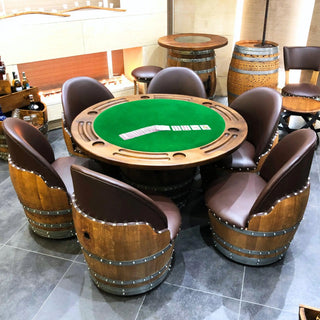
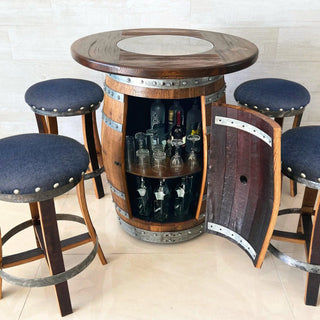
A full barrel bar set with two matching stools, a half barrel mounted to a wall as a corner bar, or a barrel cabinet with a flip-up tasting top all earn their square footage. A barrel parked against a blank wall as a side table does not.
Step 6. Layer the lighting — ambient, task, accent.
A bourbon lounge needs at minimum three lighting layers on independent dimmers:
- Ambient. A pair of 2,700K pendants over the bar zone, or a pair of wall sconces if the ceiling is low. 600 to 800 lumens per fixture. This is the "house lights" layer.
- Task. Under-counter LED strip on the bar pour zone, 2,700K-3,000K, 450 to 600 lumens per linear foot. You cannot pour two ounces accurately by ambient light alone.
- Accent. Picture lights on the stave wall, floor uplight behind the barrel, or candle vignettes on side tables. 2,200K-2,400K for the deep amber glow.
Wire each layer to its own dimmer. The same room reads as Sunday-afternoon casual at 60 percent ambient and as after-dinner pour at 20 percent ambient plus 80 percent accent.
Step 7. Add the side surfaces and the small things that close the room.
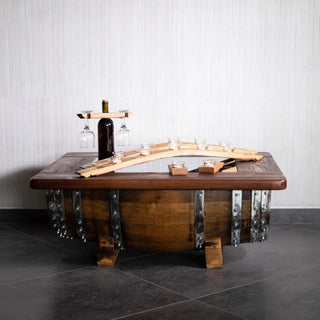
Every seat needs a place to set a glass within arm's reach without leaning. That means a side table — 18 to 22 inches tall, 12 to 18 inches across — per seat, or a single low coffee surface that every seat can reach. A barrel head used as a low table works for a four-top. A reclaimed-stave side table works for individual chairs.
Other quiet upgrades:
- A small tasting mat on the bar zone for flights and scoring.
- A pour tray to corral the bottles currently in rotation.
- A magazine rack or low shelf for tasting journals, score cards, and the occasional Garden & Gun back issue.
- Throws on the chair backs. Wool, not synthetic. Cold-weather lounges live or die on the throw blanket.
Common mistakes to avoid
- Pointing the seating at the TV when the barrel is the focal point. Pick a focal point and orient the room to it.
- Putting an area rug too small for the seating. All four legs of every chair should sit on the rug, or the rug looks like a postage stamp under the furniture.
- Hard surfaces on five of six room sides. Floor + four walls + ceiling all hard equals echo. Soft mass on at least three surfaces is the working minimum.
- A single ceiling fixture as the only light. Lounges need at least three layers on dimmers.
- A barrel in a corner with no light. The grain disappears. The barrel becomes a chunk of brown.
- Seating spaced more than 8 feet apart. Voices drop, the conversation breaks into pairs, and the room loses its lounge feel.
A note on the barrel itself
The room above is built around a real, authentic Bordeaux-type wine barrel — 53-to-59-gallon stock, hand-wire-brushed staves, finished with spar varnish. Reclaimed cooperage oak takes light and pulls the eye in a way reproduction furniture cannot. Our family workshop ships full barrel sets, half barrel bars, and barrel cabinets with free shipping in the continental U.S. (in-stock orders ship within 5 business days) — exactly the focal-point pieces the planning sequence above is designed around.