
Short answer: Make use of the space you already have before you give up wall: the underside of shelves, the inside of a bar, the tabletop and the ceiling. Options from Oak Wood Wine Barrels include the Stave Stemware Rack ($44.55), which holds four glasses on two bottles without touching the wall, and the Multi-Use Bar ($1,237.50), which hangs stemware inside the barrel. If you have to use a wall, choose a piece that can hold both bottles and glasses.
Prices as of October 6, 2026; each link shows live stock.
How do you plan stemware storage in a small wine room?
Before buying anything, sort your glasses by how often you use them. The everyday glasses need to be visible and near where you pour. The special glasses (fine crystal, dessert glasses, the flutes that get pulled out twice a year) need protection more than access.
That separation typically clears it right up. The daily glasses go somewhere quick, and the rest go somewhere closed. Wall space, the most precious commodity in a small room, is saved for bottles and the one or two pieces you want people to see.
Which seven solutions save wall space?
1. Rails under an existing shelf or cabinet
Stemware rails screw to the underside of a shelf or upper cabinet, and the glasses hang by their feet. The shelf already existed, so no wall and no floor are needed. Start by measuring your tallest glass, then leave enough space to slide it out without tipping the bowl into the counter. Don't screw into flimsy board. Screw into solid wood.
Best for: everyday glasses just above where you pour.
2. Stemware storage inside the bar itself
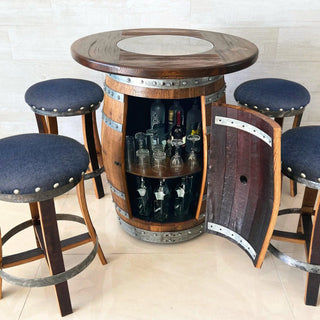
A barrel bar can store glasses inside of the barrel. The Multi-Use Bar ($1,237.50) is designed to store spirits, hang stemware and lay aging wine in a single 27.4 x 27.4 x 37 inch unit (±10%). Multiple bar sets in Barrel Bars offer a choice of a stemware shelf or a flat shelf.
Best for: a room where the bar is the main piece of furniture anyway.
3. A stave rack on the tabletop
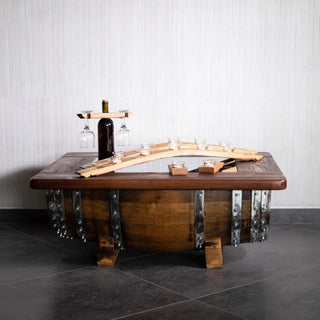
The Stave Stemware Rack ($44.55) is a Wine Barrel stave that sits on two bottles and holds four glasses. At 37.2 inches long, it rests on a bar top, sideboard or console (bottles and glasses not included). It doesn't use a wall, and it shows off this week's glasses.
Best for: the four glasses currently in use.
4. A two-glass balance for the pair you use tonight
The 2-glass balance is a small stave piece, about 9.8 inches long, for showing two wine glasses. It's available in the Build-a-Pack (from $36), where you can choose up to six stave accessories, including cigar ashtrays and candle holders.
Best for: couples, and a small table that doesn't have room for any more.
5. A wall rack that holds bottles and glasses together
If you do give up wall, make it do double duty. The Stave Trio Rack, Bottle Display ($193.05) is one item that can hold three bottles and eight wine glasses. The Stave Trio Rack, Glass Display ($193.05) stores twelve glasses. Each is 24.8 inches wide, 37.2 inches tall and 3.5 inches deep (±10%). The back hooks come pre-installed; you supply the wall hooks.
Best for: a wall for the dining or bar area that has to hold the bottles too.
6. Closed storage for fine crystal
Thin crystal is safer in a closed cabinet or box with dividers than out in the open. The closed storage keeps the dust off, so the glasses don't need rinsing before every use, and dividers stop them from knocking together. Stand them upright on a shelf, since the rim is the thinnest part of the glass.
Best for: special-occasion glasses that are taken out a few times a year.
7. A rack hung from the ceiling
In a room with height to spare, a hanging rack uses ceiling that nothing else will. Attach it to the framing, not just drywall, keep it above head height and out of the way of door paths, and remember the glasses will sway if someone bumps the rack.
Best for: above a tasting table or an island, but never above a walkway.
Which solution fits which glasses?
| Solution | Wall space used | Best for | Example from our catalog |
|---|---|---|---|
| Rails under a shelf | None | Everyday glasses | (uses your shelf) |
| Inside the bar | None | Daily glasses and bottles in one piece | Multi-Use Bar, $1,237.50 |
| Tabletop stave rack | None | Four glasses on display | Stave Stemware Rack, $44.55 |
| Two-glass balance | None | A pair for tonight | Build-a-Pack, from $36 |
| Bottle-and-glass wall rack | About 25 × 37 in | Glasses plus bottles | Trio Rack, Bottle Display, $193.05 |
| Closed cabinet or box | None visible | Fine crystal | (any closed cabinet) |
| Ceiling rack | None | Rooms with spare height | (fastened to framing) |
How do you combine them in one small room?
Select two solutions, one for each group of glasses. In a small wine corner, that may be a barrel bar holding the everyday glasses and bottles, with a stave stemware rack on top for the glasses in use this week, while the fine crystal lives in a closed cabinet in another room. With a dining wall, a trio rack can fit the bottles you'll open soon and eight glasses in one footprint.
Don't scatter the glasses in four or five places. Two clear homes are easier to keep tidy than many small ones.
What should you know before ordering?
All of the above pieces from Oak Wood Wine Barrels are handcrafted from Bordeaux-type oak Wine Barrels and finished with spar varnish. Most items are in stock, and we ship in-stock orders within five business days. Shipping is free within the continental U.S.
For more ideas in a tight space, see How to Create a Wine Cellar Feel in a Small Space. For the glasses themselves, check out The Best Wine Glasses to Pair With a Barrel Bar Setup.
Frequently asked questions
How do you store wine glasses in a small space?
Start with the non-wall space: under shelves, inside a bar, on the tabletop. If you use a wall, pick a piece that holds bottles and glasses together.
Should wine glasses be stored upside down?
Glasses are hung upside down by the foot in hanging racks, which suits everyday glasses. If you have fine crystal on a shelf, stand it up. The rim is the weakest part.
How many glasses does the stave trio rack hold?
The glass version holds twelve wine glasses. The bottle version holds eight glasses and three bottles. Both are $193.05.
Do the stave wall racks come with hanging hardware?
The back hooks are already in place. You just need to add the wall hooks.
Can you hang stemware inside a barrel bar?
Yes. The Multi-Use Bar is designed to hang stemware, lay aging wine and store spirits.