
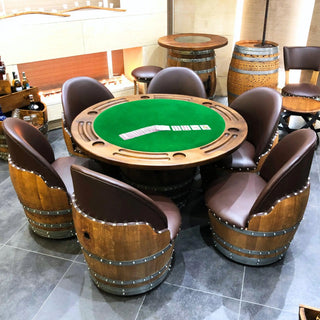
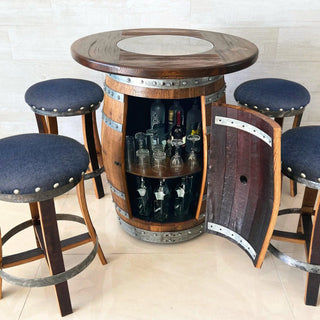
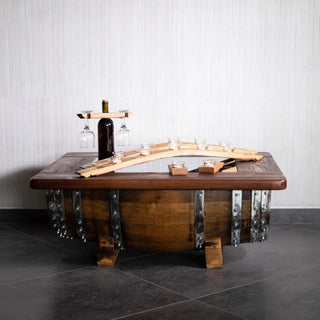
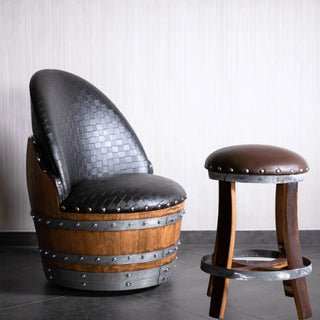
To refinish wood furniture like a wine barrel bar after 5-10 years of daily use, the right process is a light cleanup and re-coat, not a full strip-and-refinish. Spar varnish, the marine-grade finish we apply at our family workshop, builds up in thin layers and is designed to be touched up rather than stripped. The full project takes 6-8 hours of active work spread over 2 days (most of which is dry time), uses materials that total under $80, and requires intermediate-level skill - if you can paint trim, you can refinish a barrel bar. The guide below is the same process we walk customers through over email when their piece reaches the 5-year mark. If your barrel is past the touch-up stage or has significant damage, contact our workshop for a refinishing-by-mail quote.
Time required: 6-8 hours active work over 2 days (24-48 hours including dry time)
Skill level: Intermediate
Cost: $50-$80 in materials (assuming you already own basic tools like a brush, drop cloth, and gloves; the full retail list below totals roughly $100 if you are buying everything from scratch)
When to do it: every 3-5 years for active-use bars; every 7-10 years for display pieces
Tools and Materials
| Tool / Material | Quantity | Approx. Cost |
|---|---|---|
| Spar varnish (Helmsman or equivalent, satin) | 1 quart | $25 |
| Sandpaper, 220-grit | 4 sheets | $5 |
| Sandpaper, 320-grit | 4 sheets | $5 |
| Tack cloths | 3 | $8 |
| Mineral spirits | 1 pint | $10 |
| Lint-free cotton rags | 6-8 | $10 |
| Natural-bristle brush, 2-inch | 1 | $15 |
| Foam brush, 2-inch | 2 | $4 |
| Painter's tape | 1 roll | $5 |
| Disposable nitrile gloves | 1 box | $8 |
| Drop cloth | 1 | $5 |
Total: $100 retail; you likely have half of these already.
Step 1: Assess the Surface (15 minutes)
Before sanding anything, walk around the piece and identify what needs work:
- Light surface scratches: handled with 320-grit and a re-coat
- Cup rings or water spots: typically need 220-grit sanding to remove
- Dull or hazy spar varnish: re-coat without sanding (just a light scuff)
- Cracked or peeling finish: this is past the touch-up category; spot-strip to bare wood and re-build the finish locally
- Loose hoops or structural issues: stop and address structurally first (see post #42)
Use a flashlight at a low angle - raking light shows surface defects that direct light hides. Mark problem spots with a small piece of painter's tape.
Most 5-year-old bars are in the first three categories. If you find category 4 or 5, the project scope expands.
Step 2: Clean the Surface (20 minutes)
Wipe the entire piece down with a lint-free rag dampened (not soaked) in mineral spirits. This removes:
- Wax buildup from spilled drinks
- Oils from skin contact (the most common dulling cause)
- Dust embedded in the spar varnish
Use light circular motions. Change the rag when it picks up visible color. Let the piece dry for 15-20 minutes before any sanding.
If the piece has been waxed regularly (we do not recommend wax over spar varnish, but some owners do it), the mineral spirits step may need to be repeated 2-3 times to fully remove the wax. New spar varnish will not bond over wax.
Step 3: Scuff-Sand with 320-Grit (45-60 minutes)
The goal of this sanding pass is not to remove finish. It is to create a microscopic texture for the new spar varnish to bond to. Use 320-grit sandpaper, hand-sand only (no power sanders on a curved barrel surface), and apply very light pressure.
Sand with the grain on flat surfaces (the top, the bar rail). Sand following the curve on the staves. The finish should go from glossy to slightly hazy - that is the right amount.
For the spots flagged in step 1:
- Scratches: feather them in with 220-grit first, then transition to 320-grit
- Water spots: 220-grit until the spot is gone, then 320-grit blend
- Hoops: lightly steel-wool (000 or 0000) to refresh the patina if needed; do not sand
Vacuum the piece thoroughly, then wipe with a tack cloth. Any dust left on the surface will show in the final finish.
Step 4: First Coat of Spar Varnish (60-90 minutes work, 8-12 hours dry)
Stir the spar varnish thoroughly with a paint stick - do not shake. Shaking introduces bubbles that show in the finish.
Apply with a natural-bristle brush in long, even strokes:
- Top (flat surface): load brush, draw 18-inch strokes with the grain, tip off (lighter pressure) at the end
- Staves (curved surface): load brush, draw vertical strokes following the stave's curve, one stave at a time
- Hoops: do not coat (the hoops are intentionally not varnished; they develop patina)
- Top rail and accessories: same technique as the top
Move quickly enough that the varnish does not start setting up before you blend strokes (typical working time is 10-15 minutes per section). Do not over-brush - once the varnish starts to set, leave it alone.
Let dry 8-12 hours. Spar varnish is slower-drying than polyurethane intentionally; this is what gives it the marine-grade durability.
Step 5: Light Sand Between Coats (20 minutes)
After the first coat is fully dry to the touch (no tackiness when you press a fingernail), lightly scuff the surface with 320-grit. Two-three passes per section, very light pressure. Vacuum and tack-cloth again.
This inter-coat sanding is what makes spar varnish look professional. Skip it and you get a finish that looks like a single thick coat (which catches dust and shows brush marks). Do it and you get the depth that makes the reclaimed oak look like museum-quality conservation work.
Step 6: Second Coat of Spar Varnish (60-90 minutes work, 8-12 hours dry)
Same technique as step 4. Slightly thinner coat - the second coat does not need to fully cover; it needs to blend with the first.
Let dry 8-12 hours.
Step 7: Optional Third Coat for High-Wear Surfaces (90 minutes plus dry time)
The bar top, top rail, and any surface that takes drink contact benefits from a third coat. Vertical surfaces (stave sides) do not need a third coat.
Sand between coats with 320-grit, vacuum, tack-cloth, and apply.
Step 8: Cure Time Before Use (24-72 hours)
Spar varnish is dry to the touch in 12 hours but does not reach full hardness for 7-14 days. The piece can be used after 24-72 hours, but avoid:
- Coasters with rubber backs (can leave marks on uncured varnish)
- Hot drinks set directly on the surface (until 14 days)
- Cleaning with anything but a soft dry cloth (until 14 days)
Most owners stage the project to start on a Friday so the piece is ready for normal use by Monday and fully cured by the following weekend.
Common Mistakes
-
Sanding too aggressively. This is the most common refinishing mistake. 220-grit and below removes finish faster than you intend. Default to 320-grit; step down to 220 only for specific defects.
-
Using polyurethane instead of spar varnish. Polyurethane is fine for indoor furniture in stable conditions, but spar varnish is what was originally applied. Mixing finishes can cause bonding issues. Match the original.
-
Working in cold or humid conditions. Spar varnish wants 60-80°F and below 70% RH. Garage refinishing in January or August can produce bad results.
-
Skipping the inter-coat sanding. This is what separates a professional-looking refinish from a hobbyist one.
-
Refinishing the hoops. The hoops are meant to patina. Refinishing them throws off the visual balance of the piece.
-
Power-sanding curved surfaces. Orbital sanders leave swirl marks on the curved stave surface. Hand-sand only on barrels.
When to Call a Professional Instead
For most 5-year-old bars, the steps above are well within DIY scope. Call a professional refinisher if:
- The finish is cracked or peeling across more than 20% of the surface
- There is rot, water damage, or structural compromise
- The hoops are loose enough to slide
- You have tried to refinish and the result has bubbles, runs, or fish-eyes
- The piece is over 15 years old and has never been re-coated
Contact our workshop with questions. Spar varnish cure-time data is published on the Minwax Helmsman technical data sheet (TDS) and aligns with ASTM D 1640 dry-to-touch and full-cure testing standards: dry to touch in ~12 hours, recoat at 24 hours, full cure in 7-14 days at 70°F/50% RH. For inter-coat sanding and bonding chemistry, the USDA Forest Products Laboratory's Wood Finishing Bulletin and Fine Woodworking magazine's archive on spar varnish technique are the two standard references.
How Often to Re-Coat Going Forward
A refinished bar starting from this process should hold for 5-7 years before the next re-coat, assuming:
- Indoor use (no exterior exposure)
- Stable humidity (35-55% RH)
- No abrasive cleaners
- Spills wiped within an hour
Active-use bars (4+ pour sessions per week) may need re-coating at 3-4 years. Display pieces may go 8-10 years.
For the full 12-month care calendar that prevents most early-refinish situations, see our 12-month care calendar for indoor barrel furniture, the P7 pillar hub. For the comparison of spar varnish vs. tung oil vs. wax, see post #40.