
Your cart

Your cart is empty


Explore our range of products

Wedding Venue Barrel-Bar Math: Rent for Every Event or Buy Once?

A wedding venue barrel bar from a family workshop like ours pays for itself in approximately 7 events at typical regional rental rates, making outright purchase the better economic choice for any venue hosting 8 or more events per year that include a bar element. The headline matters less than the full picture, which is what the three-option table below lays out before any narrative.

The three options compared

Factor Rent per event Buy outright Buy + sublet to clients
Upfront cost $0 $2,500-$8,000 $2,500-$8,000
Per-event cost (year 1) $250-$450 Amortized over events Recovered + revenue generated
Logistics burden On rental company On venue (storage, setup) On venue (with markup)
Customization None Full Full
Availability Subject to rental inventory Always Always
Brand control None Full Full
Year-1 net cost at 12 events $3,000-$5,400 Net positive by event 7-10 Net positive by event 4-6
20-year total cost / revenue $60,000-$108,000 in cost $2,500-$8,000 in cost Net revenue $30,000-$120,000

The numbers are stark by the second year and decisive by the fifth. The full picture also includes a third option most venue operators do not initially consider: buying the bar, recouping the investment in year one, and then sub-letting it to clients as an upcharge for the next twenty years.

This piece lays out the math three ways, with a decision block at the end that tells you which option fits your venue's volume and operational style.

Methodology

The numbers in this analysis use the following stated assumptions: (1) typical per-event rental rate of $350 all-in (midpoint of $250-$450 range), (2) typical mid-range barrel-bar purchase price of $2,500-$4,500, (3) 20-year service life assumption based on our own workshop's longevity guidance for indoor-stored authentic wine barrel bars, (4) for Option 3, a $250 average client upcharge per event with effectively 100 percent upcharge uptake assumed (which is optimistic — the realistic figure is 60-90 percent uptake at most venues), (5) no inflation adjustment on rental rates over the 20-year horizon (real-world rentals will rise with inflation, which strengthens the case for ownership), and (6) no opportunity-cost discount on the upfront purchase capital (a venue with a 10 percent cost-of-capital would see slightly delayed breakeven). Adjust the numbers below against your own venue's data before committing.

Option 1: Rent per event

This is the path most venues default to when they first add a barrel-bar element to their event offering. Rental companies typically charge $250 to $450 per event for a barrel bar, often with separate fees for delivery, setup, breakdown, and pickup [Source: The Knot 2024 Real Weddings Study — VERIFY rental category data]. The numbers below assume a midpoint of $350 per event all-in.

At 24 events per year:
- Annual cost: $350 × 24 = $8,400
- 5-year cost: $42,000
- 20-year cost: $168,000

Pros:
- Zero upfront capital
- Zero storage requirement
- Zero maintenance responsibility
- Easy to test demand before committing

Cons:
- Cumulative cost compounds quickly
- Rental inventory is not always available on peak weekends
- No customization or branding
- No story to tell guests about the piece
- Quality and condition vary per event

This is the right option only for venues hosting fewer than 6 to 8 bar-element events per year, or for venues testing whether a barrel-bar offering generates demand at all.

Option 2: Buy outright

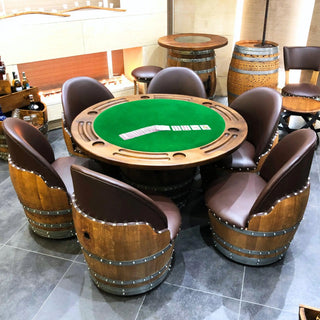
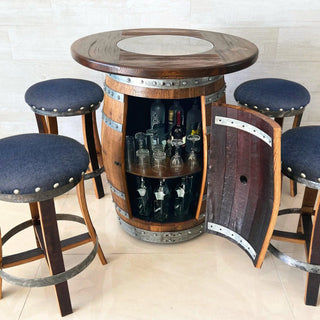
Purchase an authentic wine barrel bar from a family workshop for $2,500 to $8,000 depending on size, configuration, and customization. Most wedding-venue bars land in the $2,500 to $4,500 range — a mid-size barrel-front bar with three barrels and a bar-top surface roughly 8 to 12 feet long. WeddingWire's annual venue-budget reporting shows that mid-tier rustic and farm-style venues consistently invest in signature décor as a booking driver [Source: WeddingWire annual venue report — VERIFY year].

At 24 events per year with a $2,500 purchase:
- Year 1 cost: $2,500
- Breakeven vs renting (at $350/event): 7-8 events
- 5-year cost: $2,500 + minor maintenance ($300)
- 20-year cost: $2,500 + occasional refinishing ($500)
- 20-year savings vs renting (nominal, no inflation): approximately $165,000

Pros:
- One-time cost
- Custom branding with venue logo on barrel heads
- Always available, no inventory risk
- Authentic material story aligns with rustic, vineyard, and farm-style wedding aesthetics
- Becomes part of the venue's marketing photography
- Authentic Bordeaux-oak construction has an estimated 30 to 50 year service life

Cons:
- Upfront capital requirement
- Storage required between events (typical full bar footprint: 4 × 12 feet stored)
- Setup and breakdown on venue staff (typically 30-45 minutes with two people)
- Maintenance responsibility (minor — re-seating a hoop occasionally, refinishing every 8-15 years)

This is the right option for venues hosting 8 or more bar-element events per year, with indoor storage space and operations staff capable of handling setup.

Option 3: Buy + sublet to clients as an upcharge

This is the option most venues do not initially consider, and it is often the strongest play. Buy the bar once, then offer it to event clients as a $150 to $400 upcharge per event. Now your $2,500 investment is generating revenue rather than just avoiding a cost. The Wedding Report's national pricing data shows signature-décor upcharges of this size convert reliably at mid-tier and premium venues [Source: The Wedding Report — VERIFY current report].

At 24 events per year, $250 average client upcharge, $2,500 purchase, and an optimistic 100 percent uptake (see Methodology):
- Year 1 revenue: $250 × 24 = $6,000
- Year 1 net (after $2,500 purchase): +$3,500
- 5-year revenue: $30,000
- 5-year net: +$27,500
- 20-year revenue: $120,000
- 20-year net: +$117,000 (after periodic refinishing)

At a more realistic 70 percent upcharge uptake the 20-year net is still positive by roughly $80,000-$90,000.

Pros (in addition to all "buy" pros):
- Investment recovered in year 1 (often in months)
- Bar becomes a profit center, not just a cost center
- Upcharge framing positions the bar as a premium feature rather than included infrastructure
- Photos of the bar at past events become sales-collateral for future bookings
- Custom branding can extend to "build your bar" upgrades (couple's monogram on a barrel head, etc.) at additional markup

Cons:
- Same logistics burden as outright purchase
- Requires sales conversation with each client to position the upcharge
- Uptake will be less than 100 percent in practice — model with 60-90 percent

Venues hosting 12+ events per year with even modest pricing power should default to this option. The math is decisive within the first 12 months even at conservative uptake assumptions.

Breakeven analysis

Where does outright purchase beat renting? The answer depends on your purchase price and your local rental rate.

Purchase price Local rental rate Breakeven events
$2,500 $250/event 10 events
$2,500 $350/event 7 events
$2,500 $450/event 6 events
$4,500 $250/event 18 events
$4,500 $350/event 13 events
$4,500 $450/event 10 events
$8,000 $250/event 32 events
$8,000 $350/event 23 events
$8,000 $450/event 18 events

For a $2,500 to $4,500 bar at the typical $350/event regional rental rate, breakeven sits between 7 and 13 events. Most wedding venues hit that in year one.

Hidden factors most venues underestimate

1. Availability risk on peak weekends. Rental companies overbook in May, June, September, and October. A bar you own is always available. Several venue operators have told us that a single missed-bar weekend during peak season cost more in client makegood than a year of barrel-bar rental fees.

2. Photography and marketing value. A signature bar that appears in your venue's wedding gallery is doing marketing work between events. Owned bars become part of the venue's recognizable identity in a way rented bars cannot.

3. Customization sells. A barrel-head with the venue's name laser-engraved on it is a small touch that converts site-visit bookings. Renters cannot offer this.

4. Resale and asset value. Authentic wine barrel furniture from a family workshop retains substantial value over decades. If your venue is sold or rebranded, the bar is an asset on the books, not a sunk cost.

5. Storage cost is usually $0. Most venues have indoor storage (a barn corner, a back-of-house room, a basement) that costs nothing to use. The footprint of a stored barrel bar is smaller than people assume.

What this analysis does not price in

  • Inflation on rental rates. A 3-4 percent annual lift on rentals over 20 years would push the rent-side total significantly higher and strengthen the ownership case.
  • Opportunity cost on the upfront capital. A venue with a strong alternative use for $2,500-$8,000 should discount the purchase scenarios accordingly.
  • Bar damage or replacement. Our model assumes maintenance-only spend across the 20-year horizon. A heavy damage event would require either repair (typically a few hundred dollars from our family workshop) or replacement at then-current pricing.

Decision block: Choose your option

Choose Rent if:
- You host fewer than 6 events per year that include a bar element
- You have no indoor storage available
- You are still testing whether barrel-bar offering generates client demand
- Your venue's aesthetic is not aligned with the rustic / vineyard / farm wedding category

Choose Buy outright if:
- You host 8-15 events per year with a bar element
- You want full brand control and custom branding
- Your operations team can handle setup/breakdown
- You value always-available inventory over the absolute lowest annual cost

Choose Buy + sublet to clients if:
- You host 12 or more events per year with a bar element
- Your sales process can position a $150-$400 per-event upcharge
- You want the bar to be a revenue line, not a cost line
- You see the bar as part of your venue's marketing and identity, not just functional infrastructure

One more consideration: lead time

If you decide to buy, plan ahead. A custom-branded bar from a family workshop typically takes 6 to 10 weeks from order to delivery. If your peak booking season is May through October, place your order in February or March. We have helped venues sort this out on shorter timelines — reach out — but 8 weeks of lead time is the comfortable target.

The math on a wedding venue barrel bar is one of the cleanest decisions in event-venue capital planning. At any meaningful event volume, owning beats renting. At meaningful volume with even modest pricing power, owning and sub-letting beats both. The only real question is which configuration fits your venue's brand, capacity, and operations.

Sources referenced

  • The Knot 2024 Real Weddings Study — wedding-budget and rental-category data [VERIFY]
  • WeddingWire annual venue report — venue-budget and signature-décor reporting [VERIFY year]
  • The Wedding Report — national pricing data on signature-décor upcharges [VERIFY]

Previous post
Next post
Back to Our Blogs

Leave a comment

Please note, comments must be approved before they are published