
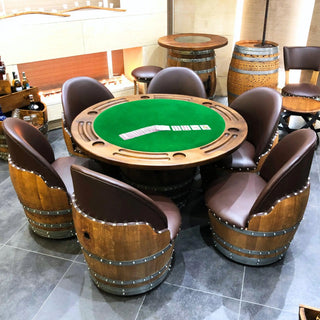
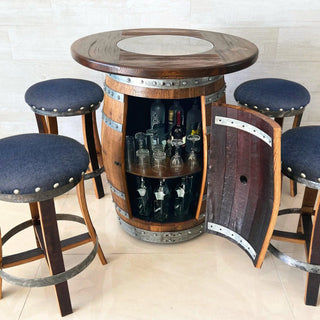
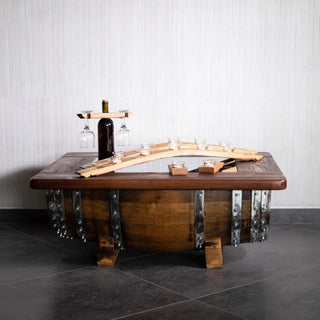
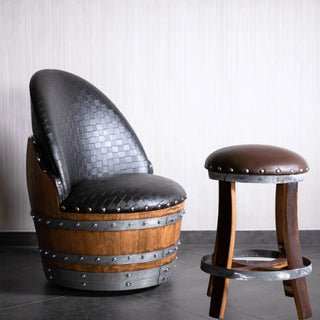
A wedding welcome drinks setup is the 30–60 minute hosting window between ceremony end and reception start, when 100+ guests arrive at the venue and need a glass in hand within the first three minutes. A wine barrel bar — single unit or paired with a second for high-volume events — is the most-recommended configuration in the wedding industry because it pulls double duty: functional drink station during the welcome hour, photographed background piece throughout the night. Below are six setups venues and planners should add to the standard playbook, each with bar configuration, glassware count for a 100-guest event, and bartender requirements.
For venues sourcing wine barrel bars for events, contact our workshop at obarrel.com for venue-pricing on multi-unit orders. The Bureau of Labor Statistics tracks bartender employment under SOC code 35-3011 and publishes annual occupational wage data venues can reference for staffing-budget planning [Source: AUTHORITATIVE SOURCE NEEDED — BLS Occupational Employment and Wage Statistics for SOC 35-3011 Bartenders]. Across our commercial venue clients, multi-unit barrel bar orders (two or more bars per event) are standard for 150-plus-guest receptions — venues that book recurring events typically buy two as a starting kit.
1. Signature cocktail welcome — single featured drink
One featured cocktail, batched in advance, poured from a large dispenser or built-to-order by a single bartender at a barrel bar.
Bar configuration: One barrel bar, 22-inch round top, positioned 8–10 feet from the ceremony exit path so the line forms naturally as guests walk in.
Glassware for 100 guests: 120 rocks glasses or coupes (20% buffer for breakage and slow returns). Pre-poured 80; staff pours the remaining 40 as guests arrive.
Bartender requirements: 1 bartender for pre-poured + topped-off service. 2 bartenders if cocktails are built to order with shaking and stirring.
Best for: Cocktail-forward weddings, summer-to-fall calendar
Cost benchmark: $4–$8 per signature cocktail, batched
2. Sparkling welcome — Prosecco / Champagne tower or tray
Pre-poured sparkling wine in flutes, either tray-passed by floor staff or staged at the barrel bar in a stair-step display.
Bar configuration: One barrel bar as the back-stage refill station, with two waitstaff tray-passing flutes to arriving guests. Bar holds 4 cases of sparkling wine in a wine bucket plus the stacked tray refill area.
Glassware for 100 guests: 150 champagne flutes (allows for double-pour for those who linger). Rent or in-house, depending on venue.
Bartender requirements: 1 bartender at the bar refilling trays, 2 floor staff passing trays. Total: 3 staff.
Best for: Black-tie weddings, holiday-season weddings, formal-ceremony venues
Cost benchmark: $3–$7 per flute, depending on sparkling tier
3. Beer + wine cart — relaxed, self-serve adjacent
A barrel bar staged with 3–4 wine options and 4–6 craft beer options in ice tubs flanking the bar. Guests order from the bartender, who pours wine and pops beer caps.
Bar configuration: One barrel bar with a 2-section back display (red wines left, whites right), two galvanized ice tubs on the floor flanking the bar for chilled beer/cider/white wine.
Glassware for 100 guests: 120 wine glasses (universal stem works for both red and white), 80 beer pint glasses or 100 single-use cups if the venue floor plan permits.
Bartender requirements: 1 bartender. Self-serve beer from the tubs if the venue floor plan permits — that drops the wait time to zero.
Best for: Casual-to-semi-formal weddings, enclosed-pavilion and covered garden-room venues, late-summer through early-fall calendar
Cost benchmark: $3–$5 per pour, depending on selection tier
4. Late-summer aperitivo bar — Italian-style welcome
A spritz-forward bar featuring Aperol, Campari, and white wine spritzes alongside marinated olives, taralli, and crispy snacks. Pre-batched spritzes pour fast and look intentional in clear glassware on a barrel bar.
Bar configuration: One barrel bar with three large glass dispensers (Aperol Spritz, Negroni Sbagliato, Hugo Spritz). Small barrel-head tray with snack bowls on the side.
Glassware for 100 guests: 130 wine balloons or large rocks glasses (the spritz benefits from the wider mouth).
Bartender requirements: 1 bartender for dispenser-pour and orange-slice garnish.
Best for: Late-summer (August–September) destination weddings, Italian-themed receptions, covered-pavilion and garden-room reception spaces
Cost benchmark: $5–$8 per spritz, batched
5. Winter mulled wine and hot cider bar
A warm-drink welcome station for cold-weather weddings. Two slow cookers on or beside the barrel bar — one mulled red, one spiced cider — with optional bourbon or brandy spike.
Bar configuration: One barrel bar with two slow cookers on the back surface, ladles, mugs stacked on the side. Add a tray of orange-clove garnishes and cinnamon sticks.
Glassware for 100 guests: 130 ceramic mugs or insulated handle-style glassware (single-use is unfortunate but acceptable in cold-weather covered-tent settings).
Bartender requirements: 1 bartender ladling and spiking on request.
Best for: November through February weddings, enclosed lodge and barn reception venues, late-afternoon ceremonies
Cost benchmark: $2–$4 per mug (mulled wine and cider are cost-efficient at scale)
6. Brunch mimosa bar — daytime ceremony welcome
A mimosa and bloody mary station for late-morning or early-afternoon ceremonies. Build-your-own approach: champagne and three juices for mimosas, vodka and a full bloody mary garnish board for the heartier option.
Bar configuration: One barrel bar with three juice carafes (orange, grapefruit, pineapple) on the left, vodka and bloody mary mix on the right, a 12-inch garnish board with celery, olives, bacon, lemon wedges, hot sauce.
Glassware for 100 guests: 120 champagne flutes (mimosas), 80 pint glasses or tall rocks (bloody marys). Many guests will have both across a 60-minute window.
Bartender requirements: 2 bartenders — one mimosa station, one bloody station. Volume is high in the first 20 minutes; a single bartender will back up.
Best for: Brunch and late-morning weddings, garden-room and covered-pavilion ceremonies, intimate (50–100 guest) events
Cost benchmark: $4–$7 per pour
Configuration summary for 100 guests
| Setup | Bar count | Bartenders | Glassware count | Best season |
|---|---|---|---|---|
| 1. Signature cocktail | 1 | 1–2 | 120 rocks/coupes | Year-round |
| 2. Sparkling welcome | 1 + 2 tray staff | 3 total | 150 flutes | Black-tie / holiday |
| 3. Beer + wine cart | 1 | 1 | 120 wine + 80 beer | Late summer / fall |
| 4. Aperitivo bar | 1 | 1 | 130 balloon glasses | Aug–Sep |
| 5. Mulled / cider | 1 | 1 | 130 mugs | Nov–Feb |
| 6. Brunch mimosa | 1 | 2 | 120 flutes + 80 tall | Daytime weddings |
Why a barrel bar wins as a wedding welcome unit
Venues and planners gravitate to wine barrel bars for welcome drinks for five reasons:
- It's already photographed. Couples building Pinterest boards have seen barrel bars in venue galleries. Showing one at the venue tour closes a percentage of bookings.
- It's the right footprint. A 22-inch round top forces guests into single-file approach, which prevents the crowd-clumping that happens at long banquet-table bars.
- It moves on a hand truck. Standard barrel bar weight (90–130 lbs) loads onto a single dolly. Two staff can position one in under five minutes.
- It transitions to backdrop after the welcome hour. Once welcome drinks end, the barrel bar moves to the dance floor edge or photo wall and becomes a styled element through the night.
- It pairs with itself. Two barrel bars side-by-side or 6 feet apart create a doubled-throughput welcome zone for 150–200-guest events without changing the visual story.
Glassware sourcing notes
For most venues, glassware comes from the catering company or a rental partner. Budget benchmarks per glass type (rental, single-event):
- Champagne flute: $0.65–$1.25 per glass
- Universal wine glass: $0.75–$1.45 per glass
- Coupe: $0.95–$1.85 per glass
- Rocks glass: $0.55–$1.15 per glass
- Pint glass: $0.55–$0.95 per glass
For a 100-guest welcome hour, the all-in glassware rental typically runs $90–$220 depending on setup choice.
Bartender ratio guidance
The industry standard for wedding welcome bars is one bartender per 50 guests for full-service cocktails, one per 75 for wine and beer, one per 100 for pre-poured sparkling. The Bureau of Labor Statistics tracks bartender employment under occupation code 35-3011; the National Restaurant Association publishes service ratio guidelines venues can reference.
Logistics for the planner
A few wedding-specific logistics worth flagging when speccing a barrel bar welcome:
- Position 8–12 feet from the ceremony exit so guests can see the bar from their seats and walk to it directly.
- Leave 36 inches of clear floor in front for line management. Most venues underbuild approach space.
- Plan for trash and glassware return within sight of the bar — guests won't walk far to discard.
- Pre-stage 80% of the first round for sparkling and signature cocktail setups. Self-pour from a tray uses zero bartender capacity for the opening rush.
- Move the bar at the 45-minute mark to its second-hour position (photo wall, dance floor edge, or dessert station) so it never reads "abandoned" once the welcome hour ends.
A wine barrel bar handled well is the single highest-leverage furniture decision a venue can make for the welcome hour. One unit, six setup formats, full-night photo presence — the equipment cost amortizes across hundreds of events.
What venues most often get wrong with welcome drinks
After working with commercial venue clients across multiple regions, four patterns show up repeatedly when a welcome hour doesn't land:
- The bar is too far from the ceremony exit. Guests should see the bar from their seats before the recessional ends. A 25-foot walk to the bar feels much longer than an 8-foot walk, and the line never forms cleanly.
- The bartender is under-staffed for the first 12 minutes. The arrival rush concentrates 70 percent of the welcome-hour demand in the first 12 minutes. Two bartenders for the opening rush, dropping to one after, is the right shape — not "one bartender for the hour."
- No second-hour transition plan. The barrel bar that's perfect for the welcome hour becomes dead space if it sits unused once the reception starts. Move it to the dance floor edge, the photo wall, or a dessert station and it earns its visual real estate all night.
- Glassware count is too tight. A 20 percent buffer on glass count is the floor. Buffer covers breakage, slow returns, and the guests who walk away with their welcome glass into the reception room.
Transportation and setup logistics for the planner
A few specific specs worth flagging when speccing a barrel bar for an event:
- Single-bar weight: 90 to 130 pounds depending on configuration. One staff member with a hand truck or two staff lifting is the standard move-in pattern.
- Truck footprint: A 22-inch round bar with a 42-inch height needs about 8 cubic feet for transport. A standard cargo van fits four units stacked-and-padded; a 16-foot box truck fits a full multi-event load.
- Setup crew size: Two staff can set, level, and pre-stage one barrel bar in under 10 minutes once it's offloaded. Plan 30 minutes per bar end-to-end from truck door to "guest-ready."
- Floor protection: Felt pads under the lower hoop prevent floor marks on hardwood and tile reception spaces. Most rentals include them; verify before delivery.
- Liability and insurance: Confirm the rental contract covers in-transit damage and on-site liability. Most venue clients carry general-event liability that extends to furniture rentals, but verify per event.
Browse our wine barrel bar collection at obarrel.com for the venue-spec models that match the setups above.