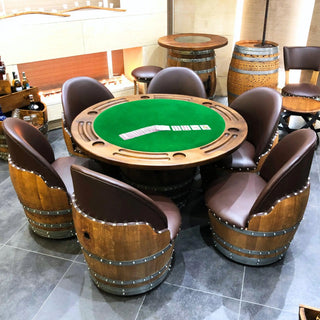
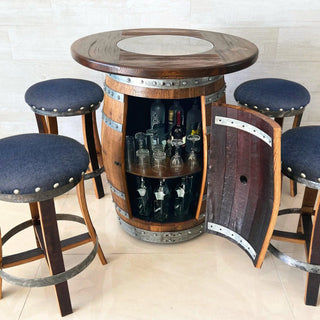
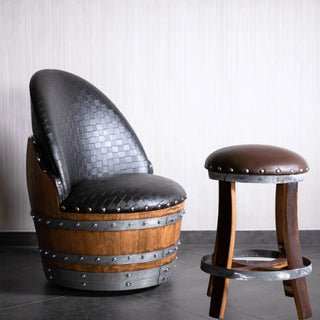
Short answer: Choose a format (24 minis, 24 pre-poured vials or full bottles), line them up in order so the pours build through December, number them 1 to 24, and set them on a barrel top with a clear place for pouring. At Oak Wood Wine Barrels, the Round Top with Glass Center ($595) turns a 53–59 gallon barrel you already own into that surface, and the Bistro Pub Set (from $1,404) includes the finished barrel, round top and foot rail.
Prices as of October 6, 2026; each link shows live stock. Order by December 10 for Christmas delivery.
What is a bourbon advent calendar?
One pour a night from December 1 through December 24, opened in order. You can buy boxed calendars, but when you make your own, you get to pick every pour and the size of the pour, and the surface you put it on still has value in January.
Once you have the bottles, expect an hour or so to set up. Sourcing takes longer, especially if you are hunting for minis, so start in early November.
What do you need?
| Item | Purpose | Note |
|---|---|---|
| A barrel top | Display and pour station | A round top about 35 inches across leaves room for 24 small bottles and a pour spot |
| 24 vessels | One per night | 50 ml minis, or small glass vials with tight caps |
| 24 numbered tags | Day markers | Kraft tags or thin wood discs |
| Twine | Ties tags to bottles | Natural color reads best on oak |
| One tasting glass | The nightly pour | Same glass every night, so notes compare |
| Notebook and pen | Tasting notes | Keep them on the bar |
| Small funnel | Filling vials | Only for the vial format |
| Water and a dropper | Opening up high-proof pours | A few drops at a time |
Step 1: Which format should you choose?
Make this decision before you buy a single bottle.
- Format A, 24 full bottles. The most flexible, since you get to keep the leftovers, and the most expensive. Best for the collector looking for a reason to open bottles that have been waiting.
- Format B, 24 minis. The classic look. A 50 ml mini is about 1.7 ounces. Your selection is limited to what is available because not all bourbons are sold in miniature bottles.
- Format C, pre-poured vials. Purchase a few full bottles, or split bottles with friends, and pour approximately 1.5 ounces into each vial. A 750 ml bottle is around 25 ounces, good for about 16 pours. This provides the greatest variety for the money, but it takes an evening of pouring and labeling.
| Format | Relative cost | Lineup choice | Prep work | Look on the barrel top |
|---|---|---|---|---|
| A: full bottles | Highest | Widest | Least | Bold, takes the most room |
| B: minis | Middle | Limited to what's sold in minis | Little | The classic calendar look |
| C: vials | Lowest per pour | Wide | Most | Neat and uniform |
Step 2: How do you plan the 24 nights?
Plan the order first, then shop. A climbing calendar keeps things interesting through week three, where most people lose the thread.
- Days 1–7: approachable, lower-proof pours. On Day 1, put out a bottle you know well as your baseline.
- Days 8–14: contrasts. Try alternating a wheated bourbon and a high-rye one to see what the grain is doing.
- Days 15–21: move up to bottled-in-bond pours (by law: 100 proof, at least four years old, from one distillery and one distilling season) and single-barrel bottles.
- Days 22–24: the bottles you've been saving, with the highest proof last.
Vary the proof throughout the month, and don't pour your best in the first week. If Day 3 is the high point, Day 17 has nowhere to go.
Step 3: How do you lay out 24 bottles on a barrel top?
Number the tags 1 to 24 and tie one to each bottle or vial. Then set them up in one of two ways:
- A grid of six rows by four, with numbers facing outward. It makes Day 17 easy to find.
- A spiral from the outside toward the center. It looks better in photos.
Either way, leave one clear spot at the front for the pour station: the glass, the notebook and the water. Place taller bottles at the back so you can still read the numbers. Each day, put the empty back in its place to keep the layout clean.
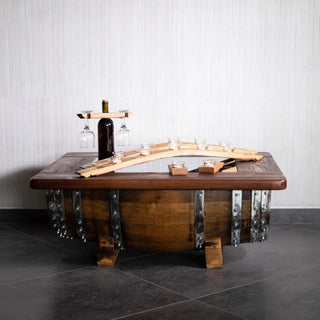
A dust-free alternative: the Half-Barrel Coffee Table ($783) has a full-depth inside display under a removable wood-and-glass top. Line the minis up inside, under the glass, and take one out each night. The calendar stays clean and visible next to the couch.
Step 4: How should you light it?
Use one warm lamp near the barrel, and turn off the overhead light. If you like candlelight, put the candles on another surface, such as the mantel or dining table, away from the bottles and paper tags. High-proof spirits are flammable, and you should never leave a candle burning unattended.
Step 5: How do you run the nightly ritual?
Same glass. Same chair. Same time. Pour at room temperature and write three short notes for each pour: the smell, the taste and the finish. For pours above 100 proof, add water drop by drop and taste again.
Once a week, set up that week's pours side by side and pick a favorite. The Perfect Duo Gift Pack ($104) features a 5-glass stave flight shooter and a 5-candle stave centerpiece, making that weekend recap a breeze.
Step 6: What happens after Christmas Eve?
Save the notebook. Twenty-four nights of notes, with your top three marked, make a shopping list for next year. The barrel top is back to being your everyday bar surface.
Which barrel top surface should you use?
| Piece | Price | Size | Best for |
|---|---|---|---|
| Round Top with Glass Center | $595 | 35.4 in round, 2 in thick | You already own a 53–59 gallon barrel |
| DIY Bistro Kit | from $801 | Round top plus foot rail; stools optional | Turning your own barrel into a bistro table |
| Bistro Pub Set | from $1,404 | Finished barrel 37.2 in tall, plus top and foot rail | Starting from scratch |
| Half-Barrel Coffee Table | $783 | 35.4 × 35.4 × 20.3 in | A calendar under glass, at sofa height |
Sizes are ±5–10%, per the product pages. Most items are in stock, in-stock orders ship within five business days, and sets are delivered by appointment. Order in early November to have everything ready for December 1. See Barrel Tops for additional surfaces and accessories.
To learn the label terms before you shop, read How to Read a Bourbon Label. See How to Host a Bourbon Tasting on a Wine Barrel Table for a one-night version with friends.
Frequently asked questions
How many bottles do you need for a DIY bourbon advent calendar?
Twenty-four pours. That's 24 bottles with minis. With pre-poured vials, a 750 ml bottle fills about 16 pours of 1.5 ounces, so a few bottles or a bottle swap with friends will get you through the month.
How much should each pour be?
About 1.5 ounces, a standard pour of liquor. A 50 ml mini holds about 1.7 ounces.
When should you set up a bourbon advent calendar?
On the last weekend of November, so Day 1 is ready on December 1. Pour vials close to that date and seal them tightly to prevent anything from evaporating.
Will a round barrel top fit a Whiskey Barrel?
Yes. The round top from Oak Wood Wine Barrels fits 53 to 59 gallon barrels, which includes standard Whiskey Barrels (about 53 gallons) and Bordeaux-type Wine Barrels (about 59 gallons).
What is the difference between bottled-in-bond and barrel proof?
Bottled-in-bond is 100 proof, at least four years old, from one distillery and one distilling season. Barrel proof is bottled at or close to the strength it came out of the barrel (little or no water added).