
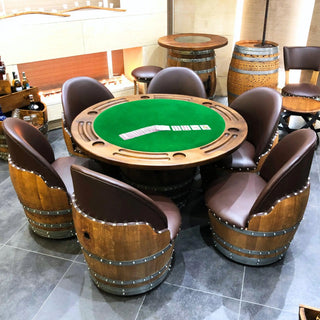
Short answer: The hidden costs of cheap barrel furniture arrive after checkout: veneer that can't be repaired, finishes that wear through, loose decorative hoops, delivery fees, parts that weren't in the box and finally having to buy the piece twice. Before you buy, look for solid staves, a named finish and a written list of what's included. Solid single pieces from Oak Wood Wine Barrels, such as the Barrel Stool ($337.50) or the Hoop Side Table ($391.50), are handmade from Bordeaux-type oak Wine Barrels and finished with spar varnish.
Prices as of October 6, 2026; each link shows live stock.
What are the hidden costs of cheap barrel furniture?
These are costs that are not reflected in the price tag. All nine below come with a check you can do before you buy.
1. Veneer or laminate that can't be repaired
A barrel look can be printed or veneered onto particleboard or plywood. When the edges chip or the surface lifts, there is not much you can do. Particleboard that gets wet swells and does not go back.
- The cost: replacing the piece instead of fixing it.
- How to avoid it: check the cut edges. Solid staves have end grain all the way through. A real Wine Barrel also has wine stain on the inside of the staves.
2. A thin finish that wears through
A thin clear coat wears quickly on a top that gets glasses, condensation and spills. Water rings come first, then bare patches.
- The cost: stripping, sanding and refinishing, either your weekend or a refinisher's bill.
- How to avoid it: ask what the finish is. If a seller knows the answer, they will state it. Oak Wood Wine Barrels pieces are finished with spar varnish, a finish that is meant to stay flexible as wood moves.
3. Decorative hoops that loosen
The staves on a real barrel are held together with steel hoops. On a lookalike, the hoops can be thin bands just for the look, held by a few small fasteners.
- The cost: re-securing the hoops, or living with a piece that rattles and shifts.
- How to avoid it: ask if the hoops are original barrel hoops and how they are attached.
4. Rough edges you have to sand yourself
The edges of seats, the rims of tops and any place hands might touch should be smooth, even if the rest of the piece is meant to look rustic. A wire-brushed top is intentional texture. A splinter on the edge of a seat is not.
- The cost: sandpaper, finish and a couple of hours, or snagged clothing.
- How to avoid it: ask for close-up photos of the edges you will be touching the most.
5. Wobble on a hard floor
If the base is not level, it rocks. On a chair it's annoying; on a bar holding bottles and glasses it's a real problem.
- The cost: felt pads and shims that hide the problem, not fix it.
- How to avoid it: test it on a hard floor when it arrives, and ask the seller up front what they'll do if it rocks.
6. Delivery charges that appear after checkout
Heavy furniture may have freight surcharges, residential delivery fees, or delivery to the curb only.
- The cost: money you didn't plan for, or carrying a heavy barrel up the driveway yourself.
- How to avoid it: read the shipping terms before you pay and ask how the piece gets to your door. Oak Wood Wine Barrels ships free within the continental U.S., and larger orders such as sets, cabinets and game tables are delivered by appointment.
7. Parts that aren't in the box
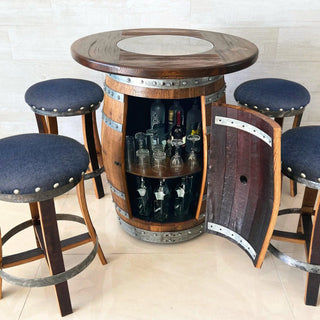
Stools, tops, foot rails, wall hooks, screws and even the barrel itself often come separately. As long as it's written down, it's okay. This is clearly stated on our product pages. The Round Top with Glass Center ($595) is the top only, with no barrel. The Bistro Pub Set (from $1,404) includes the finished barrel, round top and foot rail. The #8 screws for the rail and the angles for attaching the top are not included. Stave wall racks come with back hooks installed; you supply the wall hooks.
- The cost: a second order and a wait until you can use the piece.
- How to avoid it: read each "not included" line and add those parts to your total before you compare prices.
8. Return freight on a heavy piece
If a large item isn't what you expected, sending it back can mean paying freight on something heavy, whatever the seller's terms are.
- The cost: freight charges or holding onto a piece you don't want.
- How to avoid it: get your questions answered before you order. Check the listed dimensions (ours are L × W × H, with a ±5% or ±10% tolerance, because each barrel is different), verify what's included, and read the seller's terms. You can call Oak Wood Wine Barrels at (832) 933-8787 before you buy.
9. Buying it twice
This is where the other eight costs add up. Divide the price of an item by the years you'll actually use it. A product that costs half as much but lasts a third as long costs more per year, and you pay the delivery, assembly and disposal twice.
- The cost: the full price, again, plus the hassle.
- How to avoid it: buy the solid version of a smaller piece, not the cheap version of a larger piece. One stool or side table you keep is better than a whole set you have to replace.
How can you check a piece before you buy?
Ask for these, and walk away from a seller who can't answer:
- What is it made from: solid staves from a real barrel, or veneer?
- Are there any wine stains or charring inside the staves?
- What is the finish?
- Are the hoops original, and how are they held on?
- What are the dimensions, with tolerance?
- What exactly is included, and what isn't?
- How is it delivered, and who carries it inside?
- What do the seller's written terms say?
What does a solid barrel piece cost at Oak Wood Wine Barrels?
Entry points by category, as of October 6, 2026:
| Category | Entry piece | Price | Build |
|---|---|---|---|
| Stave accessories | Stave Candle Centerpiece | $24.95 | One stave, holds five candles |
| Wall racks | 3-Bottle Stave Wall Rack | $175.50 | Staves and metal hoops, holds three bottles |
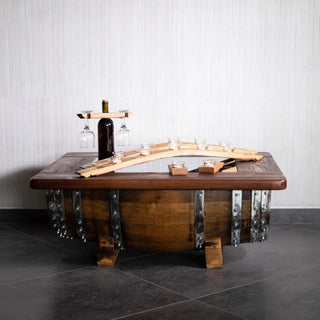
| Tables | Steel-Leg Center Table | $260.50 | Barrel top on satin black steel legs |
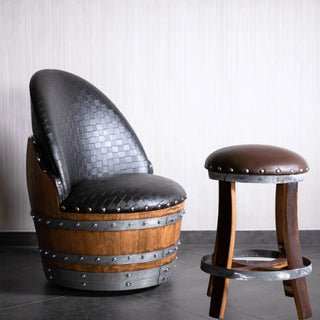
| Seating | Barrel Stool | $337.50 | Staves and metal hoops, memory foam seat |
| Bars and cabinets | Bar Cabinet | $1,237.50 | Bordeaux-type Wine Barrel cabinet with a door shelf |
| Bar sets | Bistro Pub Set (no stools) | $1,404 | Finished barrel, round top and foot rail |
Browse them in Best Sellers and Barrel Bars. Check out 9 Questions to Ask Before Buying Handmade Barrel Furniture and How to Spot a Real Wine Barrel Chair (vs. a Lookalike) for more questions to ask before you buy.
Frequently asked questions
How can you tell real barrel furniture from a lookalike?
Check the cut edges for solid end grain, the inside of the staves for wine stain, and the hoops for real steel that holds the staves together. Ask the seller directly what it's made from.
Is cheap barrel furniture ever worth it?
It can be, for a short, known use such as a one-time event. If it is something you plan to keep, add delivery fees, missing parts and the possibility of replacing it before comparing prices.
Why is real barrel furniture more expensive?
Each piece is handcrafted from a used barrel, not cut from new boards. For example, the barrel in the Bistro Pub Set is fully cleaned, sanded and finished with spar varnish. No two barrels are exactly the same size.
Does Oak Wood Wine Barrels charge for shipping?
No. We ship orders within the continental U.S. for free. Most items are in stock, and in-stock orders ship within five business days.
What should I do when a large piece arrives?
Check it before the driver leaves, take pictures of any damage, write it on the delivery paperwork, and call the seller immediately.