
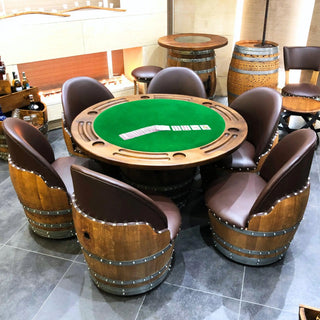
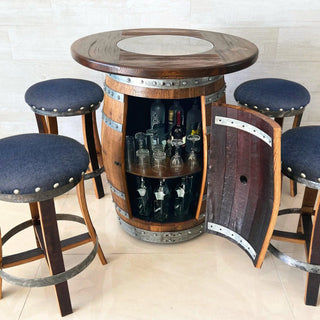
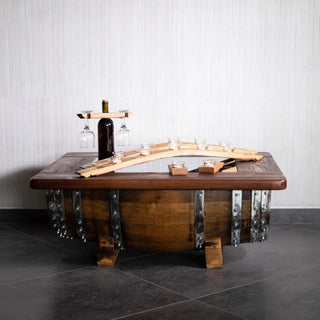
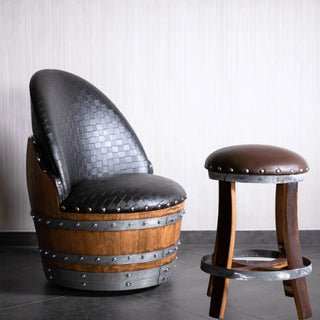
Bordeaux oak vs American oak is the single biggest material decision behind a wine barrel piece of furniture. Bordeaux (French) oak — Quercus robur and Quercus petraea — is tighter-grained, lower in vanillin, and tends to finish darker with more grain detail. American white oak — Quercus alba — is wider-grained, higher in vanillin and tannin, and finishes lighter with more pronounced toast lines. Both make excellent furniture; they produce different looks and pair with different rooms.
Below is the side-by-side comparison, what each wood means visually and structurally, why each is used for different beverages, and how to choose between them for a basement bar, man cave, or sunroom piece. If you want to see how our family sources and finishes both species, the back-story is on our family page.
The comparison at a glance
| Factor | Bordeaux / French oak | American white oak |
|---|---|---|
| Botanical species | Quercus robur, Q. petraea | Quercus alba |
| Primary source | France (Bordeaux, Burgundy, Limousin), Hungary, Eastern Europe | Missouri, Kentucky, Tennessee, Appalachian U.S. |
| Grain pattern | Very tight, fine grain | Wider, more open grain |
| Tannin content | Lower, more subtle | Higher |
| Aroma compounds | Higher in eugenol (clove, spice) | Higher in vanillin (vanilla, coconut, sweet) |
| Typical use in wine/spirits | Fine wines (Bordeaux, Burgundy, premium domestic reds) | Bourbon (required), American whiskey, some chardonnay |
| Color when finished | Deeper amber, darker red-brown | Honey-gold, lighter caramel |
| Visible toast lines | Subtler, integrated with grain | Pronounced, often visible bands |
| Durability as furniture | Excellent; tight grain resists wear | Excellent; slightly more porous |
| Price as raw barrels | Higher (premium import market) | Lower (domestic supply chain) |
| Best room for the finish | Lounge, sunroom, formal basement bar | Man cave, rustic basement, three-season porch |
What the grain difference actually means
The most practical difference between the two woods is grain density. Bordeaux oak grows slowly in cooler European climates and produces growth rings often 1-2 mm apart. American white oak grows faster and produces rings 2-4 mm apart. That tighter grain matters for furniture in three ways.
Visual. A tight-grained stave looks more refined under finish — the lines read as detail rather than openness. An open-grained American stave reads more rustic, with the grain functioning as a primary design element.
Tactile. Tight grain feels smoother under the hand even after wire-brushing. Open grain feels more textural, with visible ridges where the soft summer growth has been brushed deeper than the hard winter growth.
Liquid resistance. Both species are watertight enough for barrel use (thanks to tyloses, the structures that block white oak's vessels). But the finer Bordeaux grain holds finish slightly better over time. Practically, that means a Bordeaux-oak bar top tends to need refinishing on a longer cycle than an American-oak top in the same conditions.
Why each wood is used for different beverages
The species pairing with each beverage isn't arbitrary — it comes from the chemistry of the wood.
Bordeaux oak and fine wine
French and other European oaks are lower in vanillin and higher in spice compounds. That subtler flavor profile lets the wine's primary fruit and terroir show through. Bordeaux-type wine barrels are the global standard for premium Cabernet Sauvignon, Merlot, Burgundy, and most domestic premium reds. The wood is air-seasoned outdoors for 24-36 months before being used in barrel construction, which reduces harsh tannins and bitter compounds.
American oak and bourbon
American white oak is the only legal material for bourbon barrels — bourbon must be aged in new charred oak containers, and in practice that means new charred American white oak. The high vanillin content of Quercus alba is responsible for the characteristic vanilla-coconut-caramel notes that define bourbon.
Why both end up in furniture
Once a barrel is retired from its beverage, both species make excellent furniture. The aging history changes the wood's appearance — wine-aged Bordeaux barrels have purple-red interior staining, bourbon-aged American barrels have heavy black char inside — and you can usually identify a piece's beverage origin at a glance.
What each one looks like as a piece of furniture
Bordeaux oak as furniture
A Bordeaux-oak barrel bar finished in spar varnish reads as a darker, richer piece. The outside has a deep amber tone, the interior shows purple-red wine staining, and the grain lines are subtle. Wire-brushing accents the grain without making the piece look rough. This finish style fits well in:
- Formal basement bars with leather seating
- Lounge spaces with dark wood floors
- Sunrooms paired with iron and rattan
- Man caves built around a wine-and-cocktail theme
American oak as furniture
An American-oak whiskey or bourbon barrel bar reads lighter and more rustic. The exterior is honey-gold to medium caramel. The interior shows heavy black char (often called the "alligator skin" from heavy toast). Wire-brushing produces dramatic grain texture. This finish style fits well in:
- Casual basement bars and man caves
- Rustic-themed three-season porches (fully enclosed)
- Smoke lounges and cigar rooms
- Spaces with reclaimed-wood flooring or barn-style beams
Which is more durable as furniture?
Both are equivalently durable for furniture use. White oak — whether French or American — is one of the densest, hardest commercial hardwoods. The Janka hardness scores are within a few percent of each other (American white oak runs roughly 1,360 lbf), and both species have the tyloses-blocked vessels that make them naturally water-resistant.
In real-world use, a barrel bar from either species, finished properly with marine-grade spar varnish and used indoors, will last 15-30+ years. The species choice is mostly aesthetic; it is not a longevity decision.
The one functional difference worth noting: American oak's wider grain absorbs finish slightly faster, so on a brand-new American-oak piece you may need to apply an extra finish coat to fully seal the surface. Most quality workshops do this already, but it's worth asking.
Bordeaux oak vs. American oak in a single room
A common question we get: can you mix the two? The answer is yes, with care.
A Bordeaux-oak bar paired with American-oak stave-back stools works because the bar reads as the anchor and the stools as accent. A 50/50 mix — half wine barrel pieces and half whiskey barrel pieces in the same small room — tends to look indecisive. If you mix, weight the mix in favor of one species and use the other as supporting accent.
For a deeper look at room layout, see 11 Basement Bar Layouts Built Around a Single Barrel.
Why we source Bordeaux-type wine barrels
Our family workshop sources Bordeaux-type wine barrels — 53-59 gallon, retired from wineries after 2-5 vintages of holding red wine — for most of our bars, chairs, and tables. The reasons:
- Aesthetic. The wine-stained interior is the visible feature of every piece. Bordeaux-oak wine barrels develop the deepest, most varied interior staining over their wine years.
- Grain. The tight French and Eastern European oak grain holds finish beautifully and ages with depth.
- Provenance. A Bordeaux-type wine barrel often comes with traceable winery and vintage history.
- Differentiation. Most "barrel furniture" on the U.S. market is built from bourbon barrels because they are cheaper and more available. Building from wine barrels gives our pieces a different look and a story most competitors can't tell.
We also build select pieces from American-oak whiskey and bourbon barrels for customers who want that lighter, more rustic finish. Both are real reclaimed barrels with real provenance.
For more on how the workshop was built around this sourcing decision, see our family page.
How to choose between them
Choose Bordeaux oak if:
- You want a darker, richer, more refined finish
- The room has formal or upscale design language
- You prefer the wine-stained interior aesthetic
- You're building a wine-and-cocktail-focused space
- You're willing to pay 10-20% more for the import-sourced material
Choose American oak if:
- You want a lighter, honey-gold finish
- The room is casual or rustic
- You prefer the heavy interior char aesthetic
- You're building a whiskey-and-bourbon-focused space
- Budget is a priority and you want the domestic sourcing
Choose either if:
- You're building a single-piece room and the species doesn't drive the design
- You're working with an existing palette that fits both
- You can't decide and want the cooper's recommendation — most workshops have a clear preference and will tell you why
A note on Hungarian and Eastern European oak
Increasingly visible in the U.S. barrel-furniture market is Hungarian oak — typically Quercus petraea sourced from Hungary, Romania, and the Czech Republic. It behaves very similarly to French Bordeaux oak (tight grain, lower vanillin) at a lower price point. Hungarian oak barrels are used heavily in European wine production and increasingly in some U.S. winery programs. As furniture, the finish is nearly indistinguishable from French oak to a non-expert eye.
If a workshop says "European oak" without specifying France, the piece is often built from Hungarian or Eastern European stock. That's not a bad thing — the wood is genuinely comparable — but it's worth knowing.
FAQ
Is one species better than the other?
No. Both are excellent for furniture. The choice is aesthetic and budget-driven, not quality-driven.
Can I tell the difference once it's finished?
Usually yes, by interior color and grain pattern. American-oak pieces show black char inside and lighter exterior tone. Bordeaux-oak pieces show purple-red wine staining inside and darker exterior tone.
Does the species affect the smell?
Slightly. A Bordeaux-oak wine barrel piece has a faint red-wine-and-spice note. An American-oak bourbon piece has a faint vanilla-caramel note. Both fade to almost nothing within a few weeks indoors.
Why are Bordeaux-oak pieces usually more expensive?
Imported raw barrels cost more than domestically sourced bourbon barrels, and the supply is tighter because fewer barrels enter the secondhand market each year.
About Oak Wood Wine Barrels — A family workshop handcrafting authentic Bordeaux-oak wine, whiskey, and bourbon barrel furniture. 1,500+ Etsy sales, 4.9-star Star Seller rating. Shop our collection at obarrel.com.