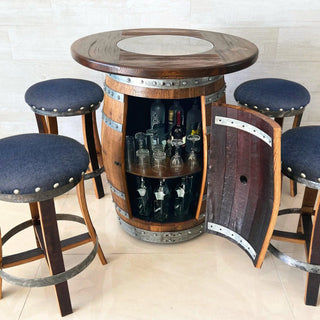
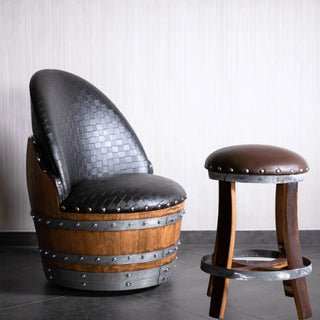
A wine decanting station built into a wine barrel cabinet is the single best storage decision for a serious enthusiast who decants regularly. A barrel cabinet — a 53-to-59-gallon Bordeaux-type barrel converted with a flip-up or hinged tasting top and interior storage — gives you 18 to 22 inches of working surface above 24 inches of enclosed cabinet space below. That is the exact footprint a decanting station needs: a flat working top for the pour, accessible enclosed storage for decanters and accessories, and a vertical face for tools and lighting. The build sequence below organizes that space into a functional decanting station that handles two to four bottles per evening without clutter.
Tools and materials
| Category | Item | Notes |
|---|---|---|
| Cabinet | Wine barrel cabinet with flip-up or hinged top | 53-59 gallon Bordeaux-type stock |
| Decanters | One standard Bordeaux decanter, one aerating decanter | 750-1500 ml capacity |
| Tools | Two-prong wine key, lever-style wine key, foil cutter | The basics |
| Aerator | Pour-through aerator (Vinturi-style or Riedel) | For younger reds |
| Drip mat | 12 in. round leather or felt mat | Catches drips on the cabinet top |
| Light | Tea light or LED puck candle | Sediment check (see Step 4) |
| Reference | Vintage chart or framed wine-region map | Wall above cabinet |
| Storage | Soft cloth, microfiber polishing cloth | For decanter drying |
| Optional | Crystal stopper, decanter funnel | Long-pour applications |
Time required: 20-30 minutes to lay out and assemble the station. The hard part is the cabinet itself; once that is in place, the station builds in an evening.
Skill level: Beginner. No tools required beyond what comes with the cabinet.
Step 1. Place the cabinet where the light works.
A decanting cabinet should sit where the host can work it without leaning, where light is available for sediment checks, and where the room flow does not put guests directly behind the working surface.
The placement rules:
- Counter-height working top. A wine barrel cabinet typically lands at 36-38 inches at the top. That is standard counter height and the right height for decanting work.
- Within arm's reach of the bottle storage. If your wine wall or stave rack lives on a different wall, the decanting cabinet should sit no more than three steps away.
- Out of the direct walking path. The host should be able to stand at the cabinet for 5-10 minutes per bottle without blocking guest traffic.
- Under or beside a dedicated light source. A picture light, a pendant, or a directional spot at 2,700K, 400-700 lumens, 90+ CRI. Decanting work needs to see label colors and sediment accurately.
Step 2. Lay out the working surface.
The 18-to-22-inch barrel top divides naturally into three zones:
- Left zone (6 inches). The bottle landing. This is where the bottle to be decanted gets set down after foil removal and uncorking.
- Center zone (8-10 inches). The drip mat and the active decanter. This is the pouring zone.
- Right zone (4-6 inches). Tools and accessories — wine key, foil cutter, polishing cloth.
Keep the layout consistent for muscle memory. After the third or fourth decanting, the hand reaches for the wine key without looking.
Step 3. Organize the cabinet interior.
The 24-inch enclosed space below the working top should hold the decanters, the aerator, and any specialty tools. A shelf at the midpoint divides the space into two functional levels:
- Upper shelf. Two decanters, stoppers, the aerator, the funnel. Items that get used per bottle.
- Lower shelf. Polishing cloths, backup wine keys, candle and matches for sediment check, vintage chart reference card.
Felt or leather liner on both shelves protects the decanters and keeps glass from clinking against wood. A small bottle of distilled water and an unscented soft cloth handle in-the-moment decanter rinsing between uses.
Step 4. Add the sediment-check light.
Older red wines — anything over 8-10 years old as a rough rule, though heavy reds like Brunello, big Bordeaux, and vintage Port can throw sediment earlier — typically benefit from a sediment check. The classic decanting sequence involves a candle or small light placed below the bottle neck, with the host watching for the first sediment to reach the shoulder of the bottle as the pour reaches its end. That is the cue to stop pouring.
A simple LED puck candle or an actual tea light placed on a small holder at the back of the cabinet's working surface serves the function. The candle stays in the cabinet when not in use; it comes out only for vintage-bottle work.
Step 5. Mount the vintage chart or wine-region reference.
A small framed reference — a vintage chart for major wine regions, a framed wine-region map, a small chalkboard for tonight's pour notes — mounted on the wall directly above the cabinet finishes the decanting station as a working surface. The reference is functional (consult it when deciding decant time) and decorative (it carries the station's visual story upward).
A 12-by-16-inch framed reference at 60-inch eye height above the cabinet top is the working size.
Step 6. Light the station.
A single picture light or directional spot above the cabinet at 2,700K, 400-700 lumens, 90+ CRI does three jobs:
- Illuminates the working surface for decanting accuracy.
- Lights the framed reference above for at-a-glance lookup.
- Casts warm raked light across the barrel staves of the cabinet itself.
Wire to a separate dimmer from the room's main lighting. Decanting work wants more light than the surrounding lounge.
Common mistakes to avoid
- Putting the cabinet in a low-traffic dead corner. The decanting station is part of the host's hospitality. It should sit where guests can watch the pour, not in a closet.
- Decanting under cool white lighting. 4,000K+ light makes sediment hard to see and makes wine labels read inaccurately. Stay at 2,700K.
- Decanting young wines too long. Most reds under 5 years old need 30-60 minutes of decanting maximum. Longer is overoxidation, not breathing.
- Skipping the drip mat. Wine on spar-varnish-finished oak wipes up easily, but repeated drips will eventually leave shadows. The drip mat is cheap insurance.
- Storing decanters with stoppers in. Decanters need to dry fully between uses. Stoppers go on the shelf, not on the decanter, when storing.
- Treating the cabinet as general bar storage. Cocktail tools, mixers, and bourbon glassware belong on a separate bar piece. The decanting cabinet is for wine service only.
What the Finished Station Looks Like in Use
A finished decanting station reads as a working surface, not as a display. The host opens a bottle, the cork comes out cleanly, the bottle gets set on the left zone, the candle gets lit on the back of the working top, the decanter comes up from the cabinet shelf, the pour begins, sediment check happens at the shoulder, the decanter is set down with the stopper off, the bottle goes back into the cellar, and the tools return to the cabinet. Total time: under five minutes per bottle. The station is closed back up between courses.
Our family workshop builds wine barrel cabinets from authentic 53-to-59-gallon Bordeaux-type cooperage — hinged or flip-up tops, interior shelves, hand-wire-brushed staves, spar-varnish finish. The cabinet is the kind of piece that earns its placement for a decade of dinners. Free shipping in the continental U.S.; in-stock orders ship within 5 business days, then arrive 3 to 7 business days later.
A decanting station is not a single object. It is a small, organized choreography that the right cabinet makes effortless.