
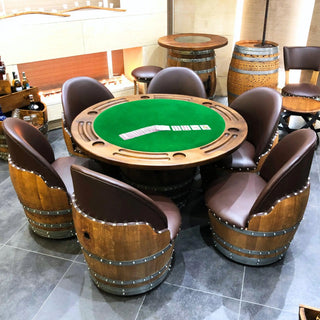
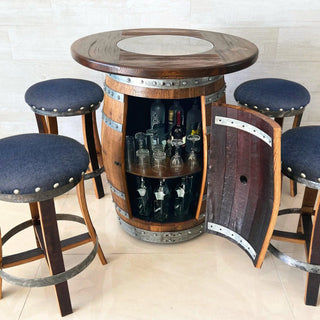
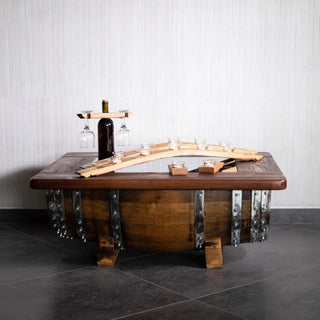
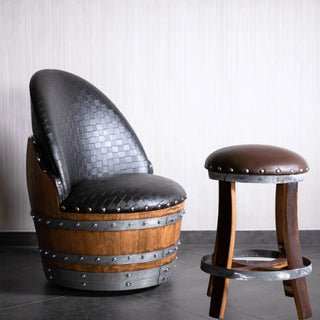
A barrel furniture specifications guide is useful because product listings are written by makers for buyers who do not yet speak the language. Phrases like "53-to-59-gallon Bordeaux," "wire-brushed staves," and "spar varnish finish" are precise to a cooper but vague to a first-time buyer. After fielding spec questions on 1,527-plus orders shipped from our family workshop, the same 20 terms surface again and again — so we built this glossary directly from real buyer email threads. It walks through the terms that appear most often on authentic wine barrel furniture listings, what each one actually means, and what to ask the seller when a spec is missing or wrong. For the broader purchase process behind these specs, see our complete buying guide for wine barrel furniture. If you want to read along with real listings, our full catalog is here.
How to use this glossary
Every entry has three parts: a one-sentence definition, a one-sentence example of what it looks like in a real listing, and a one-sentence "see also" pointing to the related term or what to ask if it is missing. Treat it as a checklist when you scroll a product page — if the listing does not address most of these, that is itself useful information about how transparent the seller is.
Bordeaux barrel / Bordeaux-type barrel
Definition: A wine barrel built to the Bordeaux specification — 225 liters (roughly 59 U.S. gallons), approximately 36 inches tall and 27 inches at the widest belly. Example in listing: "Built from an authentic 53-to-59-gallon Bordeaux-type oak barrel." See also: Burgundy barrel (228L, slightly different proportions), American Standard whiskey barrel (53 gallons, often more squat).
[Source: Federation des Tonneliers de France (French Federation of Coopers) published barrel specifications; Conseil Interprofessionnel du Vin de Bordeaux (CIVB) on standard Bordeaux barrique dimensions.]
French oak vs American oak
Definition: Two distinct oak species — French oak (Quercus petraea, tighter grain, more tannin) and American oak (Quercus alba, looser grain, more vanillin) — both used in wine barrel cooperage. Example in listing: "French oak staves from a Bordeaux chateau retirement." See also: Ask the seller which oak is in the specific piece if it is not stated; both are authentic but they look and age differently.
Stave
Definition: A single curved oak board running the length of a barrel, typically 36 inches long and 1.25 inches thick on a Bordeaux barrel. Example in listing: "Hand-wire-brushed staves preserve the original wine staining." See also: A standard Bordeaux barrel has 28-32 staves; many decorative wall pieces are built from a small number of staves removed from a retired barrel.
Head / barrel head
Definition: The flat circular end of a barrel, typically made of three or four oak boards joined edge-to-edge with a reed or rush seal. Example in listing: "Original cooperage branding burned into the head." See also: The head is where chateau names, vintages, and cooperage marks appear; ask for a photo if you want to verify provenance.
Hoop / barrel hoop
Definition: A forged steel band that compresses the staves to keep the barrel watertight; a standard Bordeaux barrel has 6 hoops. Example in listing: "Original forged steel hoops with natural rust patina retained." See also: Replacement zinc-plated hoops are a tell that the barrel has been rebuilt; authentic reclaim work keeps the originals.
Wire-brushed / hand-wire-brushed
Definition: A surface treatment that uses a wire brush to remove soft surface fibers and expose the harder grain pattern, giving the wood a textured, rustic look. Example in listing: "Staves are hand-wire-brushed before varnish to highlight the grain." See also: Sandblasted is a related but more aggressive treatment that loses some of the wine staining; hand-wire-brushed preserves more of the patina.
Spar varnish / marine-grade spar varnish
Definition: A flexible, UV-resistant varnish originally formulated for boat spars, used on wine barrel furniture because it expands and contracts with the wood without cracking. Example in listing: "Finished with three coats of marine-grade spar varnish." See also: Polyurethane is harder but more brittle on a curved barrel surface; spar varnish is the correct finish for oak barrel work, though it may need a refresh every 5-10 years on heavy-use pieces.
[Source: Epifanes Clear Gloss Varnish technical data sheet on UV resistance and flexural performance; Pettit Marine Paint Z-Spar Captain's Varnish 1015 product specification on coating elasticity.]
Satin / semi-gloss / gloss
Definition: Three sheens of varnish, ranging from matte (satin) to mirror-like (gloss); semi-gloss is the most common factory default. Example in listing: "Satin spar varnish finish for a matte, hand-rubbed appearance." See also: Ask if sheen is customizable — many workshops will switch between the three at no charge if you specify before build.
Reclaimed / authentic reclaim
Definition: Material recovered from its original use (in this case, a retired wine barrel) and repurposed, retaining the marks of that original use. Example in listing: "Authentic reclaim from retired Bordeaux barrels — interior wine staining preserved." See also: "Barrel-inspired," "barrel-style," and "barrel-look" are not reclaim language; they usually mean new oak slats made to mimic a barrel.
Provenance / cooperage mark
Definition: Documentation or visible marking that identifies where a barrel originated — typically a chateau name, vintage year, or cooperage stamp burned into the head. Example in listing: "Original cooperage mark visible on head; provenance documentation available on request." See also: Provenance language without specifics ("French wine barrel") is weaker than a specific cooperage mark visible in the photos.
53-to-59-gallon
Definition: The standard volume range for Bordeaux-type wine barrels (225L = 59 US gallons) and American whiskey barrels (53 US gallons). Example in listing: "Built from a 53-to-59-gallon authentic oak barrel." See also: Numbers significantly outside this range suggest a non-standard barrel; if a listing says "75-gallon barrel," ask for the source — that is closer to a half-cask whiskey storage barrel.
Dimensions and +/- 5% tolerance
Definition: Published dimensions for handmade barrel furniture include a tolerance range (commonly +/- 5%) because each barrel varies. Example in listing: "Approximate dimensions: 36"H x 27"W x 27"D, +/- 5%." See also: If you are fitting a tight space, ask the seller to measure the specific piece before shipping rather than relying on the published nominal.
Memory foam upholstery
Definition: A seat cushion built from viscoelastic foam that conforms to body weight, typically wrapped in fabric or leather on barrel chairs and bar stools. Example in listing: "Seat: 4-inch high-density memory foam, upholstered in commercial-grade vinyl." See also: Ask the foam density (1.8 lb minimum for durability) and the fabric rub count (15,000+ double rubs for residential, 30,000+ for commercial use).
[Source: Association for Contract Textiles (ACT) Performance Guidelines for upholstery durability and Wyzenbeek double-rub test thresholds; ASTM D4157 abrasion-resistance standard for woven fabrics.]
Commercial-grade / hospitality-grade
Definition: A durability standard typically referring to upholstery fabric rub count and frame construction suitable for restaurant, bar, or hotel use. Example in listing: "Commercial-grade vinyl rated 100,000 double rubs." See also: If a listing says "commercial-grade" without a specification number, ask for the rub count.
Live edge / natural edge
Definition: A finishing style that preserves the original curved or uneven edge of the wood rather than cutting it straight. Example in listing: "Live-edge stave shelving — outer curve of the barrel preserved." See also: Live edge is decorative; it does not affect structural integrity.
Footprint vs overall dimension
Definition: Footprint is the floor area the piece occupies; overall dimension includes overhangs (countertops, footrails, splash guards) that extend beyond the floor footprint. Example in listing: "Footprint: 27" diameter. Overall dimension with footrail: 31" diameter." See also: When measuring for a space, use overall dimension to confirm clearance, not footprint.
Weight
Definition: Shipping weight of an assembled piece, typically 80-250 pounds for a barrel bar depending on configuration. Example in listing: "Shipping weight 175 lbs; lift-gate delivery recommended." See also: Weight above 75 pounds at a residential address means you should add lift-gate service at checkout.
Lead time
Definition: Build time before the piece ships, distinct from transit time. Example in listing: "Lead time 1-2 weeks; transit 3-7 business days via LTL freight." See also: Custom pieces commonly run 4-8 weeks; ask for both lead and transit when planning around a date.
Spec-questioning checklist
Run this checklist on any listing before purchase:
- Does the listing state "authentic," "reclaimed," or "retired" — not "inspired," "style," or "look"?
- Are gallonage and barrel type stated (53-to-59-gallon Bordeaux, American Standard whiskey, etc.)?
- Are the staves identified as wire-brushed, sanded, sandblasted, or stripped?
- Is the finish identified by type (spar varnish, polyurethane, oil)?
- Are dimensions published with a tolerance (+/- 5% or similar)?
- Is shipping weight published?
- Are upholstery specs (foam density, fabric rub count) published?
- Is lead time published?
- Are warranty terms stated?
- Are interior staining and cooperage marks visible in the photos?
If a listing answers fewer than 7 of those 10, message the seller before buying. Reputable workshops answer those questions within a business day — that response time is itself a signal of who you are dealing with. Browse listings against this checklist in our catalog here.